


Detection of reassortant influenza B strains from 2004 to 2015 seasons in Barcelona (Catalonia, Spain) by whole genome sequencing
- PMID: 37011863
- PMCID: PMC10194390
- DOI: 10.1016/j.virusres.2023.199089
Detection of reassortant influenza B strains from 2004 to 2015 seasons in Barcelona (Catalonia, Spain) by whole genome sequencing
Abstract
Background: Influenza B viruses (FLUBV) have segmented genomes which enables the virus to evolve by segment reassortment. Since the divergence of both FLUBV lineages, B/Victoria/2/87 (FLUBV/VIC) and B/Yamagata/16/88 (FLUBV/YAM), PB2, PB1 and HA have kept the same ancestor, while some reassortment events in the other segments have been reported worldwide. The aim of the present study was to find out reassortment episodes in FLUBV strains detected in cases attended at Hospital Universitari Vall d'Hebron and Hospital de la Santa Creu i Sant Pau (Barcelona, Spain) from 2004 to 2015 seasons.
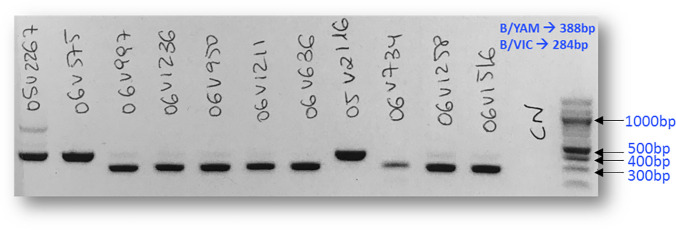
Methods: From October 2004 to May 2015, respiratory specimens were received from patients with respiratory tract infection suspicion. Influenza detection was carried out by either cell culture isolation, immunofluorescence or PCR-based assays. A RT-PCR was performed to distinguish both lineages by agarose gel electrophoresis. Whole genome amplification was performed using the universal primer set by Zhou et al. in 2012, and subsequently sequenced using Roche 454 GS Junior platform. Bioinformatic analysis was performed to characterise the sequences with B/Malaysia/2506/2007 and B/Florida/4/2006 corresponding sequences as reference of (B/VIC) and (B/YAM), respectively.
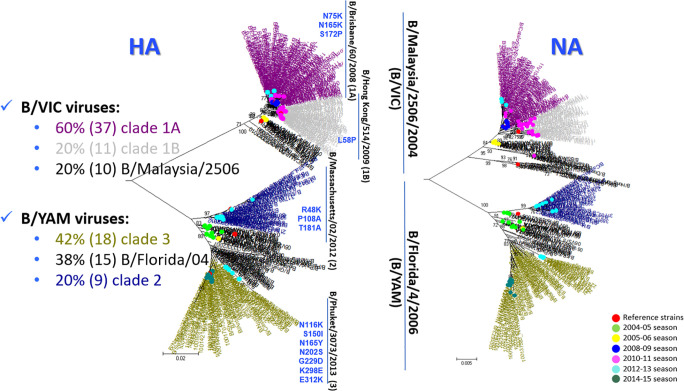
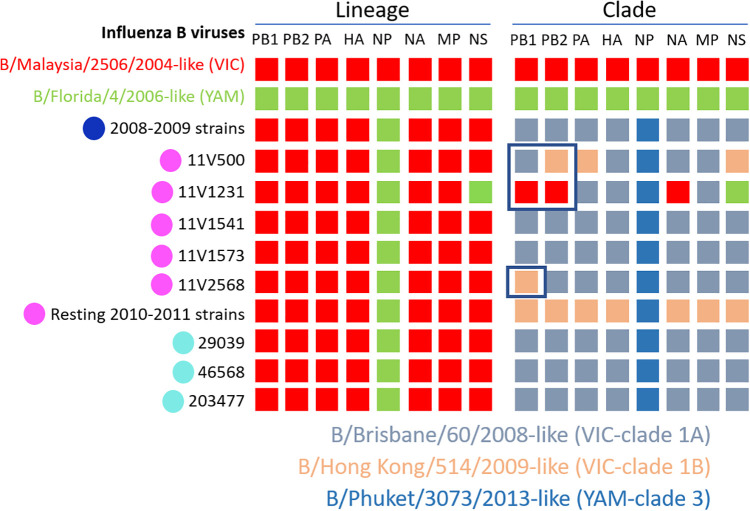
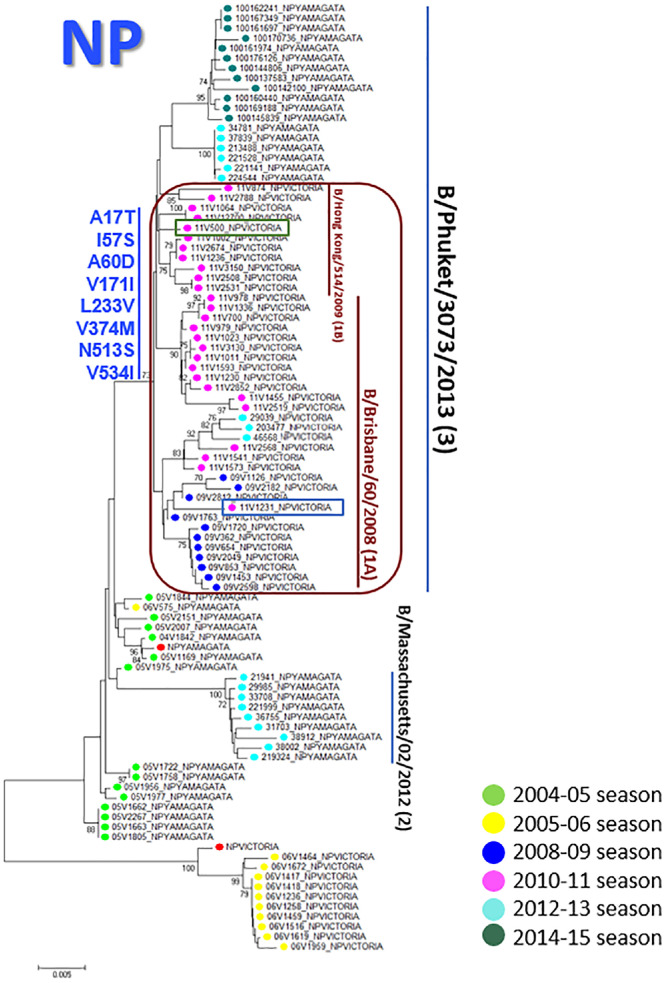
Results: A total of 118 FLUBV (75 FLUBV/VIC and 43 FLUBV/YAM), from 2004 to 2006, 2008-2011 and 2012-2015 seasons, were studied. The whole genome of 58 FLUBV/VIC and 42 FLUBV/YAM viruses was successfully amplified. Based on HA sequences, most FLUBV/VIC viruses (37; 64%) belonged to clade 1A (B/Brisbane/60/2008) except to 11 (19%), which fell within clade 1B (B/HongKong/514/2009) and 10 (17%) to B/Malaysia/2506/2004. Nine (20%) FLUBV/YAM viruses belonged to clade 2 (B/Massachusetts/02/2012), 18 (42%) to clade 3 (B/Phuket/3073/2013) and 15 (38%) fell within Florida/4/2006. Numerous intra-lineage reassortments in PB2, PB1, NA and NS were found in 2 2010-2011 viruses. An important inter-lineage reassortment event from 2008 to 2009 (11), 2010-2011 (26) and 2012-2013 (3) FLUBV/VIC (clade 1) strains to FLUBV/YAM (clade 3) was found, in addition to 1 reassortant NS in 2010-2011 B/VIC virus.
Conclusions: Intra- and inter-lineage reassortment episodes were revealed by WGS. While PB2-PB1-HA remained in complex, NP and NS reassortant viruses were found in both lineages. Despite reassorment events are not often, the characterisation only by HA and NA sequences might be underestimating their detection.
Keywords: Influenza B viruses; Lineage; Molecular epidemiology; Reassortment event.
Copyright © 2023 The Author(s). Published by Elsevier B.V. All rights reserved.
Conflict of interest statement
Declaration of Competing Interest The authors declare no conflicts of interest.
Figures
References
-
- (WHO), World Health Organisation . Manual For the Laboratory Diagnosis and Virological Surveillance of Influenza. WHO Library Cataloguing-in-Publication Data; 2011. WHO global influenza surveillance network.
-
- Antón A., Marcos M.A., Torner N., Isanta R., Camps M., Martínez A., Domínguez A., Jané M., Jiménez de Anta M.T., Pumarola T. Virological surveillance of influenza and other respiratory viruses during six consecutive seasons from 2006 to 2012 in Catalonia, Spain. Clin. Microbiol. Infect. 2016;22(6):564. doi: 10.1016/j.cmi.2016.02.007. https://www.ncbi.nlm.nih.gov/pubmed/26939538 e1-9. - DOI - PMC - PubMed
-
- Antón A., Pozo F., Niubó J., Casas I., Pumarola T. Influenza A(H1N1)pdm09 virus: viral characteristics and genetic evolution. Enferm. Infecc. Microbiol. Clin. 2012;30(Suppl 4):10–17. doi: 10.1016/S0213-005X(12)70099-X. http://www.ncbi.nlm.nih.gov/pubmed/23116787 - DOI - PubMed
-
- Bedford T., Riley S., Barr I.G., Broor S., Chadha M., Cox N.J., Daniels R.S., Gunasekaran C.P., Hurt A.C., Kelso A., Klimov A., Lewis N.S., Li X., McCauley J.W., Odagiri T., Potdar V., Rambaut A., Shu Y., Skepner E., Smith D.J., Suchard M.A., Tashiro M., Wang D., Xu X., Lemey P., Russell C.A. Global circulation patterns of seasonal influenza viruses vary with antigenic drift. Nature. 2015;523(7559):217–220. doi: 10.1038/nature14460. http://www.ncbi.nlm.nih.gov/pubmed/26053121 - DOI - PMC - PubMed
-
- Bouvier N.M., Palese P. The biology of influenza viruses. Vaccine. 2008;26(Suppl 4):D49–D53. http://www.ncbi.nlm.nih.gov/pubmed/19230160 - PMC - PubMed
Publication types
MeSH terms
LinkOut - more resources
Full Text Sources
Medical
Miscellaneous
