


Assessing preferences for HIV pre-exposure prophylaxis (PrEP) delivery services via online pharmacies in Kenya: protocol for a discrete choice experiment
- PMID: 37012008
- PMCID: PMC10083853
- DOI: 10.1136/bmjopen-2022-069195
Assessing preferences for HIV pre-exposure prophylaxis (PrEP) delivery services via online pharmacies in Kenya: protocol for a discrete choice experiment
Abstract
Introduction: Pre-exposure prophylaxis (PrEP) is highly effective at preventing HIV acquisition, but coverage remains low in high prevalence settings. Initiating and continuing PrEP via online pharmacies is a promising strategy to expand PrEP uptake but little is known about user preferences for this strategy. We describe methods for a discrete choice experiment (DCE) to assess preferences for PrEP delivery from an online pharmacy.
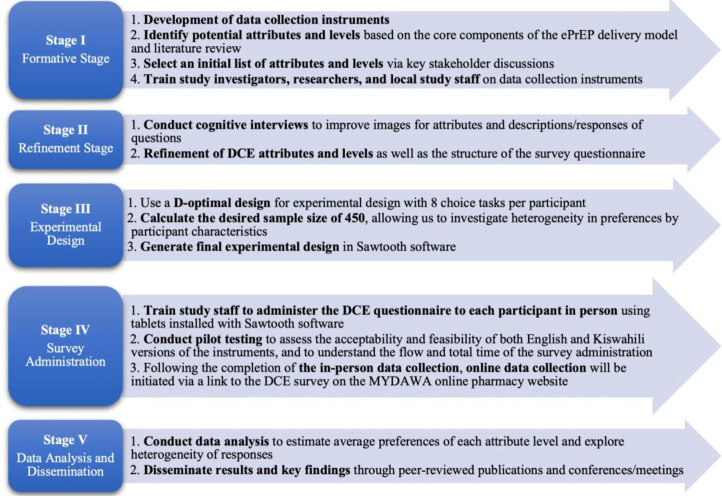
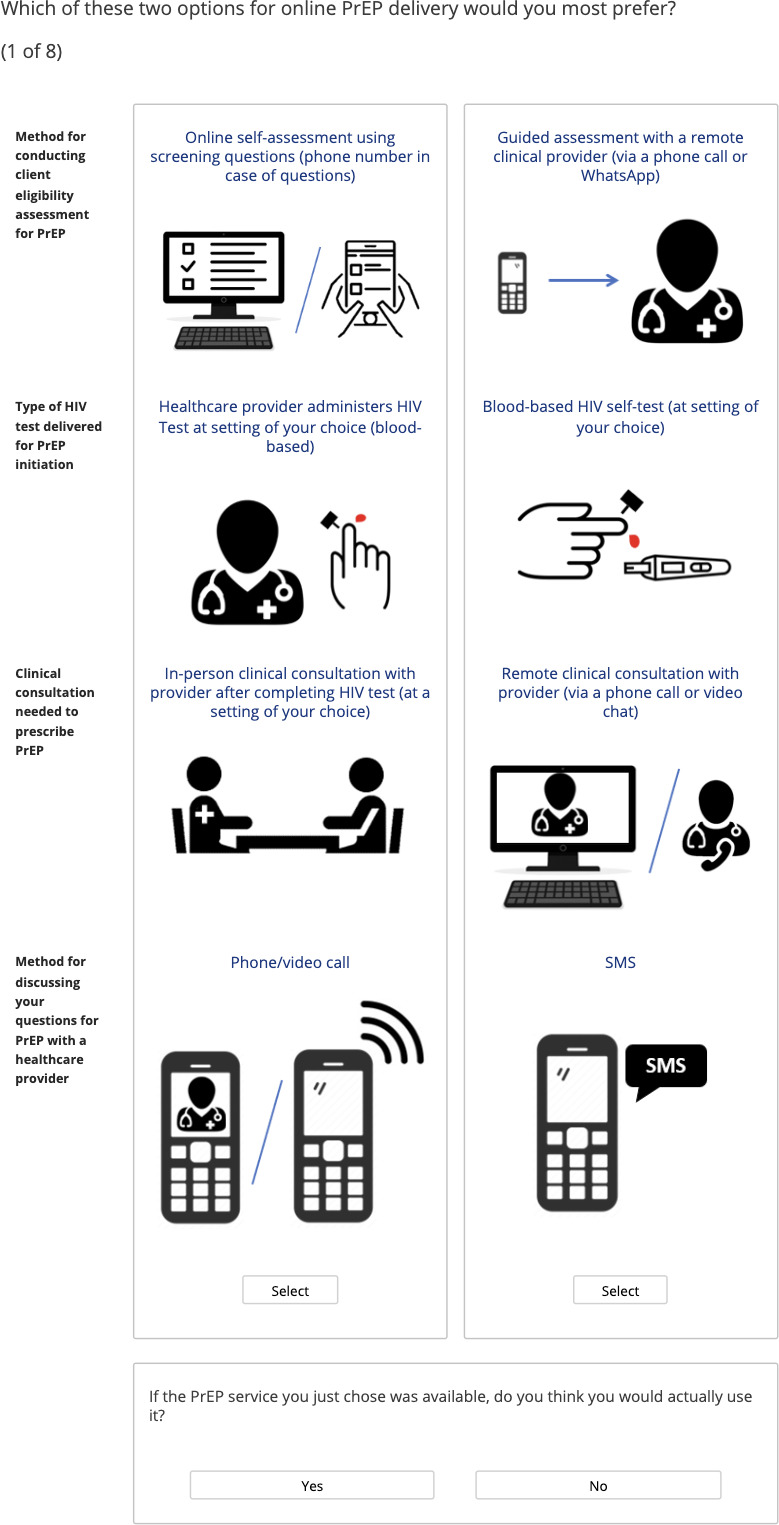
Methods and analysis: This cross-sectional study is conducted in Nairobi, Kenya, in partnership with MYDAWA, a private online pharmacy retailer with a planned sample size of >400 participants. Eligibility criteria are: ≥18 years, not known HIV-positive and interested in PrEP. Initial DCE attributes and levels were developed via literature review and stakeholder meetings. We conducted cognitive interviews to assess participant understanding of the DCE survey and refined the design. The final DCE used a D-efficient design and contained four attributes: PrEP eligibility assessment, HIV test type, clinical consultation type and user support options. Participants are presented with eight scenarios consisting of two hypothetical PrEP delivery services. The survey was piloted among 20 participants before being advertised on the MYDAWA website on pages displaying products indicating HIV risk (eg, HIV self-test kits). Interested participants call a study number and those screened eligible meet a research assistant in a convenient location to complete the survey. The DCE will be analysed using a conditional logit model to assess average preferences and mixed logit and latent class models to evaluate preference heterogeneity among subgroups.
Ethics and dissemination: This study was approved by the University of Washington Human Research Ethics Committee (STUDY00014011), the Kenya Medical Research Institute, Nairobi County (EOP/NMS/HS/128) and the Scientific and Ethics Review Unit in Kenya (KEMRI/RES/7/3/1). Participation in the DCE is voluntary and subject to completion of an electronic informed consent. Findings will be shared at international conferences and peer-reviewed publications, and via engagement meetings with stakeholders.
Keywords: HEALTH SERVICES ADMINISTRATION & MANAGEMENT; HIV & AIDS; Health economics; International health services; Public health; Telemedicine.
© Author(s) (or their employer(s)) 2023. Re-use permitted under CC BY. Published by BMJ.
Conflict of interest statement
Competing interests: None declared.
Figures
References
-
- CDC . Kenya country profile: centers for disease control and prevention. 2022. Available: https://www.cdc.gov/globalhivtb/where-we-work/kenya/kenya.html [Accessed 04 Aug 2022].
-
- The national AIDS control council. 2022. Available: https://nacc.or.ke/ [Accessed 17 Jul 2022].
-
- Kenya Ministry of Health . Guidelines on the use of antiretroviral drugs for treating and preventing HIV infection in kenya - 2018 edition. Nairobi, 2018.
Publication types
MeSH terms
Substances
Grants and funding
LinkOut - more resources
Full Text Sources
Medical
Miscellaneous
