


Impact of trauma teams on high grade liver injury care: a two-decade propensity score approach study in Taiwan
- PMID: 37012308
- PMCID: PMC10070483
- DOI: 10.1038/s41598-023-32760-9
Impact of trauma teams on high grade liver injury care: a two-decade propensity score approach study in Taiwan
Abstract
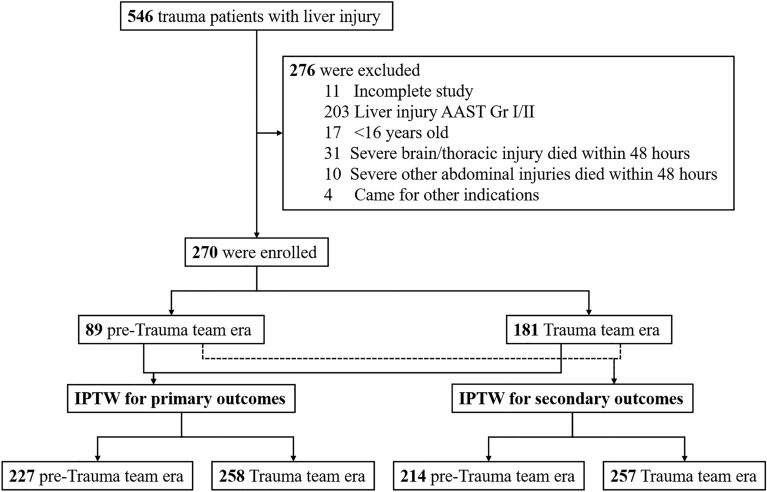
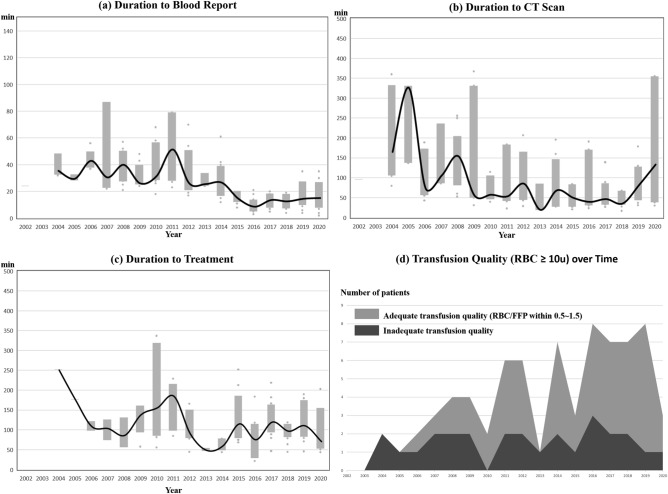
High-grade liver laceration is a common injury with bleeding as the main cause of death. Timely resuscitation and hemostasis are keys to the successful management. The impact of in-hospital trauma system on the quality of resuscitation and management in patients with traumatic high-grade liver laceration, however, was rarely reported. We retrospectively reviewed the impact of team-based approach on the quality and outcomes of high-grade traumatic liver laceration in our hospital. Patients with traumatic liver laceration between 2002 and 2020 were enrolled in this retrospective study. Inverse probability of treatment weighting (IPTW)-adjusted analysis using the propensity score were performed. Outcomes before the trauma team establishment (PTTE) and after the trauma team establishment (TTE) were compared. A total of 270 patients with liver trauma were included. After IPTW adjustment, interval between emergency department arrival and managements was shortened in the TTE group with a median of 11 min (p < 0.001) and 28 min (p < 0.001) in blood test reports and duration to CT scan, respectively. Duration to hemostatic treatments in the TTE group was also shorter by a median of 94 min in patients receiving embolization (p = 0.012) and 50 min in those undergoing surgery (p = 0.021). The TTE group had longer ICU-free days to day 28 (0.0 vs. 19.0 days, p = 0.010). In our study, trauma team approach had a survival benefit for traumatic high-grade liver injury patients with 65% reduction of risk of death within 72 h (Odds ratio (OR) = 0.35, 95% CI = 0.14-0.86) and 55% reduction of risk of in-hospital mortality (OR = 0.45, 95% CI = 0.23-0.87). A team-based approach might contribute to the survival benefit in patients with traumatic high-grade liver laceration by facilitating patient transfer from outside the hospital, through the diagnostic examination, and to the definitive hemostatic procedures.
© 2023. The Author(s).
Conflict of interest statement
The authors declare no competing interests.
Figures

References
-
- National center for injury prevention and control CfDCaP. Leading causes of death reports. 1981–2019 (2020). https://webappa.cdc.gov/sasweb/ncipc/leadcause.html. Accessed May 8, 2021
-
- Ministry of health and welfare. Cause of death statistics September 8, 2020. https://www.mohw.gov.tw/lp-4964-2.html. Accessed May 8, 2021; 2019
Publication types
MeSH terms
Substances
LinkOut - more resources
Full Text Sources
