. 2023 May;145(5):651-666.
doi: 10.1007/s00401-023-02566-0. Epub 2023 Apr 4.

Molecular characterisation defines clinically-actionable heterogeneity within Group 4 medulloblastoma and improves disease risk-stratification

Affiliations

Molecular characterisation defines clinically-actionable heterogeneity within Group 4 medulloblastoma and improves disease risk-stratification

Jack Goddard et al. Acta Neuropathol. 2023 May.

Abstract

Group 4 tumours (MBGrp4) represent the majority of non-WNT/non-SHH medulloblastomas. Their clinical course is poorly predicted by current risk-factors. MBGrp4 molecular substructures have been identified (e.g. subgroups/cytogenetics/mutations), however their inter-relationships and potential to improve clinical sub-classification and risk-stratification remain undefined. We comprehensively characterised the paediatric MBGrp4 molecular landscape and determined its utility to improve clinical management. A clinically-annotated discovery cohort (n = 362 MBGrp4) was assembled from UK-CCLG institutions and SIOP-UKCCSG-PNET3, HIT-SIOP-PNET4 and PNET HR + 5 clinical trials. Molecular profiling was undertaken, integrating driver mutations, second-generation non-WNT/non-SHH subgroups (1-8) and whole-chromosome aberrations (WCAs). Survival models were derived for patients ≥ 3 years of age who received contemporary multi-modal therapies (n = 323). We first independently derived and validated a favourable-risk WCA group (WCA-FR) characterised by ≥ 2 features from chromosome 7 gain, 8 loss, and 11 loss. Remaining patients were high-risk (WCA-HR). Subgroups 6 and 7 were enriched for WCA-FR (p < 0·0001) and aneuploidy. Subgroup 8 was defined by predominantly balanced genomes with isolated isochromosome 17q (p < 0·0001). While no mutations were associated with outcome and overall mutational burden was low, WCA-HR harboured recurrent chromatin remodelling mutations (p = 0·007). Integration of methylation and WCA groups improved risk-stratification models and outperformed established prognostication schemes. Our MBGrp4 risk-stratification scheme defines: favourable-risk (non-metastatic disease and (i) subgroup 7 or (ii) WCA-FR (21% of patients, 5-year PFS 97%)), very-high-risk (metastatic disease with WCA-HR (36%, 5-year PFS 49%)) and high-risk (remaining patients; 43%, 5-year PFS 67%). These findings validated in an independent MBGrp4 cohort (n = 668). Importantly, our findings demonstrate that previously established disease-wide risk-features (i.e. LCA histology and MYC(N) amplification) have little prognostic relevance in MBGrp4 disease. Novel validated survival models, integrating clinical features, methylation and WCA groups, improve outcome prediction and re-define risk-status for ~ 80% of MBGrp4. Our MBGrp4 favourable-risk group has MBWNT-like excellent outcomes, thereby doubling the proportion of medulloblastoma patients who could benefit from therapy de-escalation approaches, aimed at reducing treatment induced late-effects while sustaining survival outcomes. Novel approaches are urgently required for the very-high-risk patients.

Keywords: Biomarkers; Medulloblastoma; Paediatric Oncology; Risk-stratification.


Conflict of interest statement

S.M.P. reports grants or contracts from ITCC-P4 companies; Lilly, Roche, Pfizer, Charles River, Bayer HealthCare, Pharma Mar, Amgen, Sanofi, Astra Zeneca and Servier. S.Ru. reports participation on advisory boards for Bayer (Germany), Roche (Germany), BMS (Germany) and data safety monitoring board for Cellgene (USA). All other authors declare no competing interests.

Figures
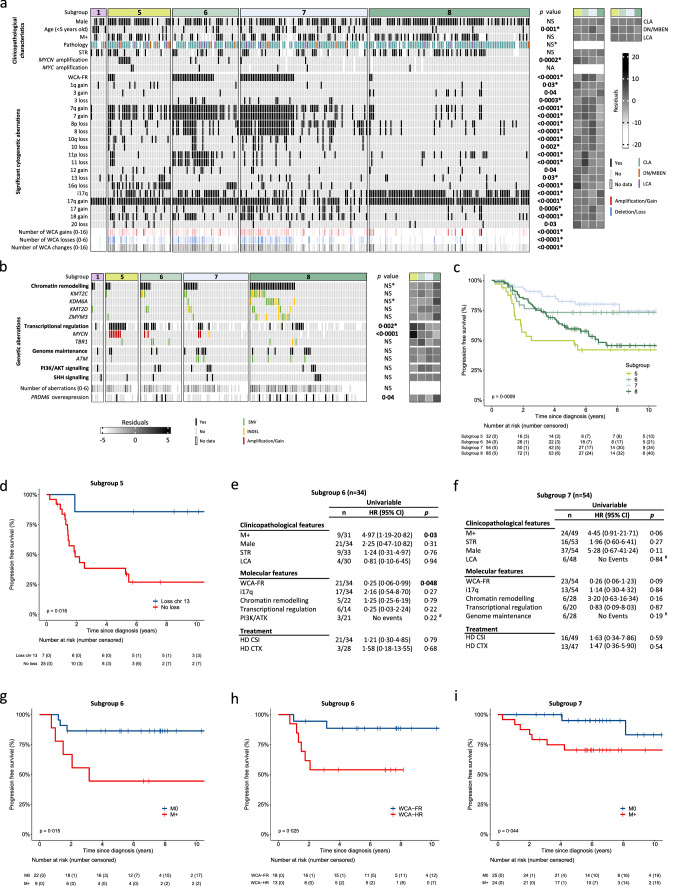
Fig. 1
Fig. 1
Characterisation of MBGrp4 second-generation methylation subgroups. Distribution of a established clinicopathological characteristics and significantly enriched cytogenetic aberrations. b Gene-specific genetic alterations within MBGpr4 methylation subgroups. For Fig. 2a and b, significance is shown from Fisher’s exact or Kruskal–Wallis tests, *depicts significance recapitulated in validation cohort. Residuals from χ2 test indicate subgroup-enrichment (strong relationships are indicated by darker shades of grey) alongside scale bar. Number of WCA gains (red), losses (blue), total WCAs and number of genetic aberrations (black) are also shown with increasing colour intensity indicating a higher number of changes. Features with a cohort-wide frequency of ≥ 5% or with a subgroup-specific frequency ≥ 10% were included in the analysis. MYC amplifications are shown despite their low frequency. Full data is shown in Supplementary Fig. S4, online resource. c Kaplan–Meier plot of PFS by MBGrp4 methylation subgroup. d Kaplan–Meier plot for PFS in subgroup 5 for chromosome 13 loss. Univariable Cox proportional hazards models of PFS in MBGrp4 e subgroup 6 and f subgroup 7 for clinical and molecular features ≥ 10%. Kaplan–Meier plots of PFS by g metastatic disease in subgroup 6, h WCA groups in subgroup 6 and i metastatic disease in subgroup 7. At-risk tables are shown in two-year increments with number of patients censored in parentheses with significance shown by p value generated from log-rank test. Abbreviations: M +  metastatic disease, M0 non-metastatic disease, STR  sub-total resection, CLA classic, DN/MBEN desmoplastic/nodular or medulloblastoma with extensive nodularity, LCA large-cell/anaplastic, WCA-FR/HR whole chromosome aberrations-favourable risk/high risk, CTX chemotherapy, HR hazard ratio, CI confidence interval. #Estimates not possible due to group with no events, p values reported from log-rank test
Fig. 2
Fig. 2
Characterisation of MBGrp4 WCA groups. Distribution of a established clinicopathological characteristics and significant cytogenetic aberrations. b Genetic alterations in chromatin remodelling genes within MBGpr4 WCA groups. For a and b, significance is shown from Fisher’s exact or Mann–Whitney U tests, *depicts significance recapitulated in validation cohort. Residuals from χ2 test indicate subgroup-enrichment (strong relationships are indicated by darker shades of grey) alongside scale bar. Number of WCA gains (red), losses (blue), and total WCA (black) are also shown, with increasing colour intensity indicating a higher number of changes. Features with a cohort-wide frequency of ≥ 5% or with a subgroup-specific frequency ≥ 10% were included in the analysis. MYC amplifications are shown despite low frequency. All data is shown in Supplementary Fig. S5, online resource. c Kaplan–Meier plot of PFS by MBGrp4 WCA groups. Univariable Cox proportional hazards models of PFS within d WCA-FR and e WCA-HR, assessing clinical and molecular features ≥ 10%. Kaplan–Meier plot of PFS by f metastatic disease and g extent of resection within WCA-FR. Kaplan–Meier plot of PFS by h sex, i metastatic disease, j subgroup 5 and k subgroup 7 within WCA-HR. At risk tables are shown in two-year increments with number of patients censored in parentheses with significance shown by p value generated from log-rank test. Abbreviations: M +  metastatic disease, M0 non-metastatic disease, STR  sub-total resection, CLA classic, DN/MBEN desmoplastic/nodular or medulloblastoma with extensive nodularity, LCA large-cell/anaplastic, i17q isochromosome 17q, WCA-FR/HR whole chromosome aberrations-favourable risk/high risk, CTX chemotherapy, HR hazard ratio, CI confidence interval. #Estimates not possible due to group with no events, p values reported from log-rank test
Fig. 3
Fig. 3
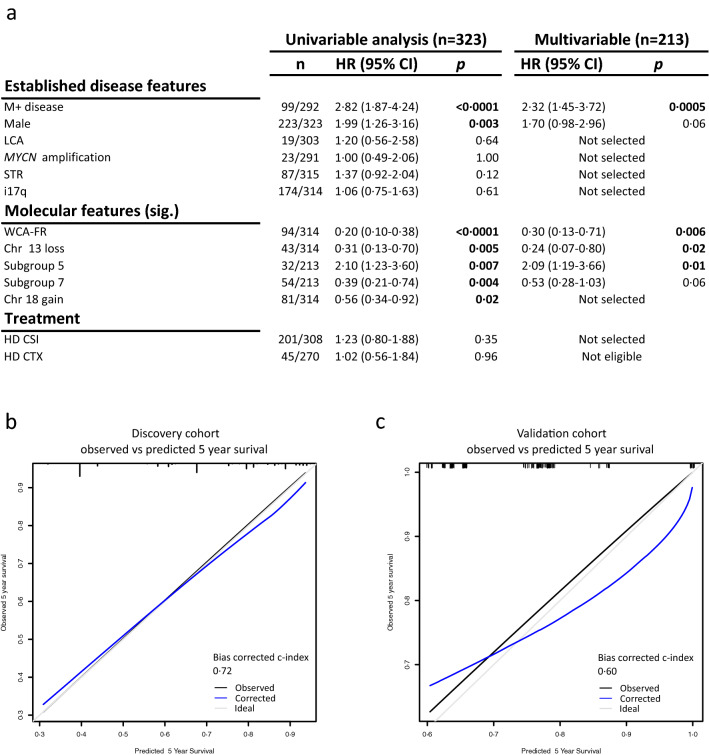
Identification of prognostic survival markers within MBGrp4. a Univariable (n = 323) and multivariable (n = 213) Cox regression analyses of progression-free survival in our MBGrp4 survival cohort. Established MB features were considered alongside molecular factors with a frequency ≥ 10%; only significant features (sig.) are shown. For multivariable analysis, HR and p values are shown for variables retained from backwards selection. Dose of chemotherapy was not considered due to extent of missing data. Calibration plots of multivariable Cox models within both b discovery and c validation cohorts for survival at 5 years alongside the bias-corrected c-index. Abbreviations: M +  metastatic disease, M0 non-metastatic disease, STR  sub-total resection, CLA classic, DN/MBEN desmoplastic/nodular or medulloblastoma with extensive nodularity, LCA large-cell/anaplastic, WCA-FR/HR whole chromosome aberrations-favourable risk/high risk, CTX chemotherapy, HR hazard ratio, CI confidence interval
Fig. 4
Fig. 4
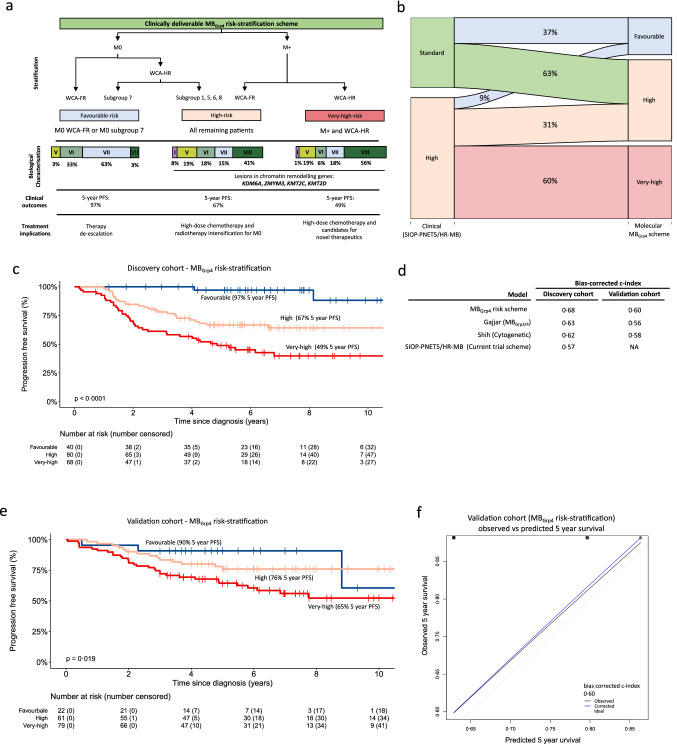
Refined MBGpr4 risk-stratification. a Summary of MBGrp4 risk-stratification scheme with corresponding biological annotation and clinical implications. b Reclassification of risk groups. Sankey plot showing the relationship between the current clinical schemes (SIOP-PNET5-MB [21] [NCT02066220] and SIOP-HR-MB [2] [EudraCT: 2018-004250-17]) and the MBGrp4 risk-stratification scheme. c Kaplan–Meier plot of PFS by MBGrp4 risk-stratification group. At-risk tables are shown in two-year increments with number of patients censored in parentheses and significance shown by p value generated from log-rank test. d Performance of MBGrp4 risk-stratification scheme in comparison to the current clinical-trial risk scheme (SIOP-PNET5-MB [21] and SIOP-HR-MB [2]), a previously reported cytogenetic risk scheme (Shih et al. [35]) and a published combined MBGrp3/4 risk scheme (Gajjar et al. [14]) measured by bias-corrected c-index at 5 years within discovery and validation cohorts. e Kaplan–Meier PFS plot for the MBGrp4 risk-stratification scheme within the external validation cohort (Northcott et al. [23]). f Calibration plot of the MBGrp4 risk-stratification within the validation cohort for survival at 5 years alongside the bias-corrected c-index. Abbreviations: M0 non-metastatic disease, M +  metastatic disease, WCA-FR whole chromosome aberrations-favourable risk, WCA-HR whole chromosome aberrations-high risk, PFS progression-free survival

References

    1. Albright AL, Wisoff JH, Zeltzer PM, Boyett JM, Rorke LB, Stanley P. Effects of medulloblastoma resections on outcome in children: a report from the Children's Cancer Group. Neurosurgery. 1996;38:265–271. doi: 10.1097/00006123-199602000-00007. - DOI - PubMed
    1. Bailey S, André N, Gandola L, Massimino M, Rutkowski S, Clifford SC. Clinical trials in high-risk medulloblastoma: evolution of the SIOP-Europe HR-MB trial. Cancers (Basel) 2022 doi: 10.3390/cancers14020374. - DOI - PMC - PubMed
    1. Cavalli FMG, Remke M, Rampasek L, Peacock J, Shih DJH, Luu B, Garzia L, Torchia J, Nor C, Morrissy AS, et al. Intertumoral heterogeneity within medulloblastoma subgroups. Cancer Cell. 2017;31:737–754.e736. doi: 10.1016/j.ccell.2017.05.005. - DOI - PMC - PubMed
    1. Chang CH, Housepian EM, Herbert C., Jr An operative staging system and a megavoltage radiotherapeutic technic for cerebellar medulloblastomas. Radiology. 1969;93:1351–1359. doi: 10.1148/93.6.1351. - DOI - PubMed
    1. Chen Z, Ioris RM, Richardson S, Van Ess AN, Vendrell I, Kessler BM, Buffa FM, Busino L, Clifford SC, Bullock AN, et al (2022) Disease-associated KBTBD4 mutations in medulloblastoma elicit neomorphic ubiquitylation activity to promote CoREST degradation. Cell Death Differ: Doi 10.1038/s41418-022-00983-4 - PMC - PubMed

Publication types