


Optimizing Respiratory Therapy Resources by De-Implementing Low-Value Care
- PMID: 37015815
- PMCID: PMC10171347
- DOI: 10.4187/respcare.10712
Optimizing Respiratory Therapy Resources by De-Implementing Low-Value Care
Abstract
Background: Our institution was experiencing a respiratory therapy staffing crisis during the COVID-19 pandemic, in part due to excessive workload. We identified an opportunity to reduce burden by limiting use of 3% hypertonic saline and/or N-acetylcysteine nebulizer therapies (3%HTS/NAC).
Methods: Leveraging the science of de-implementation, we established a policy empowering respiratory therapists to discontinue 3%HTS/NAC not meeting the American Association for Respiratory Care (AARC) Clinical Practice Guideline: Effectiveness of Pharmacologic Airway Clearance Therapies in Hospitalized Patients. After a 3-month period of educating physicians and advanced practice practitioners the policy went to into effect. Outcomes measured included monthly number of treatments, orders, and full-time employees associated with administering nebulized 3%HTS/NAC.
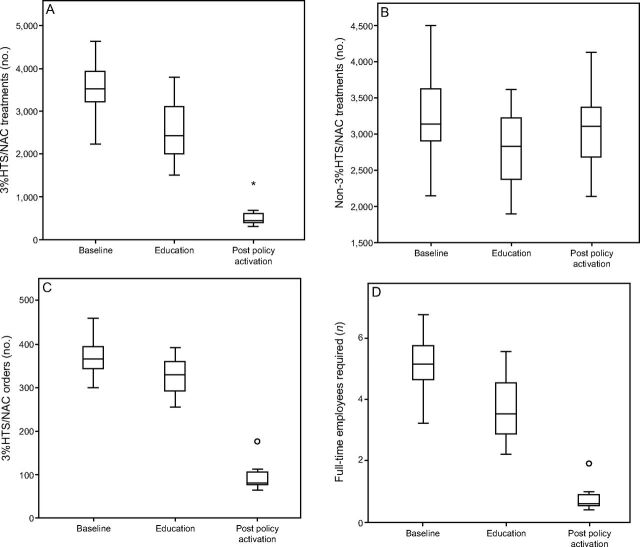
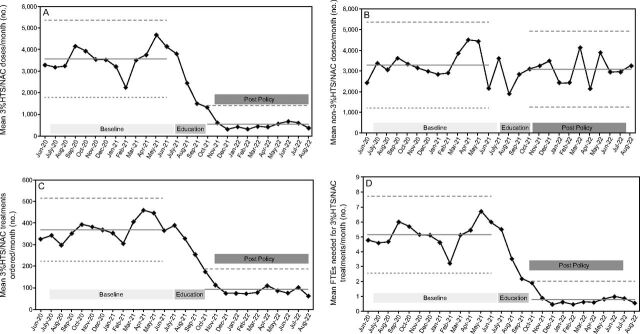
Results: Post policy activation, the monthly mean 3%HTS/NAC treatments were significantly reduced to 547.5 ± 284.3 from 3,565.2 ± 596.4 (P < .001) as were the associated monthly mean of full-time employees, 0.8 ± 0.41 from 5.1 ± 0.86 (P < .001). The monthly mean 3%HTS/NAC orders also fell to 93.8 ± 31.5 from 370.0 ± 46.9 (P < .001). Monthly mean non-3%HTS/NAC treatments remained stable; post policy was 3,089.4 ± 611.4 and baseline 3,279.6 ± 695.0 (P = 1.0).
Conclusions: Implementing a policy that empowers respiratory therapists to promote adherence to AARC Clinical Guidelines reduced low-value therapies, costs, and staffing needs.
Keywords: De-implemention; N-acetylcysteine; health workforce; hypertonic saline; nebulizer.
Copyright © 2023 by Daedalus Enterprises.
Conflict of interest statement
The authors have disclosed no conflicts of interest.
Figures
References
-
- Strickland SL, Roberts KJ, Smith BJ, Hoerr CA, Burr KL, Hinkson CR, et al. Burnout among respiratory therapists amid the COVID-19 pandemic. Respir Care 2022;67(12):1578–1587. - PubMed
-
- Miller AG, Roberts KJ, Smith BJ, Burr KL, Hinkson CR, Hoerr CA, et al. Prevalence of burnout among respiratory therapists amidst the COVID-19 pandemic. Respir Care 2021;66(11):1639–1648. - PubMed
-
- Miller AG, Roberts KJ, Hinkson CR, Davis G, Strickland SL, Rehder KJ. Resilience and burnout resources in respiratory care departments. Respir Care 2021;66(5):715–723. - PubMed
-
- van Bodegom-Vos L, Davidoff F, Marang-van de Mheen PJ. Implementation and de-implementation: two sides of the same coin? BMJ Qual Saf 2017;26(6):495–501. - PubMed
-
- Ubel PA, Asch DA. Creating value in health by understanding and overcoming resistance to de-innovation. Health Aff (Millwood) 2015;34(2):239–244. - PubMed
Publication types
MeSH terms
Substances
LinkOut - more resources
Full Text Sources
Medical
