


Burden of Common Neurologic Diseases in Asian Countries, 1990-2019: An Analysis for the Global Burden of Disease Study 2019
- PMID: 37015823
- PMCID: PMC10238164
- DOI: 10.1212/WNL.0000000000207218
Burden of Common Neurologic Diseases in Asian Countries, 1990-2019: An Analysis for the Global Burden of Disease Study 2019
Abstract
Background and objectives: Based on the Global Burden of Diseases, Injuries, and Risk Factors (GBD) study, neurologic disorders are a major cause of morbidity and mortality worldwide. However, there has been no comprehensive assessment of neurologic disorders in Asia. Data from the GBD 1990-2019 study were investigated to provide new details for neurologic disorders in Asia.
Methods: The burden of common neurologic disorders in Asia was calculated for 1990 and 2019 as incidence, prevalence, deaths, and disability-adjusted life-years (DALYs). Thirteen common neurologic disorders were analyzed. Data are presented as totals and by sex, age, year, location, risk factors, and sociodemographic index (SDI) and shown as counts and rates.
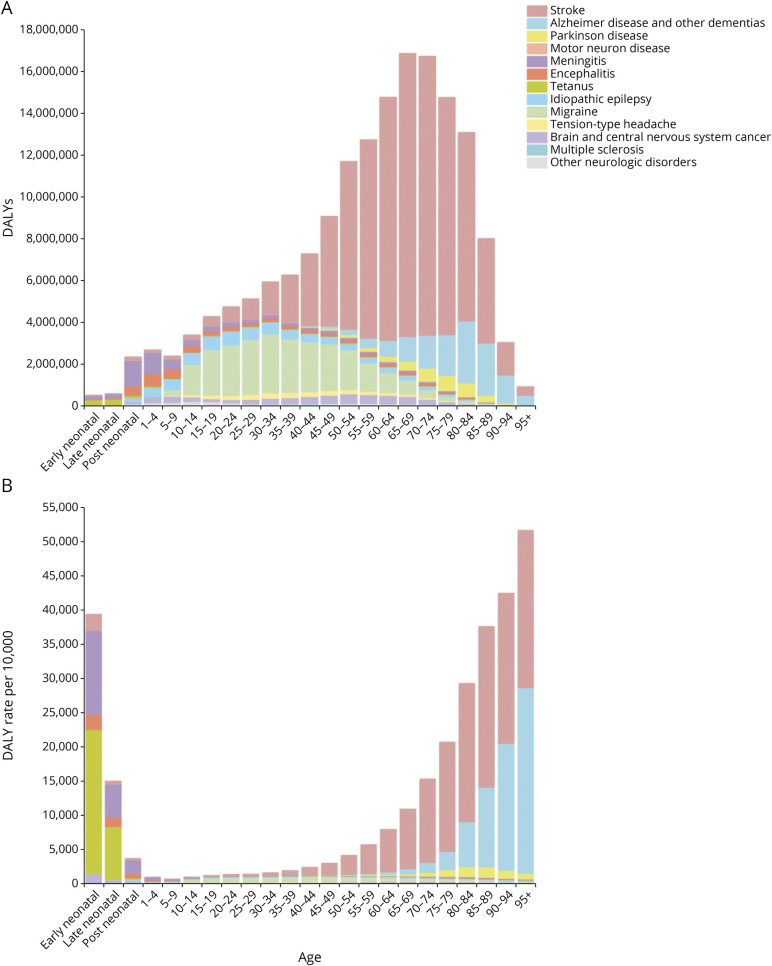
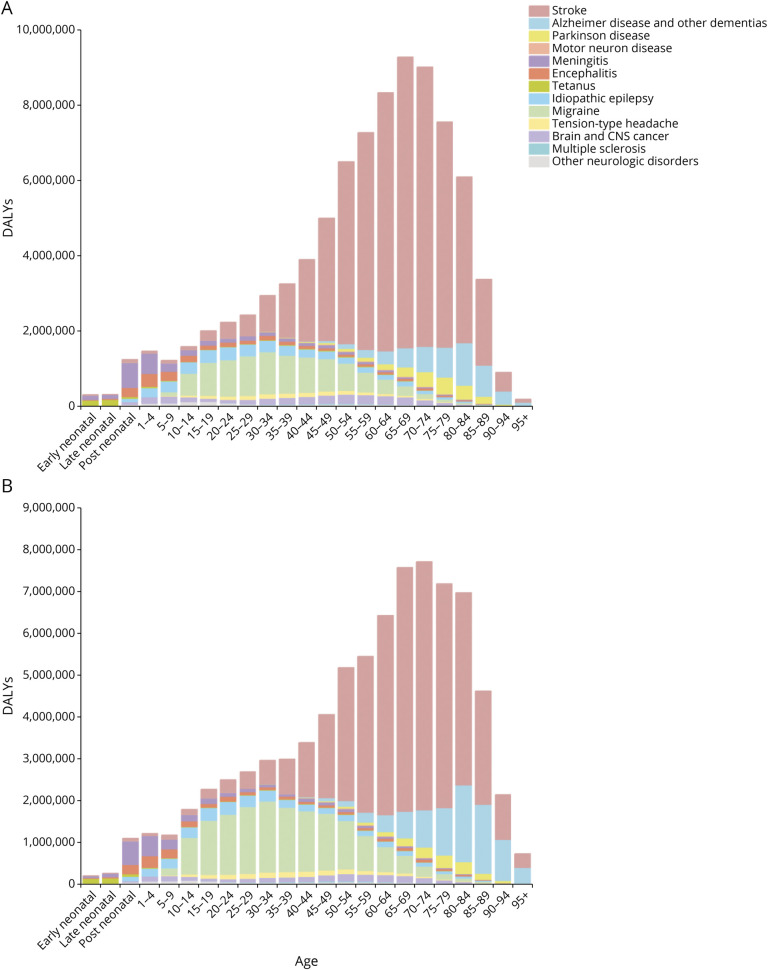
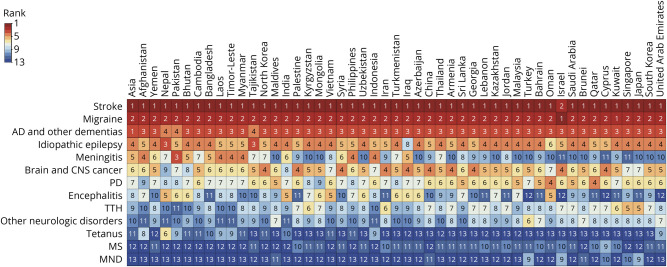
Results: In 2019, the most burdensome neurologic disorders in Asia for the absolute number of DALYs were stroke (98.8 million, 95% uncertainty interval [UI] 91.0-107.0), migraine (24.6 million, 95% UI 3.4-56.4), and Alzheimer disease (AD) and other dementias (13.5 million, 95% UI 5.9-29.8). From 1990 to 2019, the absolute number of DALYs and deaths caused by combined neurologic disorders (deaths by 60.7% and DALYs by 17.6%) increased, but the age-standardized rates (deaths by 34.1% and DALYs by 36.3%) decreased. The burden of neurologic disorders peaked among individuals aged 65-74 years and was higher among male than among female individuals; moreover, this burden varied considerably across Asian subregions and countries. Risk-attributable DALYs accounted for 86.9%, 28.5%, and 11.1% of DALYs for stroke, AD and other dementias, and multiple sclerosis, respectively. SDI was associated with both stroke and communicable neurological disorders. In terms of crude rate, the higher the SDI value, the higher the prevalence of stroke, and the lower all metrics of communicable neurological disorders.
Discussion: Neurologic disorders were the leading cause of DALYs and the second leading cause of deaths in Asia in 2019, and the burden may likely increase with the growth and aging of the Asian population. Urgent measures are needed for prevention, treatment, rehabilitation, and support services for common neurologic disorders regionally and nationally.
Copyright © 2023 The Author(s). Published by Wolters Kluwer Health, Inc. on behalf of the American Academy of Neurology.
Conflict of interest statement
Yue Wang reports no disclosures relevant to the manuscript. J. Liang was supported by grants from the Natural Science Foundation of Hubei Province (No. 2020CFB226). Y. Fang, D. Yao, L. Zhang, Y. Zhou, Yajuan Wang, L. Hu, and Z. Lu report no disclosures relevant to the manuscript. Yilong Wang was supported by grants from the National Natural Science Foundation of China (No. 81825007), the National Natural Science Foundation Beijing Outstanding Young Scientist Program (No. BJJWZYJH01201910025030), Youth Beijing Scholar Program (No.010), Beijing Talent Project-Class A: Innovation and Development (No. 2018A12), “National Ten-Thousand Talent Plan”-Leadership of Scientific and Technological Innovation; and National Key R&D Program of China (No. 2017YFC1307900, 2017YFC1307905). Z. Xiao was supported by grants from the National Natural Science Foundation of China (No. 81971055, 81471133, 82101292), the Interdisciplinary Innovative Talents Foundation from Renmin Hospital of Wuhan University (JCRCYG-2022-006) and Buchang Zhiyuan Public Welfare Projects for Heart and Brain Health (HIGHER2022094). Go to
Figures
Comment in
-
Neurologic Disease Burden in Asia Is Both Growing and Changing: But More Data Are Needed.Neurology. 2023 May 23;100(21):989-990. doi: 10.1212/WNL.0000000000207361. Epub 2023 Apr 11. Neurology. 2023. PMID: 37041079 No abstract available.
References
-
- GBD 2019 Demographics Collaborators. Global age-sex-specific fertility, mortality, healthy life expectancy (HALE), and population estimates in 204 countries and territories, 1950-2019: a comprehensive demographic analysis for the Global Burden of Disease Study 2019. Lancet. 2020;396(10258):1160-1203. doi: 10.1016/S0140-6736(20)30977-6 - DOI - PMC - PubMed
Publication types
MeSH terms
LinkOut - more resources
Full Text Sources
Medical
