


Trends in heart failure prevalence in Japan 2014-2019: a report from healthcare administration databases
- PMID: 37016908
- PMCID: PMC10192231
- DOI: 10.1002/ehf2.14321
Trends in heart failure prevalence in Japan 2014-2019: a report from healthcare administration databases
Abstract
Aims: Contemporary estimates of heart failure (HF) prevalence in Japan are scarce. We aimed to estimate HF prevalence and trends in Japan using nationally representative, large administrative claims databases.
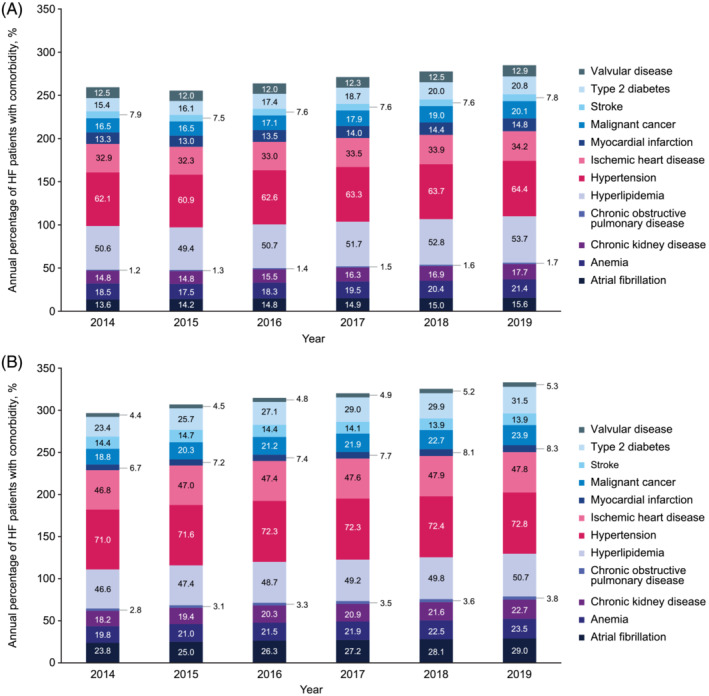
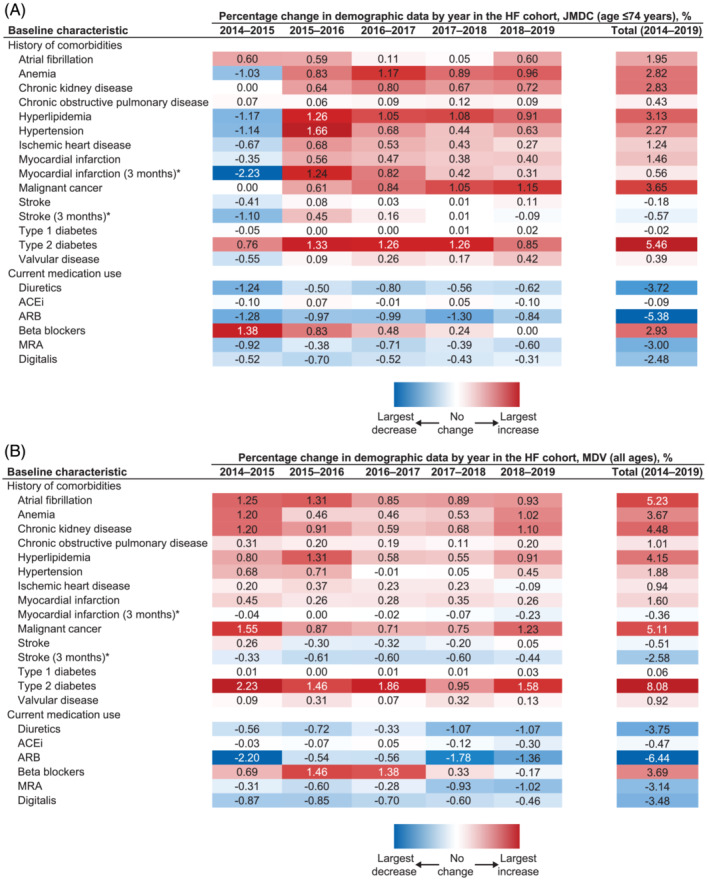
Methods and results: This retrospective analysis used data from the Japan Medical Data Center (JMDC) (age ≤74 years) and the Medical Data Vision (MDV) (all ages) databases (study period: 1 January 2014-31 December 31 2019). We calculated HF prevalence using crude and sex-/age-standardized models (weighting based on Japanese census data, 2014-2019). Among 8 954 313 individuals aged ≤74 years from JMDC, and 27 920 174 of all ages from MDV, the cumulative 6 year (2014-2019) crude and sex-/age-standardized prevalence of HF per 1000 persons (95% confidence intervals) in Japan was 21.80 [21.70, 21.89] and 41.79 [30.25, 56.11] using JMDC and 65.09 [65.00, 65.18] and 60.95 [46.94, 77.62], respectively, using MDV. We observed an increasing yearly trend in crude HF prevalence per 1000 persons: 11.12 in 2014 and 14.69 in 2019 for JMDC; 58.09 and 77.18, respectively, for MDV. There was an overall increasing trend of comorbidities over time (2014-2019) among HF patients, especially in type 2 diabetes, malignant cancer, chronic kidney disease, and atrial fibrillation. From 2014 to 2019, the percentage of patients in JMDC with type 2 diabetes increased from 15.4% to 20.8% and 23.4% to 31.5% in MDV; malignant cancer frequency increased from 16.5% to 20.1% in JMDC and 18.8% to 23.9% in MDV; frequency of chronic kidney disease increased from 14.8% to 17.7% in JMDC and 18.2% to 22.7% in MDV; and frequency of atrial fibrillation increased from 13.6% to 15.6% in JMDC and 23.8% to 29.0% in MDV.
Conclusions: We estimated that the prevalence of HF in Japan was 2.2-3.7% for patients aged ≤74 during the period 2014-2019 using the JMDC database, while the prevalence for patients of all ages was 6.5% using the MDV database.
Keywords: Database study; Heart failure; Japan; Prevalence.
© 2023 The Authors. ESC Heart Failure published by John Wiley & Sons Ltd on behalf of European Society of Cardiology.
Conflict of interest statement
Ling Zhang, Yasuhisa Ono, and Qing Qiao are employees of Boehringer Ingelheim. Toshiyuki Nagai has received research grants from the Takeda Science Foundation, the Japan Cardiovascular Research Foundation, the Japan Foundation for Aging and Health, the Mochida Memorial Foundation and the Uehara Memorial Foundation, and honoraria from Novartis Co., Ltd.
Figures
References
-
- GBD 2017 Disease and Injury Incidence and Prevalence Collaborators . Global, regional, and national incidence, prevalence, and years lived with disability for 354 diseases and injuries for 195 countries and territories, 1990–2017: a systematic analysis for the Global Burden of Disease Study 2017. Lancet 2018; 392: 1789–1858. - PMC - PubMed
-
- Lippi G, Sanchis‐Gomar F. Global epidemiology and future trends of heart failure. AME Med J 2020; 5: 5.
-
- Yang YN, Ma YT, Liu F, Huang D, Li XM, Huang Y, Tang Q, Chen BD, Ma X, Xie X, Du L, Gao X, Wang YH, Gulinaer B, Yu ZX. Incidence and distributing feature of chronic heart failure in adult population of Xinjiang. Zhonghua Xin Xue Guan Bing Za Zhi 2010; 38: 460–464. - PubMed
Publication types
MeSH terms
LinkOut - more resources
Full Text Sources
Medical
Research Materials
Miscellaneous
