


Caveolin-1 genotypes as predictor for locoregional recurrence and contralateral disease in breast cancer
- PMID: 37017811
- PMCID: PMC10175335
- DOI: 10.1007/s10549-023-06919-x
Caveolin-1 genotypes as predictor for locoregional recurrence and contralateral disease in breast cancer
Abstract
Purpose: Caveolin-1 (CAV1) has been implicated in breast cancer oncogenesis and metastasis and may be a potential prognosticator, especially for non-distant events. CAV1 functions as a master regulator of membrane transport and cell signaling. Several CAV1 SNPs have been linked to multiple cancers, but the prognostic impact of CAV1 SNPs in breast cancer remains unclear. Here, we investigated CAV1 polymorphisms in relation to clinical outcomes in breast cancer.
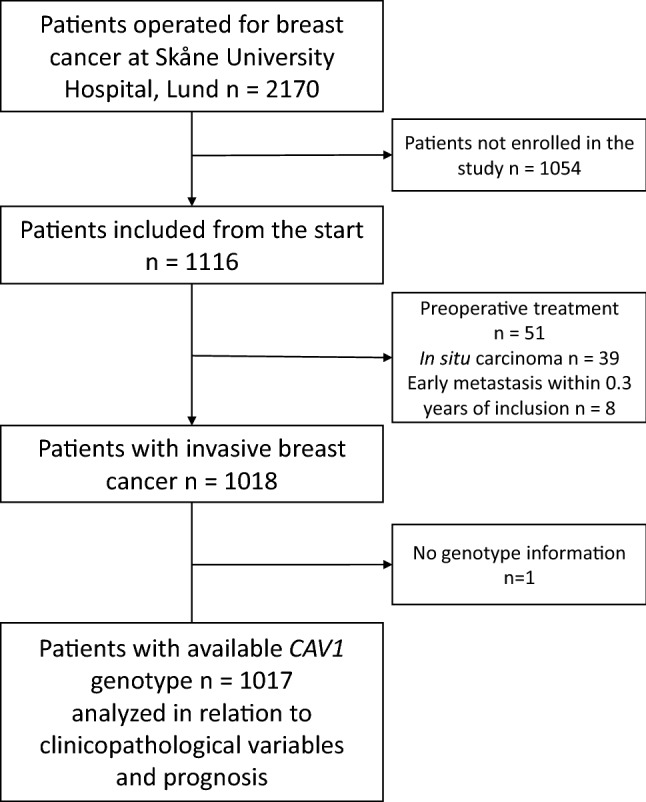
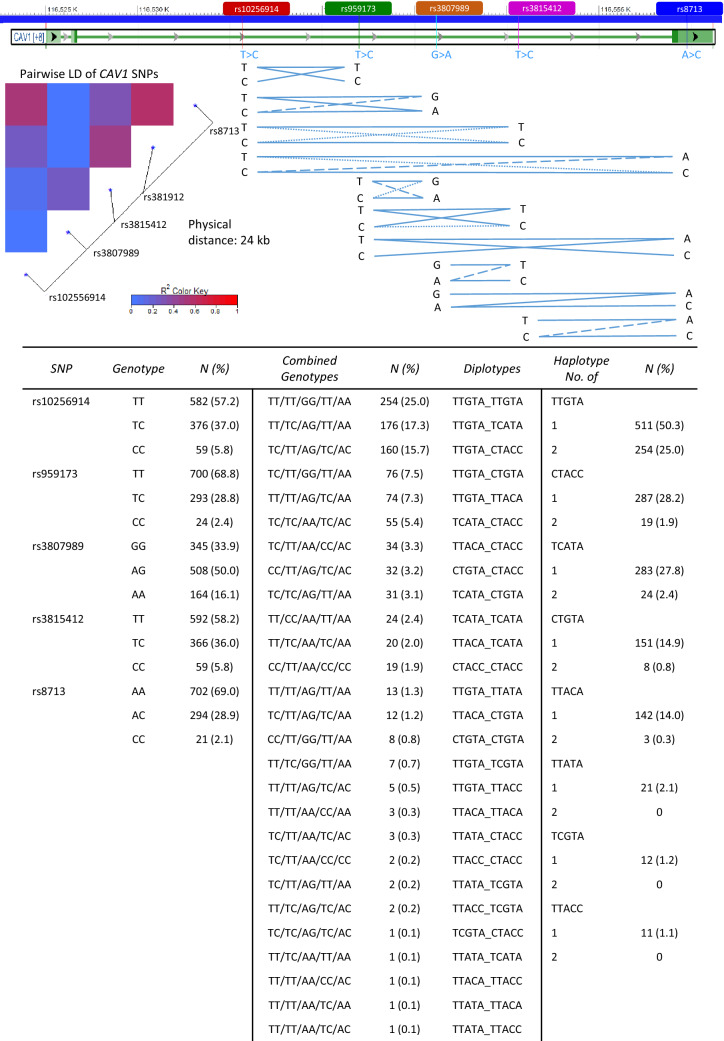
Methods: A cohort of 1017 breast cancer patients (inclusion 2002-2012, Sweden) were genotyped using Oncoarray by Ilumina. Patients were followed for up to 15 years. Five out of six CAV1 SNPs (rs10256914, rs959173, rs3807989, rs3815412, and rs8713) passed quality control and were used for haplotype construction. CAV1 genotypes and haplotypes in relation to clinical outcomes were assessed with Cox regression and adjusted for potential confounders (age, tumor characteristics, and adjuvant treatments).
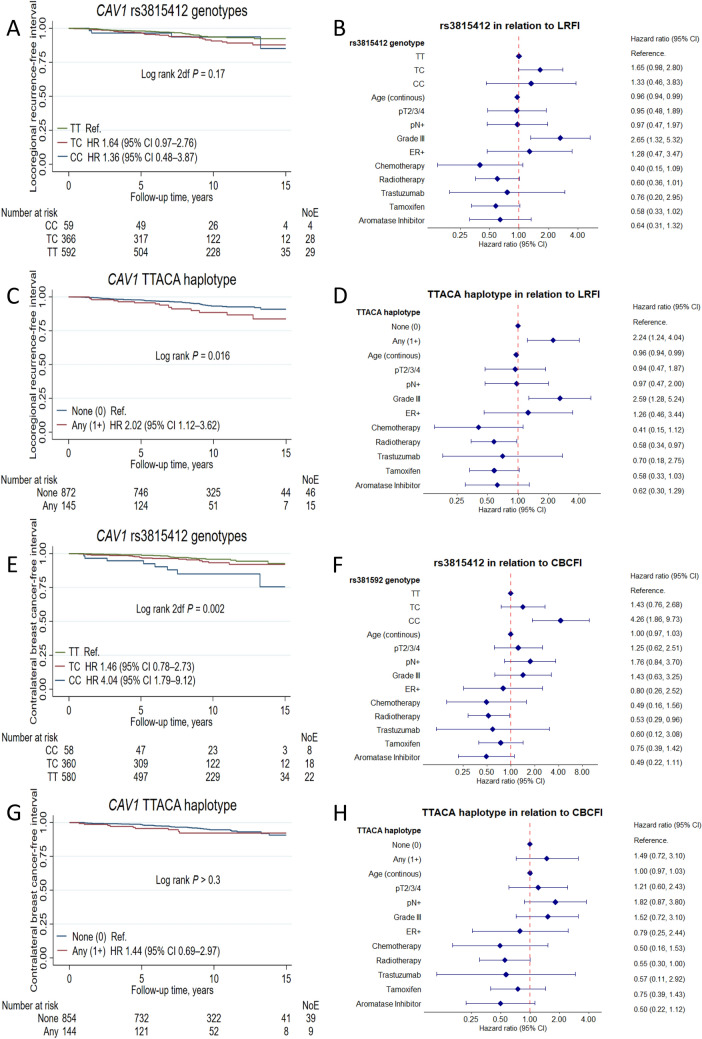
Results: Only one SNP was associated with lymph node status, no other SNPs or haplotypes were associated with tumor characteristics. The CAV1 rs3815412 CC genotype (5.8% of patients) was associated with increased risk of contralateral breast cancer, adjusted hazard ratio (HRadj) 4.26 (95% CI 1.86-9.73). Moreover, the TTACA haplotype (13% of patients) conferred an increased risk for locoregional recurrence HRadj 2.24 (95% CI 1.24-4.04). No other genotypes or haplotypes were associated with clinical outcome.
Conclusion: CAV1 polymorphisms were associated with increased risk for locoregional recurrence and contralateral breast cancer. These findings may identify patients that could derive benefit from more tailored treatment to prevent non-distant events, if confirmed.
Keywords: Caveolin-1; Contralateral breast cancer; Genotype; Locoregional breast cancer recurrence.
© 2023. The Author(s).
Conflict of interest statement
Ana Bosch has received institutional honoraria from Pfizer, Roche, and Lilly for consultation and lectures. She has participated in Advisory Board meetings for Pfizer and Novartis. Co-founder and chair of the board for SACRA therapeutics. The other authors declare no conflict of interest.
Figures
References
-
- Harris LN, Ismaila N, McShane LM, Andre F, Collyar DE, Gonzalez-Angulo AM, Hammond EH, Kuderer NM, Liu MC, Mennel RG, Van Poznak C, Bast RC, Hayes DF, American Society of Clinical O Use of biomarkers to guide decisions on adjuvant systemic therapy for women with early-stage invasive breast cancer: American Society of Clinical Oncology Clinical Practice Guideline. J Clin Oncol. 2016;34:1134–1150. doi: 10.1200/JCO.2015.65.2289. - DOI - PMC - PubMed
-
- Sørlie T, Perou CM, Tibshirani R, Aas T, Geisler S, Johnsen H, Hastie T, Eisen MB, van de Rijn M, Jeffrey SS, Thorsen T, Quist H, Matese JC, Brown PO, Botstein D, Lønning PE, Børresen-Dale AL. Gene expression patterns of breast carcinomas distinguish tumor subclasses with clinical implications. Proc Natl Acad Sci USA. 2001;98:10869–10874. doi: 10.1073/pnas.191367098. - DOI - PMC - PubMed
-
- Gnant M, Filipits M, Greil R, Stoeger H, Rudas M, Bago-Horvath Z, Mlineritsch B, Kwasny W, Knauer M, Singer C, Jakesz R, Dubsky P, Fitzal F, Bartsch R, Steger G, Balic M, Ressler S, Cowens JW, Storhoff J, Ferree S, Schaper C, Liu S, Fesl C, Nielsen TO. Predicting distant recurrence in receptor-positive breast cancer patients with limited clinicopathological risk: using the PAM50 Risk of Recurrence score in 1478 postmenopausal patients of the ABCSG-8 trial treated with adjuvant endocrine therapy alone. Ann Oncol. 2014;25:339–345. doi: 10.1093/annonc/mdt494. - DOI - PubMed
MeSH terms
Substances
Grants and funding
LinkOut - more resources
Full Text Sources
Medical
