


Sex and gender perspectives in colorectal cancer
- PMID: 37018873
- PMCID: PMC10163160
- DOI: 10.1016/j.esmoop.2023.101204
Sex and gender perspectives in colorectal cancer
Abstract
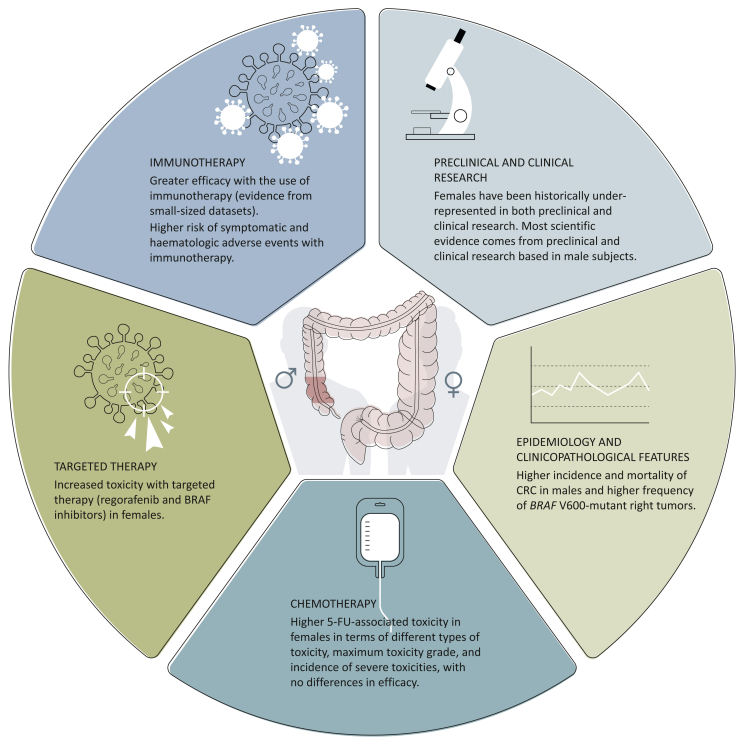
Historically women were frequently excluded from clinical trials and drug usage to protect unborn babies from potential harm. As a consequence, the impact of sex and gender on both tumour biology and clinical outcomes has been largely underestimated. Although interrelated and often used interchangeably, sex and gender are not equivalent concepts. Sex is a biological attribute that defines species according to their chromosomal makeup and reproductive organ, while gender refers to a chosen sexual identity. Sex dimorphisms are rarely taken into account, in either preclinical or clinical research, with inadequate analysis of differences in outcomes according to sex or gender still widespread, reflecting a gap in our knowledge for a large proportion of the target population. Underestimation of sex-based differences in study design and analyses has invariably led to 'one-drug' treatment regimens for both males and females. For patients with colorectal cancer (CRC), sex also has an impact on the disease incidence, clinicopathological features, therapeutic outcomes, and tolerability to anticancer treatments. Although the global incidence of CRC is higher in male subjects, the proportion of patients presenting right-sided tumours and BRAF mutations is higher among females. Concerning sex-related differences in treatment efficacy and toxicity, drug dosage does not take into account sex-specific differences in pharmacokinetics. Toxicity associated with fluoropyrimidines, targeted therapies, and immunotherapies has been reported to be more extensive for females with CRC than for males, although evidence about differences in efficacy is more controversial. This article aims to provide an overview of the research achieved so far into sex and gender differences in cancer and summarize the growing body of literature illustrating the sex and gender perspective in CRC and their impact in relation to tumour biology and treatment efficacy and toxicity. We propose endorsing research on how biological sex and gender influence CRC as an added value for precision oncology.
Keywords: colorectal cancer; gender; sex; toxicity; treatment; tumour biology.
Copyright © 2023 The Authors. Published by Elsevier Ltd.. All rights reserved.
Conflict of interest statement
Disclosure IB has received accommodation and travel expenses from Amgen, Merck, Sanofi, and Servier. JR has received personal speaker honoraria from Sanofi and Amgen, and accommodation expenses from Pierre-Fabre, Servier, Amgen, and Merck. NS has received accommodation and travel expenses from Amgen and Merck. FS reports personal financial interests, honoraria for advisory role, travel grants, research grants (past 5 years): Hoffman La-Roche, Sanofi Aventis, Amgen, Merck Serono, Servier, Bristol-Myers Squibb. MRC has received personal speaker honoraria from ROVI and accommodation expenses from BMS, Amgen, and Merck. JT reports personal financial interest in the form of scientific consultancy role for Array Biopharma, AstraZeneca, Bayer, Boehringer Ingelheim, Chugai, Daiichi Sankyo, F. Hoffmann-La Roche Ltd, Genentech Inc, HalioDX SAS, Hutchison MediPharma International, Ikena Oncology, Inspirna Inc, IQVIA, Lilly, Menarini, Merck Serono, Merus, MSD, Mirati, Neophore, Novartis, Ona Therapeutics, Orion Biotechnology, Peptomyc, Pfizer, Pierre Fabre, Samsung Bioepis, Sanofi, Scandion Oncology, Scorpion Therapeutics, Seattle Genetics, Servier, Sotio Biotech, Taiho, Tessa Therapeutics, TheraMyc, and Tolremo Therapeutics. Stocks: Oniria Therapeutics and also educational collaboration with Imedex/HMP, Medscape Education, MJH Life Sciences, PeerView Institute for Medical Education, and Physicians Education Resource (PER). EÉ has received personal speaker honoraria from Organon and Novartis; and personal advisory board honoraria from Amgen, Bayer, Hoffman-La Roche, Merck Serono, Sanofi, Pierre Fabre, MSD, and Servier. Her institution has received research funding from Amgen Inc, Array Biopharma Inc, AstraZeneca Pharmaceuticals LP, BeiGene, Boehringer Ingelheim, Bristol Myers Squibb, Celgene, Debiopharm International SA, F. Hoffmann-La Roche Ltd, Genentech Inc, HalioDX SAS, Hutchison MediPharma International, Janssen-Cilag SA, MedImmune, Menarini, Merck Health KGAA, Merck Sharp & Dohme, Merus NV, Mirati, Novartis Farmacéutica SA, Pfizer, Pharma Mar, Sanofi Aventis Recherche & Développement, Servier, Taiho Pharma USA Inc. She held/holds non-remunerated roles as Coordinator of the SEOM +MIR Section of Residents and Young Assistants of the Sociedad Española de Oncología Médica (SEOM), Speaker of the ESMO Academy of the European Society for Medical Oncology (ESMO), and Volunteer member of the ASCO Annual Meeting Scientific Program Committee: Developmental Therapeutics – Immunotherapy of the American Society of Clinical Oncology (ASCO). AG has declared no conflicts of interest.
Figures
References
-
- Sung H., Ferlay J., Siegel R.L., et al. Global cancer statistics 2020: GLOBOCAN estimates of incidence and mortality worldwide for 36 cancers in 185 countries. CA Cancer J Clin. 2021;71(3):209–249. - PubMed
-
- Haig D. The inexorable rise of gender and the decline of sex: social change in academic titles, 1945-2001. Arch Sex Behav. 2004;33(2):87–96. - PubMed
-
- Money J. Hermaphroditism, gender and precocity in hyperadrenocorticism: psychologic findings. Bull Johns Hopkins Hosp. 1955;96(6):253–264. - PubMed
Publication types
MeSH terms
LinkOut - more resources
Full Text Sources
Medical
Research Materials
Miscellaneous
