


Prognostic benefit of catheter ablation of atrial fibrillation in heart failure: An updated meta-analysis of randomized controlled trials
- PMID: 37021020
- PMCID: PMC10068943
- DOI: 10.1002/joa3.12812
Prognostic benefit of catheter ablation of atrial fibrillation in heart failure: An updated meta-analysis of randomized controlled trials
Abstract
Background: The prognostic role of catheter ablation of atrial fibrillation (AF) in patients with heart failure (HF) remains uncertain, with guideline recommendations largely based on a single trial. We conducted a meta-analysis of randomized controlled trials (RCTs) assessing the prognostic impact of AF ablation in patients with HF.
Methods: Electronic databases were searched for RCTs comparing 'AF ablation' versus 'other care' (medical therapy and/or atrioventricular node ablation with pacing) in patients with HF. Primary endpoints were ≥1-year mortality, HF hospitalization and change in left ventricular ejection fraction (LVEF). Meta-analyses were performed using random-effects modelling.
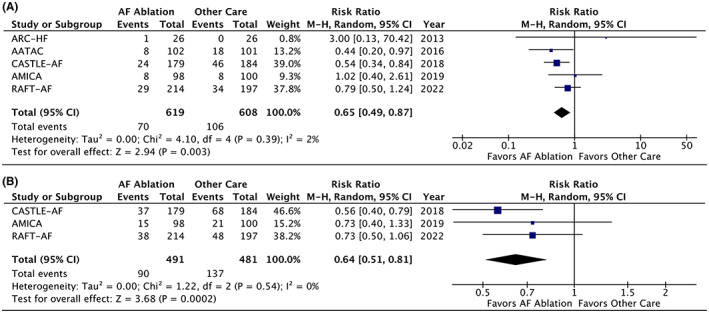
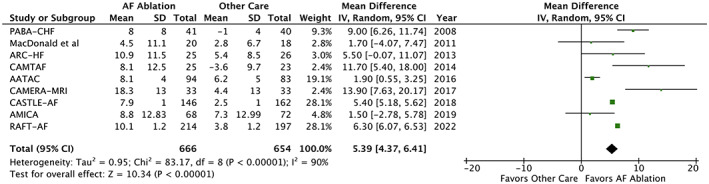
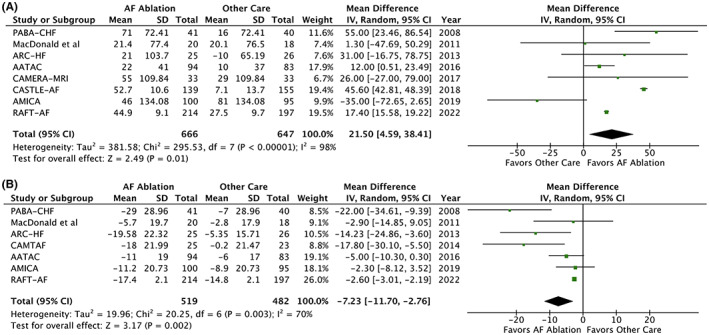
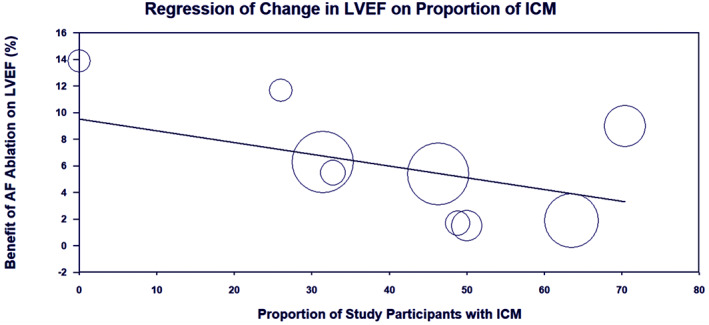
Results: Nine RCTs (n = 1462) met inclusion criteria. Compared to 'other care', AF ablation significantly reduced ≥1-year mortality (relative risk [RR] 0.65; 95% confidence intervals [CI], 0.49-0.87) and HF hospitalization (RR 0.64; 95% CI, 0.51-0.81). AF ablation demonstrated significantly greater improvement in LVEF (mean difference [MD] 5.4; 95% CI, 4.4-6.4), 6-min walk test distance (MD 21.5 meters; 95% CI, 4.6-38.4) and quality of life as measured by Minnesota Living with Heart Failure Questionnaire score (MD 7.2; 95% CI, 2.8-11.7). Meta-regression analyses showed the beneficial impact of AF ablation on LVEF was significantly blunted by higher prevalence of ischaemic cardiomyopathy.
Conclusions: Our meta-analysis demonstrates AF ablation is superior to 'other care' in improving mortality, HF hospitalization, LVEF and quality of life in patients with HF. However, the highly selected study populations in included RCTs and effect modification mediated by etiology of HF suggests these benefits do not uniformly apply across the HF population.
Keywords: atrial fibrillation; catheter ablation; heart failure; meta‐analysis.
© 2023 The Authors. Journal of Arrhythmia published by John Wiley & Sons Australia, Ltd on behalf of Japanese Heart Rhythm Society.
Conflict of interest statement
None.
Figures
References
-
- Chiang C‐E, Naditch‐Brûlé L, Murin J, Goethals M, Inoue H, O'Neill J, et al. Distribution and risk profile of paroxysmal, persistent, and permanent atrial fibrillation in routine clinical practice: insight from the real‐life global survey evaluating patients with atrial fibrillation international registry. Circ Arrhythm Electrophysiol. 2012;5:632–9. - PubMed
-
- Chiocchini A, Terricabras M, Verma A. Atrial fibrillation ablation in heart failure: what do we know? What can we do? EP Europace. 2021;23:353–61. - PubMed
-
- Wilber DJ, Pappone C, Neuzil P, De Paola A, Marchlinski F, Natale A, et al. Comparison of antiarrhythmic drug therapy and radiofrequency catheter ablation in patients with paroxysmal atrial fibrillation: a randomized controlled trial. JAMA. 2010;303:333–40. - PubMed
LinkOut - more resources
Full Text Sources
Research Materials
Miscellaneous
