. 2023 Apr 11;120(15):e2214521120.
doi: 10.1073/pnas.2214521120. Epub 2023 Apr 6.

Starships are active eukaryotic transposable elements mobilized by a new family of tyrosine recombinases

Affiliations

Starships are active eukaryotic transposable elements mobilized by a new family of tyrosine recombinases

Andrew S Urquhart et al. Proc Natl Acad Sci U S A. .

Abstract

Transposable elements in eukaryotic organisms have historically been considered "selfish," at best conferring indirect benefits to their host organisms. The Starships are a recently discovered feature in fungal genomes that are, in some cases, predicted to confer beneficial traits to their hosts and also have hallmarks of being transposable elements. Here, we provide experimental evidence that Starships are indeed autonomous transposons, using the model Paecilomyces variotii, and identify the HhpA "Captain" tyrosine recombinase as essential for their mobilization into genomic sites with a specific target site consensus sequence. Furthermore, we identify multiple recent horizontal gene transfers of Starships, implying that they jump between species. Fungal genomes have mechanisms to defend against mobile elements, which are frequently detrimental to the host. We discover that Starships are also vulnerable to repeat-induced point mutation defense, thereby having implications on the evolutionary stability of such elements.

Keywords: Starship; fungi; horizontal gene transfer; transposon.


Conflict of interest statement

The authors declare no competing interest.

Figures
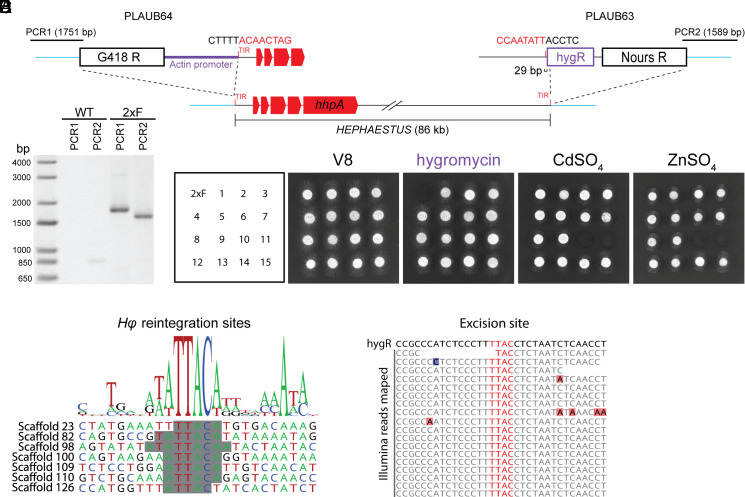
Fig. 1.
Fig. 1.
HEPHAESTUS is actively mobile within the P. variotii genome. (A) Two constructs were transformed into the CBS 144490 genome to integrate on either side of . This arrangement leads to the expression of hygR only after spontaneous excision of the region because this brings the Leptosphaeria actin promoter and hygromycin phosphotransferase coding region together. (B) PCR analysis confirmed the correct integration of PLAUB64 and PLAUB63 either side of . (C) Growth of a “double-flanked” transformant (2×F) strain and spontaneously hygromycin-resistant derivatives cultured on media supplemented with hygromycin, cadmium, or zinc. (D) Reintegration sites of within the genome identified via pooled Illumina sequencing. Shading in alignments presents the direct repeats created due to matching DNA between termini and target sites. (E) Illumina sequencing reads mapped to the hygR cassette revealed no footprint left after excision.
Fig. 2.
Fig. 2.
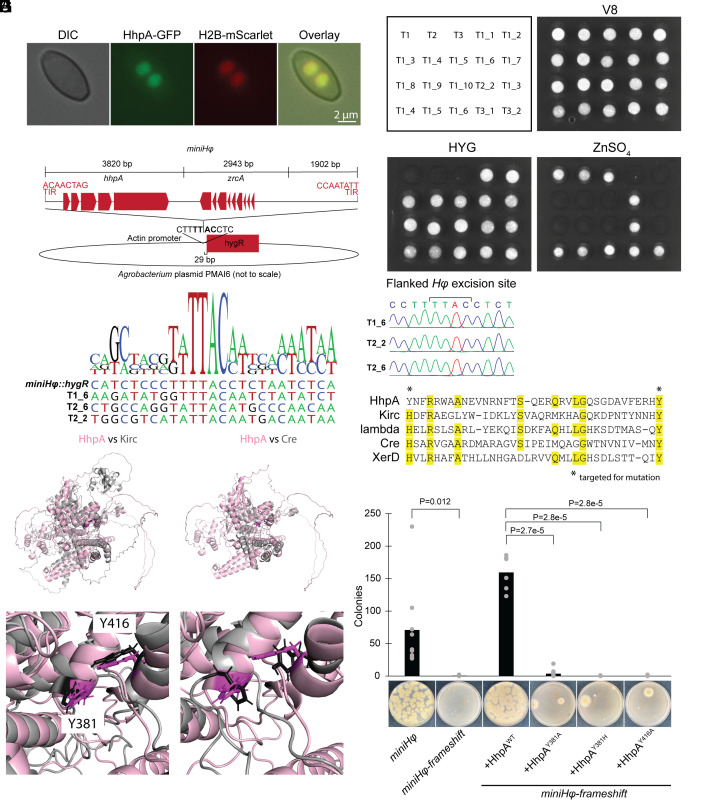
HEPHAESTUS movement is mediated by the putative tyrosine recombinase enzyme HhpA. (A) Nuclear localization of a HhpA-GFP fusion protein. (B) A minimal version of was inserted into plasmid PMAI6 29 bp upstream of the hygromycin phosphotransferase coding region. Spontaneous excision of will result in the expression of the hygR gene conferring hygromycin resistance. (C) Growth of miniHφ transformants and their spontaneously hygromycin-resistant derivatives on hygromycin and zinc. (D) Reintegration sites of the miniHφ element determined using inverse PCR. (E) Sanger sequencing of excision sites indicates that no DNA remains. (F) AlphaFold protein structure predictions for HhpA and Kirc show structural similarity despite the low level of amino acid sequence similarity between these proteins. The HphA predicted structure also shows similarity to the Cre recombinase crystal structure (PDB: 3CRX.E). Lower panels show the position of Y381 and Y416 within the putative active site of the enzyme. (G) Sequence alignment of HhpA at part of the putative tyrosine recombinase active site previously identified by Vogan et al. (H) Frameshift mutation of HhpA reduced transposition frequency, which could be restored by wild type HhpA but not by HhpA Y381A, Y381H, or Y416A.
Fig. 3.
Fig. 3.
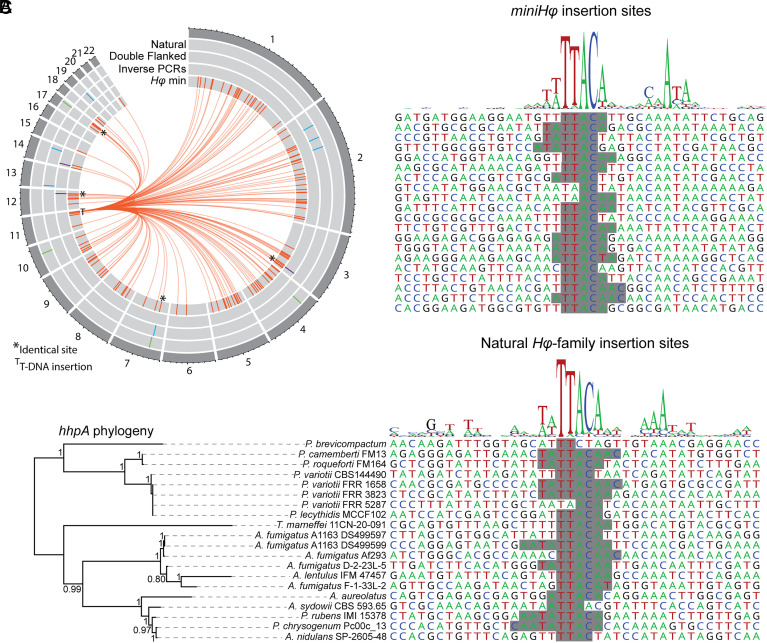
HEPHAESTUS integrates into TTAC (N7) A sites. (A) Position of the four known natural insertions, seven experimentally isolated insertions, the three miniHφ insertions identified by inverse PCR and the 132 miniHφ insertion sites from pooled Illumina reads on the 22 largest P. variotii CBS 101075 assembly scaffolds. Internal lines connect the 132 miniHφ insertion sites to the location of the T-DNA on which the miniHφ sequence was introduced. (B) Consensus sequence of all 132 miniHφ target sites, and an alignment of a subset of 20 sites from 132 characterized (a complete alignment is in SI Appendix, Fig. S2). (C) Consensus sequence at the insertion site of naturally occurring relatives. Insertion sites are ordered according to the phylogenetic relationships of the associated HhpA homologs. Shading in alignments presents the direct repeats created due to matching DNA between termini and target sites.
Fig. 4.
Fig. 4.
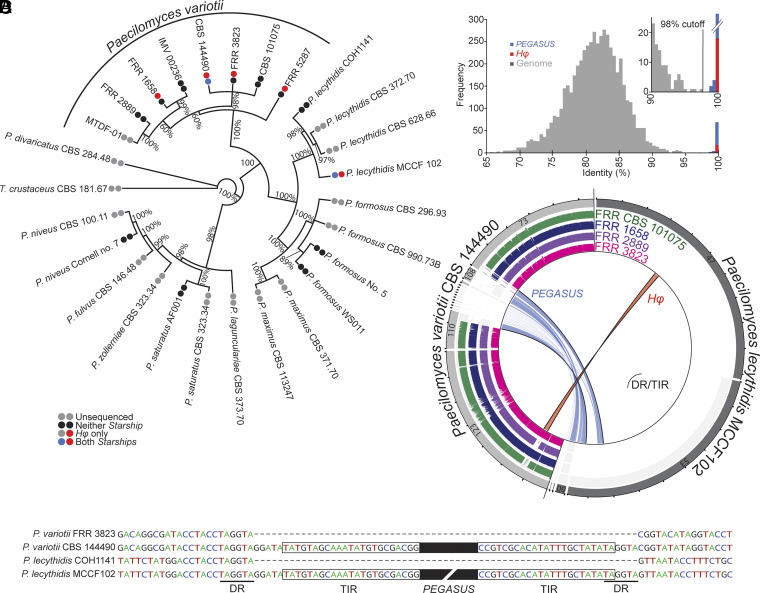
Evidence of Starship transfer between fungal species. (A) Phylogenetic tree based on the calmodulin marker showing the taxonomic relationships between publicly available Paecilomyces genomes and taxonomically supported strains from ref. . The tree was generated in MrBayes (42) and branch supports represent posterior probabilities as percentages. The distribution of and a second Starship PEGASUS is indicated by red and blue dots, respectively. (B) A histogram representing the top BLASTn search result for each 5 Kbp window of the P. variotii CBS 144490 genome against the P. lecythidis MCCF 102 contigs. The presence of highly conserved genomic regions is indicative of HGT. A cutoff of 98% was used to predict putative HGT. (C) A Circos plot showing the genomic location all BLASTn matches with >98% identity as identified in panel B. Lines drawn between the location of the Basic Local Alignment Search Tool (BLAST) queries on the P. variotii CBS 144490 contigs and subject sequences on the P. lecythidis MCCF 102 contigs. Red indicates and blue indicates PEGASUS that has also undergone HGT, albeit is fragmented in both assemblies. PEGASUS of MCCF 102 has undergone an inversion mutation since it was integrated into the genome as described in SI Appendix, Fig. S3. (D) Nucleotide sequence alignment of the edges of PEGASUS in P. variotii 144490 and P. lecythidis MCCF 102 compared to the corresponding empty sites in P. variotii FRR 3823 and P. lecythidis COH1141. Key Starship features were present including a TIR and a direct repeat (DR).
Fig. 5.
Fig. 5.
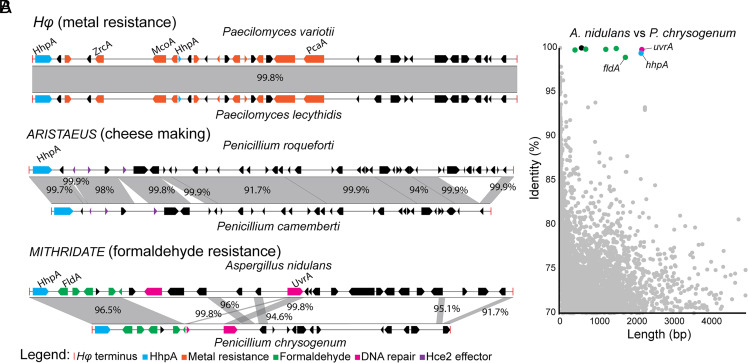
HEPHAESTUS-family Starships have transferred diverse host-beneficial cargo between fungal species. (A) Three examples of HGT events putatively driven by -family elements. HGT events involving metal resistance genes, including the original P. variotii Starship, were previously described. ARISTAEUS is a previously identified HGT event between cheese-making fungi now annotated as an element. MITHRIDATE in A. nidulans strain SP-2605-48 contains an -family Starship featuring genes putatively involved in formaldehyde resistance and DNA repair. (B) Many of the genes within MITHRIDATE show a strong HGT signal with a similar element in P. chrysogenum as assessed using BLAST all vs. all comparison of the two genomes.
Fig. 6.
Fig. 6.
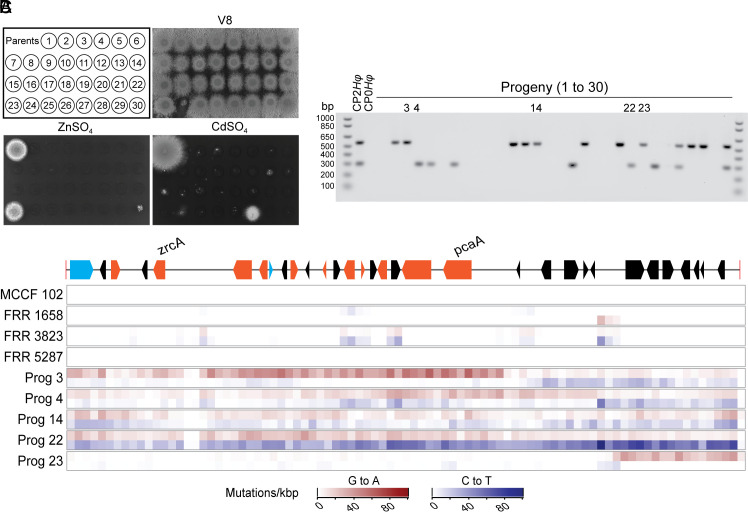
Mobility within the P. variotii genome leaves HEPHAESTUS vulnerable to destruction via repeat-induced point mutation. (A) Metal ion sensitivity phenotypes of parents and the progeny when crossed. (B) Despite showing sensitivity to zinc and cadmium, PCR analysis showed that 19 of the 30 progenies had inherited a copy of the region. (C) Multiple sequence alignment of elements in wild type or progeny showing a high frequency of transversion mutations indicative of RIP. The positions of the zrcA and pcaA genes that confer resistance to zinc or cadmium ions, respectively, are indicated.

Similar articles

Cited by

References

    1. Hawksworth D. L., Lücking R., Fungal diversity revisited: 2.2 to 3.8 million species. Microbiol. Spectr. 5, FUNK-0052-2016 (2017). - PMC - PubMed
    1. Cantrell S. A., Dianese J. C., Fell J., Gunde-Cimerman N., Zalar P., Unusual fungal niches. Mycologia 103, 1161–1174 (2011). - PubMed
    1. Stajich J. E., Fungal genomes and insights into the evolution of the kingdom. Microbiol. Spectr. 5, 619–633 (2017). - PMC - PubMed
    1. Priest S. J., Yadav V., Heitman J., Advances in understanding the evolution of fungal genome architecture. F1000 Res. 9, 776 (2020). - PMC - PubMed
    1. Stukenbrock E. H., Croll D., The evolving fungal genome. Fungal. Biol. Rev. 28, 1–12 (2014).

Publication types

LinkOut - more resources