Health-Seeking Behavior Returning to Normalcy Overcoming COVID-19 Threat in Breast Cancer
- PMID: 37024095
- PMCID: PMC10582530
- DOI: 10.4143/crt.2023.364
Health-Seeking Behavior Returning to Normalcy Overcoming COVID-19 Threat in Breast Cancer
Abstract
Purpose: The coronavirus disease 2019 (COVID-19) outbreak has significantly impacted the diagnosis and treatment of breast cancer. Our study investigated the change in diagnosis and treatment of breast cancer with the progress of COVID-19 pandemic.
Materials and methods: The study group comprised 6,514 recently diagnosed breast cancer patients between January 1, 2019, and February 28, 2021. The patients were divided into two groups: pre-COVID-19 period (3,182; January 2019 to December 2019) and COVID-19 pandemic period (3,332; January 2020 to February 2021). Clinicopathological information related to the first treatment after breast cancer diagnosis was retrospectively collected and analyzed in the two groups.
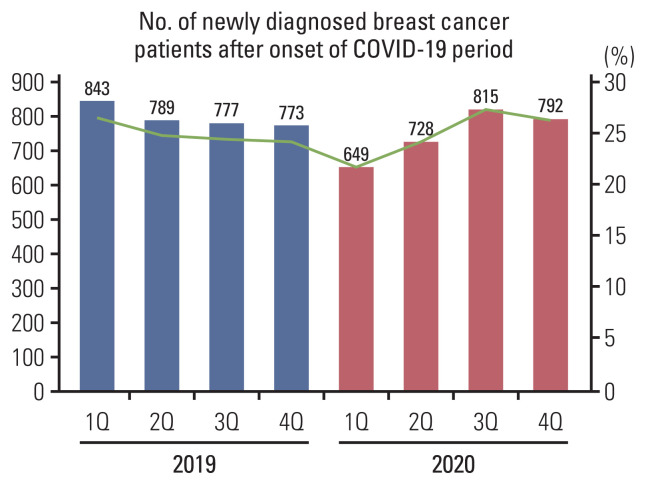
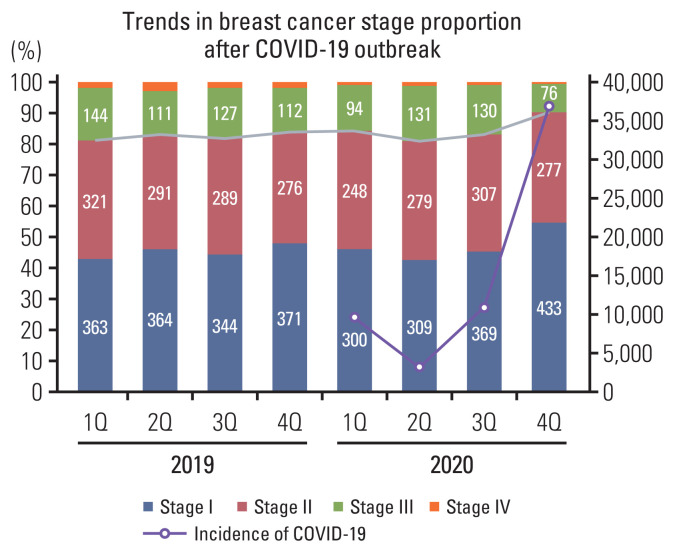
Results: Among the 6,514 breast cancer patients, 3,182 were in the pre-COVID-19 period and 3,332 were in the COVID-19 pandemic period. According to our evaluation, the least breast cancer diagnosis (21.8%) was seen in the first quarter of 2020. The diagnosis increased gradually except for the fourth quarter in 2020. While early-stage breast cancer was diagnosed 1,601 (48.1%) during the COVID-19 pandemic (p=0.001), the number of surgical treatments increased 4.6% (p < 0.001), and the treatment time was slightly shorter 2 days (p=0.001). The breast cancer subtype distribution was not statistically different between the pre-COVID-19 and COVID-19 period groups.
Conclusion: In the early stages of the pandemic, the number of breast cancer cases temporarily decreased; however, they stabilized soon, and no significant differences could be identified in the diagnosis and treatment when compared to the period before the pandemic.
Keywords: Breast neoplasms; COVID-19; Diagnosis; Therapeutics.
Conflict of interest statement
Conflict of interest relevant to this article was not reported.
Figures
Similar articles
-
COVID-19 related change in breast cancer diagnosis, stage, treatment, and case volume: 2019-2021.Breast Cancer Res Treat. 2023 Nov;202(1):105-115. doi: 10.1007/s10549-023-06962-8. Epub 2023 Aug 16. Breast Cancer Res Treat. 2023. PMID: 37584882 Free PMC article.
-
Impact of the COVID-19 Pandemic on Histopathological Diagnosis of Breast Tumours in Calabar, Nigeria.Niger J Physiol Sci. 2023 Jun 30;38(1):23-28. doi: 10.54548/njps.v38i1.5. Niger J Physiol Sci. 2023. PMID: 38243356
-
COVID-19 Pandemic Effects on Breast Cancer Diagnosis in Croatia: A Population- and Registry-Based Study.Oncologist. 2021 Jul;26(7):e1156-e1160. doi: 10.1002/onco.13791. Epub 2021 Apr 28. Oncologist. 2021. PMID: 33856084 Free PMC article.
-
Decrease in gynecological cancer diagnoses during the COVID-19 pandemic: an Austrian perspective.Int J Gynecol Cancer. 2020 Nov;30(11):1667-1671. doi: 10.1136/ijgc-2020-001975. Epub 2020 Oct 8. Int J Gynecol Cancer. 2020. PMID: 33033166 Free PMC article.
-
SEOM-GEICAM-SOLTI clinical guidelines for early-stage breast cancer (2022).Clin Transl Oncol. 2023 Sep;25(9):2647-2664. doi: 10.1007/s12094-023-03215-4. Epub 2023 Jun 16. Clin Transl Oncol. 2023. PMID: 37326826 Free PMC article.
References
-
- Emanuel EJ, Persad G, Upshur R, Thome B, Parker M, Glickman A, et al. Fair allocation of scarce medical resources in the time of COVID-19. N Engl J Med. 2020;382:2049–55. - PubMed
-
- De Vincentiis L, Carr RA, Mariani MP, Ferrara G. Cancer diagnostic rates during the 2020 ‘lockdown’, due to COVID-19 pandemic, compared with the 2018–2019: an audit study from cellular pathology. J Clin Pathol. 2021;74:187–9. - PubMed
MeSH terms
Grants and funding
LinkOut - more resources
Full Text Sources
Medical