Review
. 2023 Sep;75(5):854-884.
doi: 10.1124/pharmrev.121.000302. Epub 2023 Apr 7.

β-Arrestins: Structure, Function, Physiology, and Pharmacological Perspectives

Affiliations
Review

β-Arrestins: Structure, Function, Physiology, and Pharmacological Perspectives

Jürgen Wess et al. Pharmacol Rev. 2023 Sep.

Abstract

The two β-arrestins, β-arrestin-1 and -2 (systematic names: arrestin-2 and -3, respectively), are multifunctional intracellular proteins that regulate the activity of a very large number of cellular signaling pathways and physiologic functions. The two proteins were discovered for their ability to disrupt signaling via G protein-coupled receptors (GPCRs) via binding to the activated receptors. However, it is now well recognized that both β-arrestins can also act as direct modulators of numerous cellular processes via either GPCR-dependent or -independent mechanisms. Recent structural, biophysical, and biochemical studies have provided novel insights into how β-arrestins bind to activated GPCRs and downstream effector proteins. Studies with β-arrestin mutant mice have identified numerous physiologic and pathophysiological processes regulated by β-arrestin-1 and/or -2. Following a short summary of recent structural studies, this review primarily focuses on β-arrestin-regulated physiologic functions, with particular focus on the central nervous system and the roles of β-arrestins in carcinogenesis and key metabolic processes including the maintenance of glucose and energy homeostasis. This review also highlights potential therapeutic implications of these studies and discusses strategies that could prove useful for targeting specific β-arrestin-regulated signaling pathways for therapeutic purposes. SIGNIFICANCE STATEMENT: The two β-arrestins, structurally closely related intracellular proteins that are evolutionarily highly conserved, have emerged as multifunctional proteins able to regulate a vast array of cellular and physiological functions. The outcome of studies with β-arrestin mutant mice and cultured cells, complemented by novel insights into β-arrestin structure and function, should pave the way for the development of novel classes of therapeutically useful drugs capable of regulating specific β-arrestin functions.


Figures

Fig. 1
Fig. 1
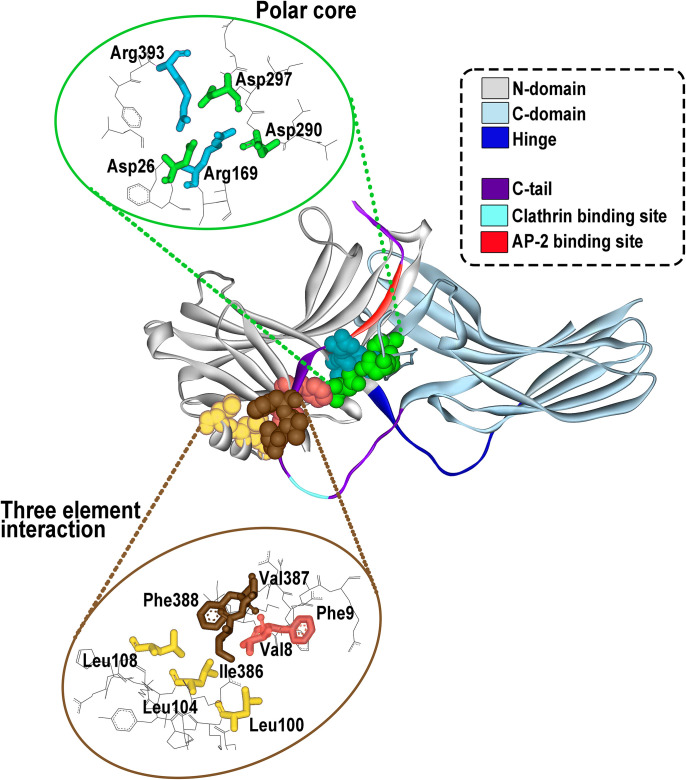
Arrestin structure and important functional elements. All arrestins consist of the N-domain (gray), the C-domain (blue-gray), and the C-terminus (C-tail, magenta) that emerges from the C-domain and is anchored to the N-domain via the so-called three-element interaction and the polar core (side chains participating in these two interactions are shown as CPK models on the structure; their spatial arrangement is shown in the insets). The N- and C-domains are connected by a 12-residue hinge region (dark blue). The C-terminus contains binding sites for clathrin (light blue) and clathrin adaptor AP2 (red). The basal arrestin conformation is stabilized by two intramolecular interactions. One is the polar core, an arrangement of five charged side chains, two of which are supplied by the N-domain, two by the C-domain, and one by the C-terminus (upper inset). The other one is the three-element interaction mediated by hydrophobic side chains of β-strand I and α-helix I of the N-domain and β-strand XX of the C-terminus (lower inset). Both of these interactions are destabilized by GPCR binding, which results in the release of the C-terminus and twisting of the two domains relative to each other by approximately 20°.
Fig. 2
Fig. 2
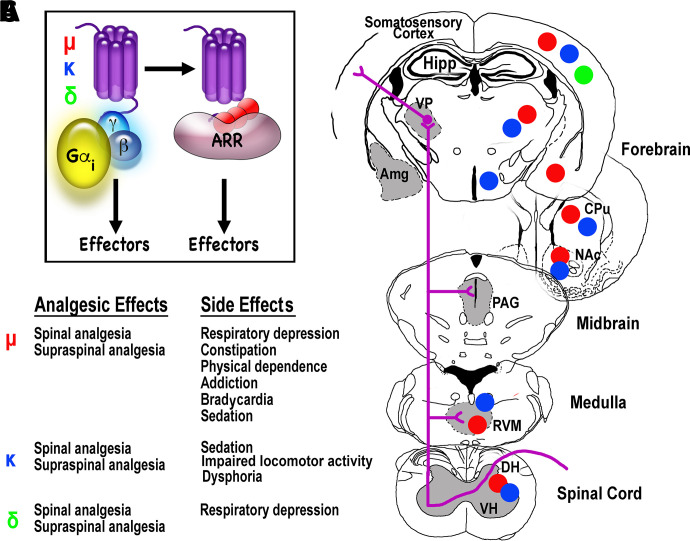
Opioid receptor subtypes: signal transduction, agonist effects, and localization. (A) The three opioid receptor subtypes (μ, κ, and δ) are G protein-coupled receptors that primarily couple to the Gi/o subfamily of G proteins. The ligand-activated receptors are phosphorylated by G protein-coupled receptor kinases, resulting in the recruitment of β-arrestins (ARR), followed by receptor desensitization and/or internalization, and, most likely, β-arrestin-dependent modulation of intracellular signaling. (B) The analgesic effects of μ, κ, and δ opioid receptor agonists are usually accompanied by a series of side effects. The potential involvement of β-arrestin-dependent signaling in mediating these side effects is currently a hotly debated issue (Gurevich and Gurevich, 2020). (C) A simplified diagram of the ascending pain pathway (for details see De Ridder et al., 2021; Wang et al., 2022a) showing the brain regions with the highest expression levels of the three opioid receptor subtypes (red circles, μ; blue, κ; green, δ). Although the striatum (CPu and NAc) is technically not part of the pain pathway, this brain region expresses high levels of μ and κ receptors. Amg, amygdala; CPu, caudate-putamen; DH, dorsal horn of the spinal cord; Hipp, hippocampus; NAc, nucleus accumbens; PAG, periaqueductal gray; RVM, rostroventral medulla; VH, ventral horn of the spinal cord; VP, ventral posterior nucleus of the thalamus.
Fig. 3
Fig. 3
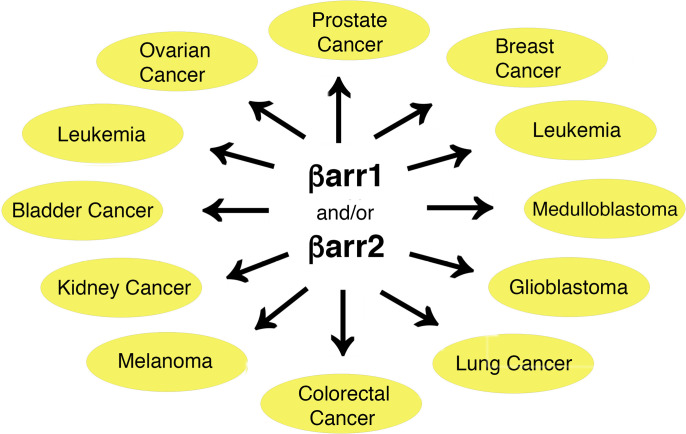
β-arrestins play important roles in regulating carcinogenic processes. The cancer types shown in this figure are briefly discussed in the text. In most but not all cases, β-arrestins contribute to tumor formation by stimulating processes that promote cell proliferation. See text for details.
Fig. 4
Fig. 4
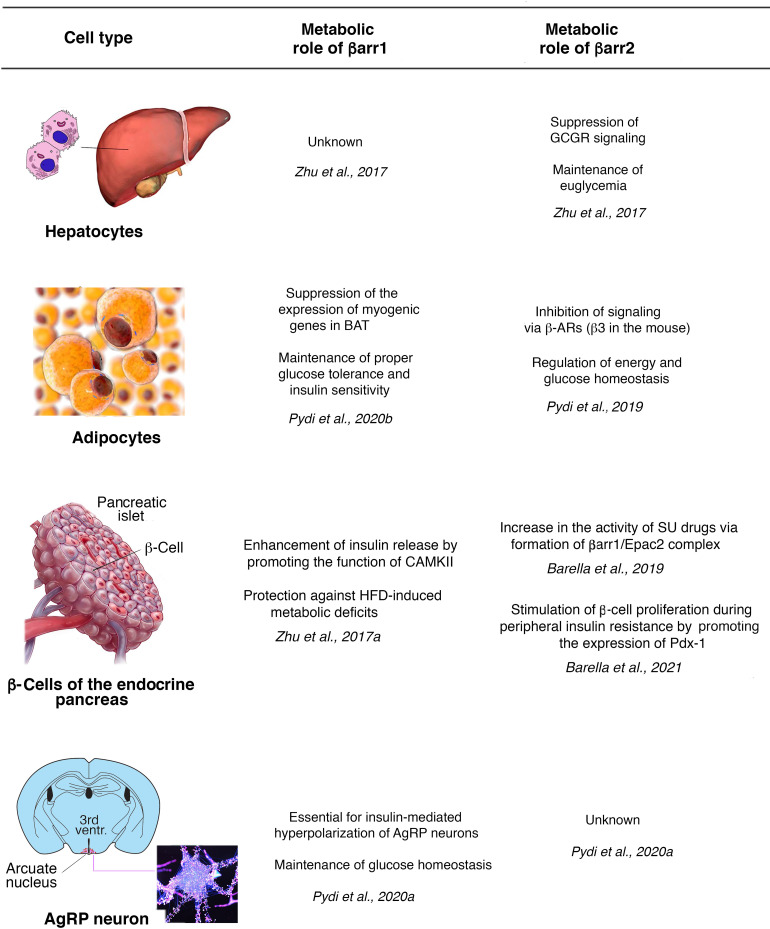
Metabolic roles of βarr1 and βarr2 in metabolically important cell types. The overview given in this figure is based on data obtained with mutant mice selective lacking or overexpressing either of the two β-arrestins in hepatocytes, adipocytes, pancreatic β-cells, or AgRP neurons of the arcuate nucleus of the hypothalamus (Pydi et al., 2022).

References

    1. Aamna B, Kumar Dan A, Sahu R, Behera SK, Parida S (2022) Deciphering the signaling mechanisms of β-arrestin1 and β-arrestin2 in regulation of cancer cell cycle and metastasis. J Cell Physiol 237:3717–3733. - PubMed
    1. Abdel-Wahab OI, Levine RL (2009) Primary myelofibrosis: Update on definition, pathogenesis, and treatment. Annu Rev Med 60:233–245. - PubMed
    1. Aguayo-Mazzucato C, Bonner-Weir S (2018) Pancreatic β cell regeneration as a possible therapy for diabetes. Cell Metab 27:57–67. - PMC - PubMed
    1. Ahmed MR, Zhan X, Song X, Kook S, Gurevich VV, Gurevich EV (2011) Ubiquitin ligase parkin promotes Mdm2-arrestin interaction but inhibits arrestin ubiquitination. Biochemistry 50:3749–3763. - PMC - PubMed
    1. Alekhina O, Marchese A (2016) β-Arrestin1 and signal-transducing adaptor molecule 1 (STAM1) cooperate to promote focal adhesion kinase autophosphorylation and chemotaxis via the chemokine receptor CXCR4. J Biol Chem 291:26083–26097. - PMC - PubMed

Publication types

LinkOut - more resources