


Gabapentin is Associated With Decreased Postoperative Opioid Use and Length of Stay After Appendectomy in Children With Perforated Appendicitis: A Propensity Score-Matched Analysis
- PMID: 37029026
- PMCID: PMC10771856
- DOI: 10.1016/j.jpedsurg.2023.03.009
Gabapentin is Associated With Decreased Postoperative Opioid Use and Length of Stay After Appendectomy in Children With Perforated Appendicitis: A Propensity Score-Matched Analysis
Abstract
Background: Gabapentin is increasingly used as an off-label, opioid-sparing pain medication in children. We investigated perioperative gabapentin administration and postoperative opioid use in children who underwent appendectomy for perforated appendicitis.
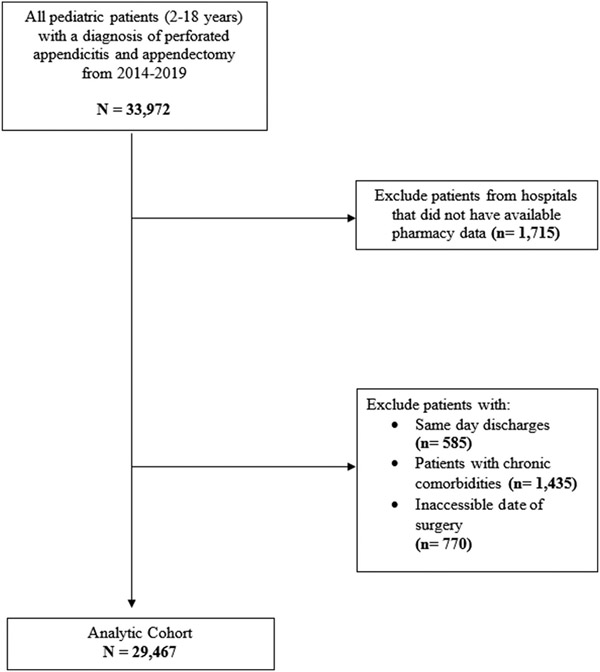
Methods: A retrospective cohort study of healthy children ages 2-18 years undergoing appendectomy for perforated appendicitis from 2014 to 2019 was performed using the Pediatric Health Information System®. Propensity score matched (PSM) analysis was conducted with 1:1 matching based on patient and hospital characteristics. Multivariable linear regression analysis was used to evaluate an association between gabapentin, postoperative opioid use, and postoperative length of stay.
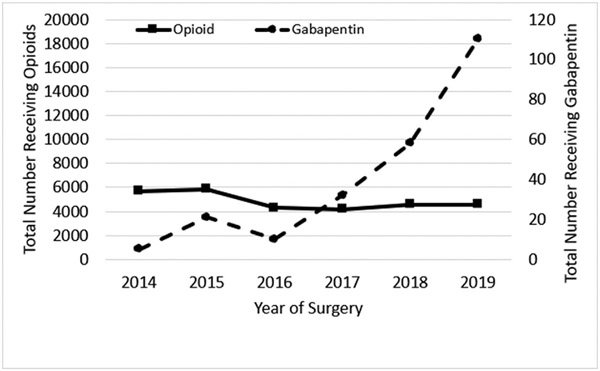
Results: Of 29,467 children with perforated appendicitis who underwent appendectomy, 236 (0.8%) received gabapentin. In 2014, <10 children received gabapentin, but by 2019, 110 children received gabapentin. On univariate analysis of the PSM cohort, children receiving gabapentin had decreased total postoperative opiate use (2.3 SD ± 2.3 versus 3.0 SD ± 2.5 days, p < 0.001). On adjusted analysis, children receiving gabapentin had 0.65 fewer days of postoperative total opioid use (95% CI: -1.09, -0.21) and spent 0.69 fewer days in the hospital after surgery (95% CI: -1.30, -0.08).
Conclusion: While overall use is infrequent, gabapentin is increasingly administered to children with perforated appendicitis who undergo an appendectomy and is associated with decreased postoperative opioid use and reduced postoperative length of stay. Multimodal pain management strategies incorporating gabapentin may reduce postoperative opioid consumption, but further studies of drug safety are needed for this off-label use in children undergoing surgery.
Level of evidence: III.
Keywords: Appendicitis; Gabapentin; Multimodal pain management; Opioid; Postoperative pain.
Copyright © 2023 Elsevier Inc. All rights reserved.
Conflict of interest statement
Declaration of competing interest None.
Figures
References
-
- Rove KO, Brockel MA, Saltzman AF, Donmez MI, Brodie KE, Chalmers DJ, et al. Prospective study of enhanced recovery after surgery protocol in children undergoing reconstructive operations. J Pediatr Urol 2018;14(3):252 e1–e9. - PubMed
-
- Saltzman AF, Warncke JC, Colvin AN, Carrasco A Jr, Roach JP, Bruny JL, et al. Development of a postoperative care pathway for children with renal tumors. J Pediatr Urol 2018;14(4):326 e1–e6. - PubMed
-
- Bennett MI, Simpson KH. Gabapentin in the treatment of neuropathic pain. Palliat Med 2004;18(1):5–11. - PubMed
MeSH terms
Substances
Grants and funding
LinkOut - more resources
Full Text Sources
Medical
Research Materials
Miscellaneous
