


Mites inhabiting nests of wood warbler, Phylloscopus sibilatrix (Aves: Passeriformes), in the Wielkopolska National Park in western Poland
- PMID: 37029286
- PMCID: PMC10167128
- DOI: 10.1007/s10493-023-00792-5
Mites inhabiting nests of wood warbler, Phylloscopus sibilatrix (Aves: Passeriformes), in the Wielkopolska National Park in western Poland
Abstract
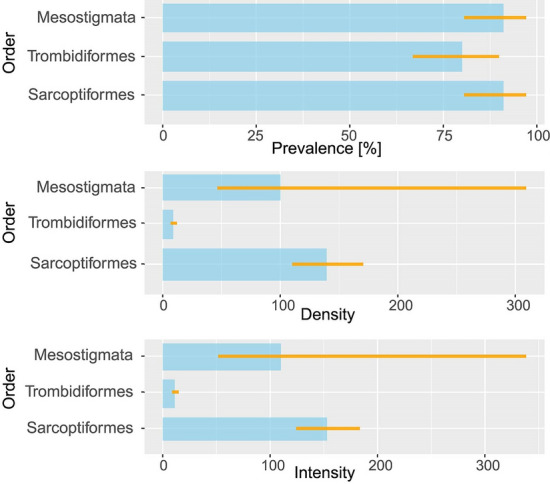
The wood warbler, Phylloscopus sibilatrix (Aves: Passeriformes), is a well-known model organism for studying bird migration, breeding habitat selection and nest predation. The nest acarofauna of this bird species has not been extensively studied so far. To provide a comprehensive report on mite species inhabiting wood warbler nests and to assess infestation parameters (prevalence, intensity, and abundance) for mite species and orders, we collected 45 nests of this bird species in the Wielkopolska National Park in western Poland. Analyses revealed a huge diversity (198 species) of mites inhabiting wood warbler nests. We found individuals belonging to the Mesostigmata, Trombidiformes and Sarcoptiformes. The Trombidiformes, represented in our study only by the Prostigmata, achieved statistically significantly lower intensity and abundance, compared to representatives of other orders. However, the number of recorded prostigmatid species was high (65). The most common were: Stigmaeus sphagneti (22 nests), Stigmaeus longipilis (16), Eupodes voxencollinus (15), Cunaxa setirostris (14), Stigmaeus pilatus (11), and Linopodes sp. 2 (10). The prevalence of Mesostigmata and Sarcoptiformes was equal, reaching 91.1%. Most of Gamasina (Mesostigmata) species found in this study were more characteristic of the soil environment and forest litter than bird nests, but there was also a typical bird parasite, viz. Ornithonyssus sylviarum. None of the observed species of Uropodina (Mesostigmata) or Oribatida (Sarcoptiformes) was typical for bird nests. Among the Uropodina, the highest parameters of nest infestation were achieved by Oodinychus ovalis, whereas among the Oribatida, they were achieved by Metabelba pulverosa. We discuss the importance of wood warbler nests for mite dispersal, survival and reproduction.
Keywords: Infestation; Mesostigmata; Prevalence; Sarcoptiformes; Trombidiformes; Wood warbler nests.
© 2023. The Author(s).
Conflict of interest statement
The authors declare that they have no conflicts of interest that are relevant to the content of this article.
Figures
References
-
- Ambros M, Krištofík J, Šustek Z. The mites (Acari, Mesostigmata) in the birds’ nests in Slovakia. Biológia. 1992;47:369–381.
-
- Bedano JC, Cantú MP, Doucet ME. Abundance of soil mites (Arachnida: Acari) in a natural soil of central Argentina. Zool Stud. 2005;44(4):505–512.
-
- Bellamy PE, Burgess MD, Mallord JW, Cristinacce A, Orsman CJ, Davis T, Grice PV, Charman EC. Nest predation and the influence of habitat structure on nest predation of Wood Warbler Phylloscopus sibilatrix, a ground-nesting forest passerine. J Ornithol. 2018;159:493–506. doi: 10.1007/s10336-017-1527-7. - DOI
-
- Błoszyk J (1999) Geograficzne i ekologiczne zróżnicowanie zgrupowań roztoczy z kohorty Uropodina (Acari: Mesostigmata) w Polsce. I. Uropodina lasów grądowych (Carpinion betuli). Dissertation, Adam Mickiewicz University, Poznań
-
- Błoszyk J, Olszanowski Z. Materiały do znajomości roztoczy gniazd i budek lęgowych ptaków. I: Uropodina i Nothroidea (Acari: Mesostigmata i Oribatida) Prz Zool. 1985;29:69–74.
MeSH terms
Grants and funding
LinkOut - more resources
Full Text Sources
