Specific causes of excess late mortality and association with modifiable risk factors among survivors of childhood cancer: a report from the Childhood Cancer Survivor Study cohort
- PMID: 37030315
- PMCID: PMC10149583
- DOI: 10.1016/S0140-6736(22)02471-0
Specific causes of excess late mortality and association with modifiable risk factors among survivors of childhood cancer: a report from the Childhood Cancer Survivor Study cohort
Abstract
Background: 5-year survival after childhood cancer does not fully describe life-years lost due to childhood cancer because there are a large number of deaths occurring beyond 5-years (late mortality) related to cancer and cancer treatment. Specific causes of health-related (non-recurrence, non-external) late mortality and risk reduction through modifiable lifestyle and cardiovascular risk factors are not well described. Through using a well-characterised cohort of 5-year survivors of the most common childhood cancers, we evaluated specific health-related causes of late mortality and excess deaths compared with the general US population and identified targets to reduce future risk.
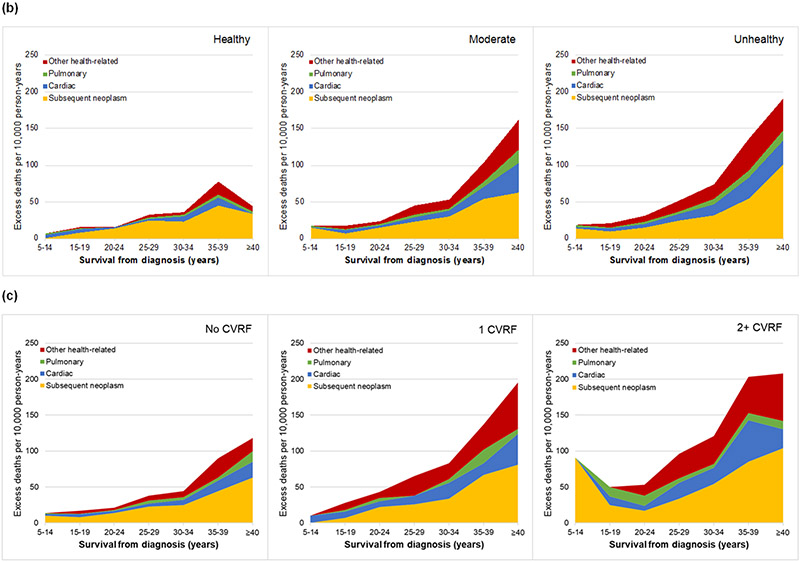
Methods: In this multi-institutional, hospital-based, retrospective cohort study, late mortality (death ≥5 years from diagnosis) and specific causes of death were evaluated in 34 230 5-year survivors of childhood cancer diagnosed at an age younger than 21 years from 1970 to 1999 at 31 institutions in the USA and Canada; median follow-up from diagnosis was 29 years (range 5-48) in the Childhood Cancer Survivor Study. Demographic, self-reported modifiable lifestyle (ie, smoking, alcohol, physical activity, and BMI) and cardiovascular risk factors (ie, hypertension, diabetes, and dyslipidaemia) associated with health-related mortality (which excludes death from primary cancer and external causes and includes death from late effects of cancer therapy) were evaluated.
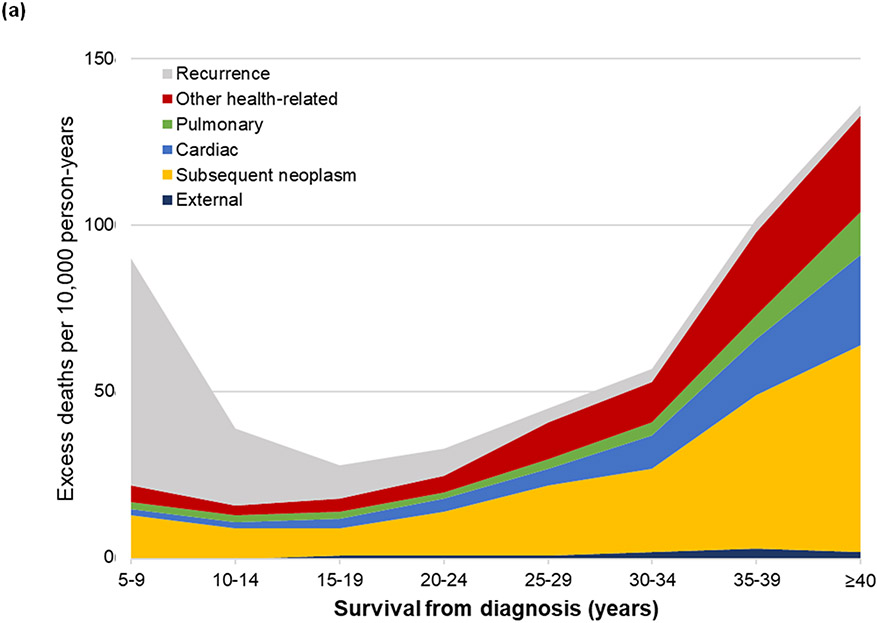
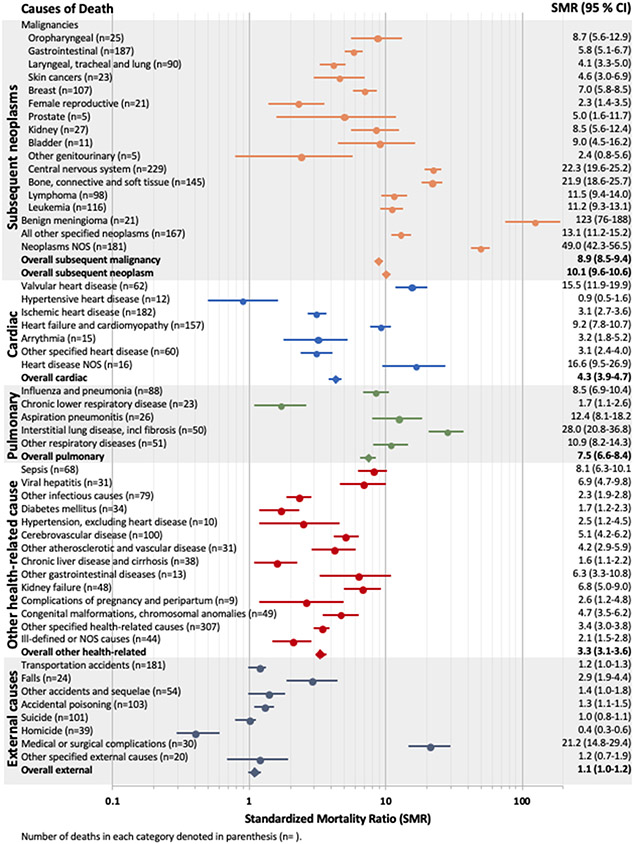
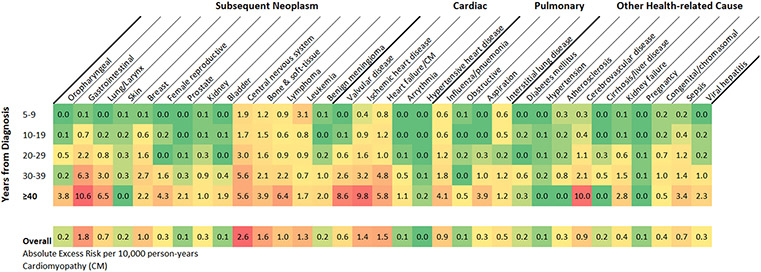
Findings: 40-year cumulative all-cause mortality was 23·3% (95% CI 22·7-24·0), with 3061 (51·2%) of 5916 deaths from health-related causes. Survivors 40 years or more from diagnosis experienced 131 excess health-related deaths per 10 000 person-years (95% CI 111-163), including those due to the top three causes of health-related death in the general population: cancer (absolute excess risk per 10 000 person-years 54, 95% CI 41-68), heart disease (27, 18-38), and cerebrovascular disease (10, 5-17). Healthy lifestyle and absence of hypertension and diabetes were each associated with a 20-30% reduction in health-related mortality independent of other factors (all p values ≤0·002).
Interpretation: Survivors of childhood cancer are at excess risk of late mortality even 40 years from diagnosis, due to many of the leading causes of death in the US population. Modifiable lifestyle and cardiovascular risk factors associated with reduced risk for late mortality should be part of future interventions.
Funding: US National Cancer Institute and the American Lebanese Syrian Associated Charities.
Copyright © 2023 Elsevier Ltd. All rights reserved.
Conflict of interest statement
Declaration of interests We declare no competing interests.
Figures
Comment in
-
Childhood cancer survivors: healthy behaviours and late mortality.Lancet. 2023 Apr 29;401(10386):1403-1405. doi: 10.1016/S0140-6736(22)02632-0. Epub 2023 Apr 5. Lancet. 2023. PMID: 37030313 No abstract available.
References
-
- Howlader N NA, Krapcho M, Miller D, Brest A, Yu M, Ruhl J, Tatalovich Z, Mariotto A, Lewis DR, Chen HS, Feuer EJ, Cronin KA (eds). SEER Cancer Statistics Review, 1975-2018. Bethesda, MD: National Cancer Institute; 2021.
-
- Oeffinger KC, Mertens AC, Sklar CA, et al. Chronic health conditions in adult survivors of childhood cancer. N Engl J Med 2006;355:1572–82. - PubMed
Publication types
MeSH terms
Grants and funding
LinkOut - more resources
Full Text Sources
Medical