. 2023 Apr 8;14(1):1983.
doi: 10.1038/s41467-023-37672-w.

The evolution and international spread of extensively drug resistant Shigella sonnei

Affiliations

The evolution and international spread of extensively drug resistant Shigella sonnei

Lewis C E Mason et al. Nat Commun. .

Erratum in

  • Author Correction: The evolution and international spread of extensively drug resistant Shigella sonnei.
    Mason LCE, Greig DR, Cowley LA, Partridge SR, Martinez E, Blackwell GA, Chong CE, De Silva PM, Bengtsson RJ, Draper JL, Ginn AN, Sandaradura I, Sim EM, Iredell JR, Sintchenko V, Ingle DJ, Howden BP, Lefèvre S, Njamkepo E, Weill FX, Ceyssens PJ, Jenkins C, Baker KS. Mason LCE, et al. Nat Commun. 2023 Apr 21;14(1):2302. doi: 10.1038/s41467-023-38041-3. Nat Commun. 2023. PMID: 37085572 Free PMC article. No abstract available.

Abstract

Shigella sonnei causes shigellosis, a severe gastrointestinal illness that is sexually transmissible among men who have sex with men (MSM). Multidrug resistance in S. sonnei is common including against World Health Organisation recommended treatment options, azithromycin, and ciprofloxacin. Recently, an MSM-associated outbreak of extended-spectrum β-lactamase producing, extensively drug resistant S. sonnei was reported in the United Kingdom. Here, we aimed to identify the genetic basis, evolutionary history, and international dissemination of the outbreak strain. Our genomic epidemiological analyses of 3,304 isolates from the United Kingdom, Australia, Belgium, France, and the United States of America revealed an internationally connected outbreak with a most recent common ancestor in 2018 carrying a low-fitness cost resistance plasmid, previously observed in travel associated sublineages of S. flexneri. Our results highlight the persistent threat of horizontally transmitted antimicrobial resistance and the value of continuing to work towards early and open international sharing of genomic surveillance data.


Conflict of interest statement

The authors declare no competing interests.

Figures
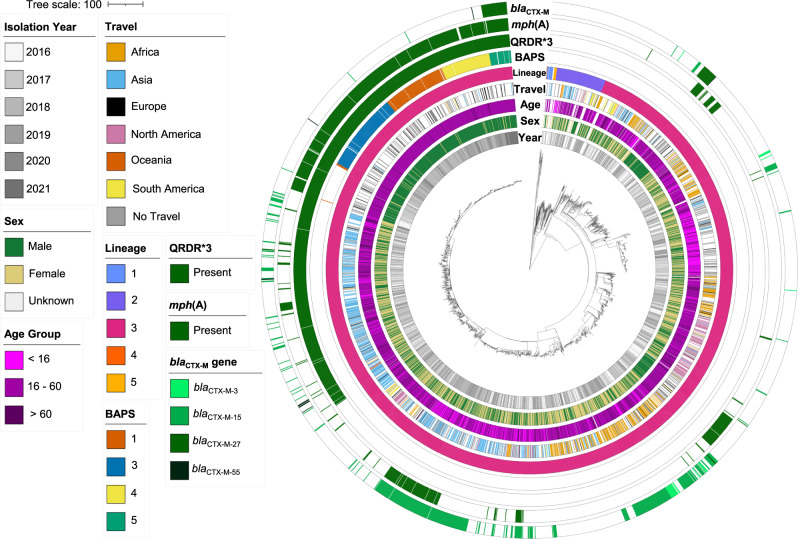
Fig. 1
Fig. 1. The emergence of an XDR S. sonnei outbreak in the United Kingdom.
A cgMLST dendrogram (midpoint rooted) of clinical isolates from the UK (n = 2,820) and genomic subtype references (n = 120) with the scale bar indicating distance in cgMLST alleles. Metadata tracks show patient and genomic features for isolates coloured according to the inlaid keys. Specifically, from inner to outer, the patient data comprises: year of isolation, patient sex, age group, and travel history (for UK isolates only), with missing/unavailable/not determined data shown as white. Genomic features then show: isolate lineage, BAPS clusters (for isolates belonging to the t10.377 cluster only), and the presence of mutations in the Quinolone Resistance Determining Region (QRDR*3 denotes all three canonical mutations; gyrA_D87G, gyrA_S83L and parC_S80I) and mph(A), and blaCTX-M genes, where white indicates absence of the gene.
Fig. 2
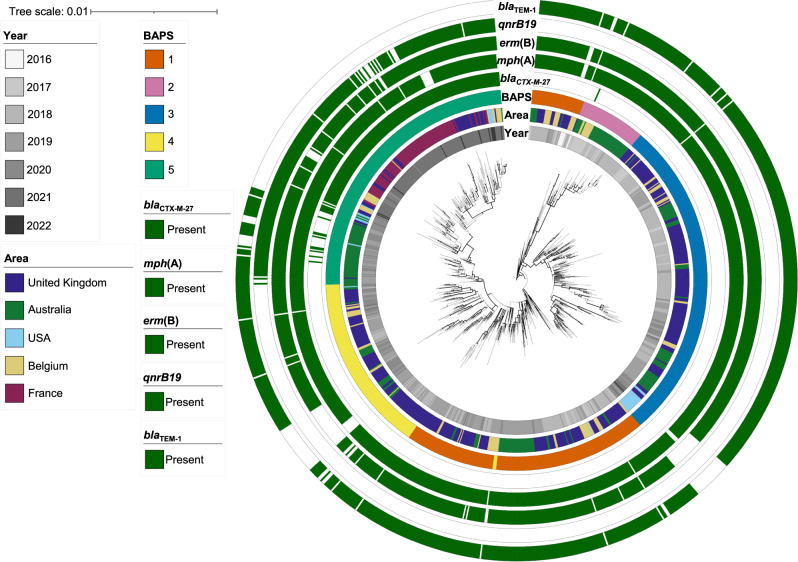
Fig. 2. The evolution and international spread of MSM-associated XDR S. sonnei.
A midpoint rooted maximum likelihood phylogenetic tree shows the distribution of UK isolates (belonging to both CipR.MSM5 and the t10.377 outbreak cluster, n = 468) and relevant related international isolates belonging to CipR.MSM5 (Supplementary Fig. 1, n = 475). Metadata tracks show year and country (area) of isolation, BAPS subtype, and the presence of selected AMR genes according to the inlaid keys. The scalebar is provided by IQTree, and represents expected number of substitutions per site across a 1717 bp alignment. Bold branches represent a bootstrap value of ≥ 70 out of 100.
Fig. 3
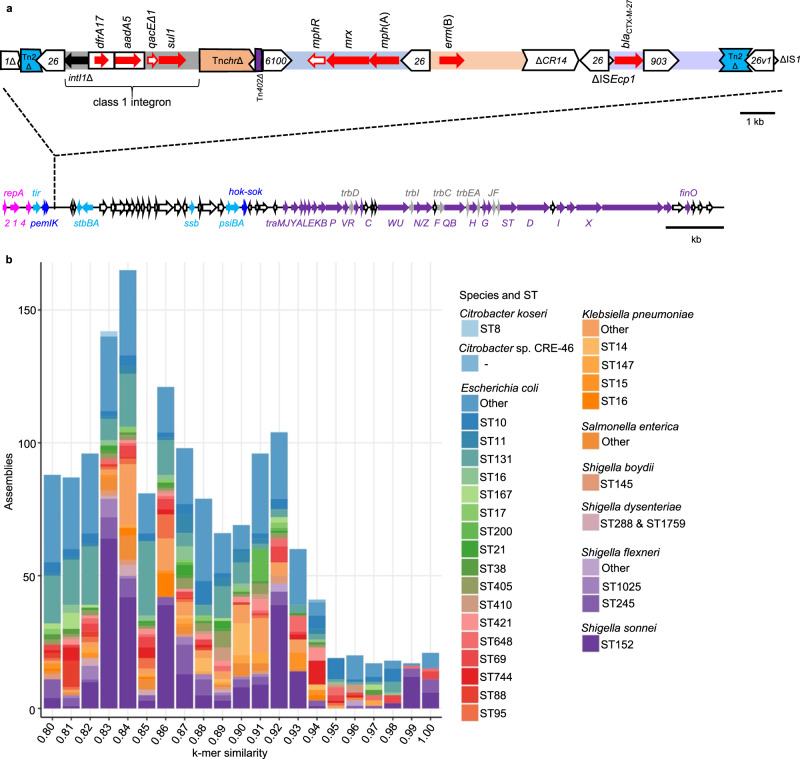
Fig. 3. Organisation and distribution of p893816-like plasmids.
a Organisation of p893816-like plasmids. The lengths and directions of transcription of various genes are shown as arrows. The upper track shows the resistance region. AMR genes indicated by solid red arrows, with resistance-related genes outlined in red. The boxes around dfrA17 and aadA5 represent the gene cassettes that carry these genes. Block arrows in white indicate various insertion sequences (IS), named/numbered as labelled, and the direction of their transposase gene. Fragments of different transposons (Tn) are shown as interrupted blocks in different colours (blue, purple, orange) and labelled by name, and a class 1 integron is also shown in grey and labelled. The lower track shows the plasmid backbone, with the AMR region insertion site indicated by dashed lines. Replication genes are in pink, conjugation genes in purple (tra) and grey (trb), toxin-antitoxin systems in blue, other genes encoding known plasmid functions in cyan and genes encoding hypothetical proteins in white. b The distribution of p893816-like plasmids. Number of draft genome assemblies in the 661 K COBS data structure showing k-mer similarity (≥0.80) to p893916, coloured by species and sequence type according to the inlaid keys. ST that are represented 10 or more times are named, while rare sequence types are collapsed into the category of ‘other’ within the respective species.
Fig. 4
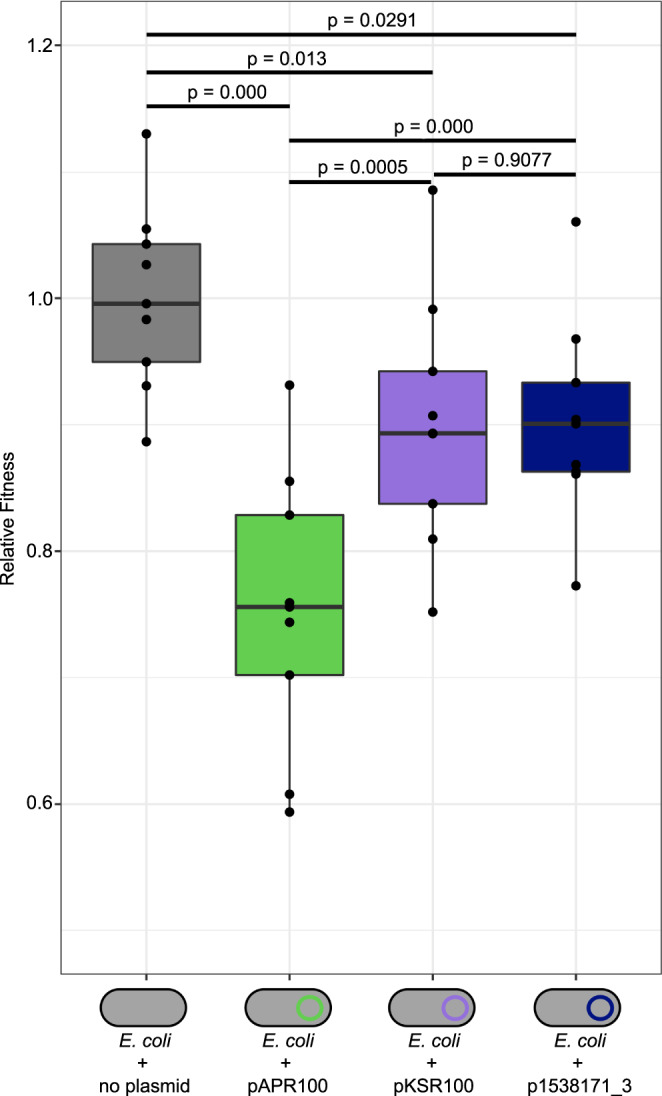
Fig. 4. Relative fitness of different Shigella MDR plasmids in E. coli.
Relative fitness of E. coli MG1655 carrying a previously characterised azithromycin resistance plasmid (pAPR100, green; pKSR100, purple), or p1538171_3 (navy) compared with a plasmid-free strain (grey). Each dataset is represented by a box and whisker plot indicating maximum and minimum values (upper and lower limits, respectively), and interquartile ranges (25th to 75th percentiles) of the original data, overlaid with black dots, indicating individual data points. The centre emboldened line on each box represents the median value. The results of pairwise statistical comparisons are shown above and with two-tailed p-values (two sample t-tests) indicated above black lines joining the pair comparators. The sample size for statistical purposes is n = 3 biologically independent samples (see methods).

References

    1. Kotloff KL, Riddle MS, Platts-Mills JA, Pavlinac P, Zaidi AKM. Shigellosis. Lancet. 2018;391:801–812. doi: 10.1016/S0140-6736(17)33296-8. - DOI - PubMed
    1. Baker S, The HC. Recent insights into Shigella. Curr. Opin. Infect. Dis. 2018;31:449–454. doi: 10.1097/QCO.0000000000000475. - DOI - PMC - PubMed
    1. Khalil I, Troeger CE, Blacker BF, Reiner RC. Capturing the true burden of Shigella and ETEC: The way forward. Vaccine. 2019;37:4784–4786. doi: 10.1016/j.vaccine.2019.01.031. - DOI - PubMed
    1. Warren BR, Parish ME, Schneider KR. Shigella as a foodborne pathogen and current methods for detection in food. Crit. Rev. Food Sci. Nutr. 2006;46:551–567. doi: 10.1080/10408390500295458. - DOI - PubMed
    1. He F, et al. Shigellosis outbreak associated with contaminated well water in a rural elementary school: Sichuan Province, China, June 7-16, 2009. PLoS ONE. 2012;7:e47239. doi: 10.1371/journal.pone.0047239. - DOI - PMC - PubMed

Publication types

Substances