


Active epilepsy prevalence among U.S. adults is 1.1% and differs by educational level-National Health Interview Survey, United States, 2021
- PMID: 37031584
- PMCID: PMC11034729
- DOI: 10.1016/j.yebeh.2023.109180
Active epilepsy prevalence among U.S. adults is 1.1% and differs by educational level-National Health Interview Survey, United States, 2021
Abstract
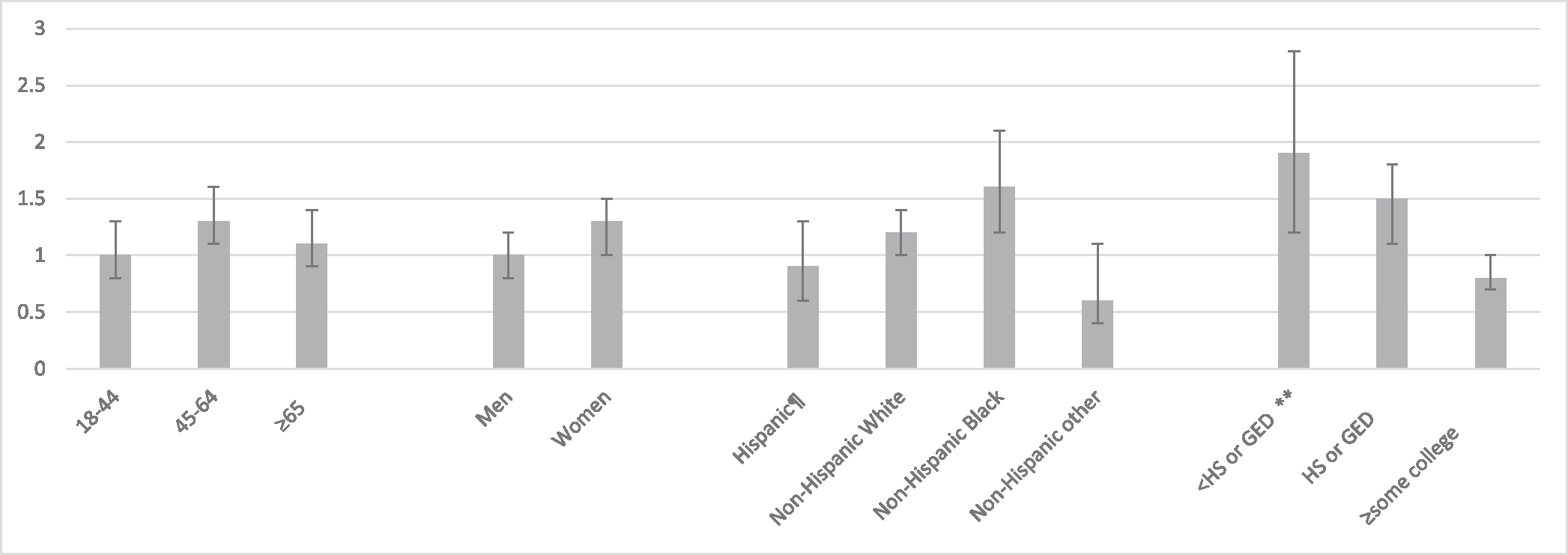
This study used the most recent national data from the 2021 National Health Interview Survey (NHIS) to provide updated estimates of the prevalence of active epilepsy (self-reported doctor-diagnosed epilepsy, currently under treatment with antiseizure medicines or had at least 1 seizure in the past 12 months, or both) and inactive epilepsy (self-reported doctor-diagnosed history of epilepsy, not under treatment with antiseizure medicines and with no seizures in the past 12 months) overall and by sex, age groups, race/ethnicity, education level, and health insurance status. In 2021, 1.1% of U.S. adults, (approximately 2,865,000 adults) reported active epilepsy; 0.6% (approximately 1,637,000 adults) reported inactive epilepsy. The prevalence of active epilepsy and inactive epilepsy did not differ by age or sex. Active and inactive epilepsy prevalence differed by educational level. Weighted population estimates are reported for each subgroup (e.g., women; non-Hispanic Blacks) for program or policy development. Although active epilepsy prevalence has remained relatively stable over the past decade, this study shows that more than half of U.S. adults with active epilepsy have ≤high school diploma/GED, which can inform the development and implementation of interventions. Additional monitoring is necessary to examine population trends in active prevalence overall and in subgroups.
Keywords: Education; Educational attainment; Epilepsy prevalence; National Health Interview Survey; Population survey.
Published by Elsevier Inc.
Conflict of interest statement
Declaration of Competing Interest The authors declare that they have no known competing financial interests or personal relationships that could have appeared to influence the work reported in this paper.
Figures
References
-
- Kobau R, Luo YH, Zack MM, Helmers S, Thurman DJ. Epilepsy in adults and access to care—United States, 2010. MMWR Morb Mortal Wkly Rep 2012;61:909–13. - PubMed
-
- Kobau R What have we learned from CDC-supported population surveillance and epidemiologic studies of epilepsy burden related to the IOM Epilepsy Across the Spectrum recommendations on surveillance. American Epilepsy Society Annual Conference; 2022. Dec 4; Nashville, TN.
Publication types
MeSH terms
Grants and funding
LinkOut - more resources
Full Text Sources
Medical
Miscellaneous
