


Study on the Relationship and Predictive Value of First-Trimester Pregnancy-Associated Plasma Protein-A, Maternal Factors, and Biochemical Parameters in Gestational Diabetes Mellitus: A Large Case-Control Study in Southern China Mothers
- PMID: 37033400
- PMCID: PMC10075321
- DOI: 10.2147/DMSO.S398530
Study on the Relationship and Predictive Value of First-Trimester Pregnancy-Associated Plasma Protein-A, Maternal Factors, and Biochemical Parameters in Gestational Diabetes Mellitus: A Large Case-Control Study in Southern China Mothers
Abstract
Objective: To investigate the relationship and predictive value of first-trimester pregnancy-associated plasma protein A (PAPP-A), maternal factors, and biochemical parameters with gestational diabetes mellitus (GDM) in southern China mothers.
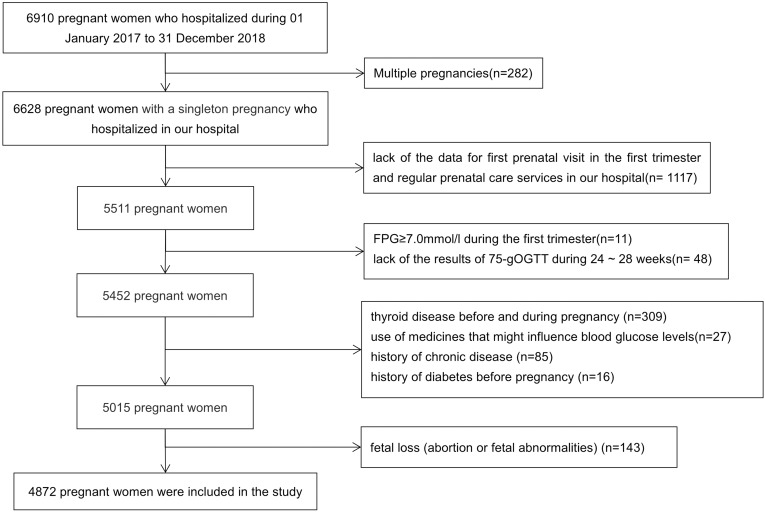
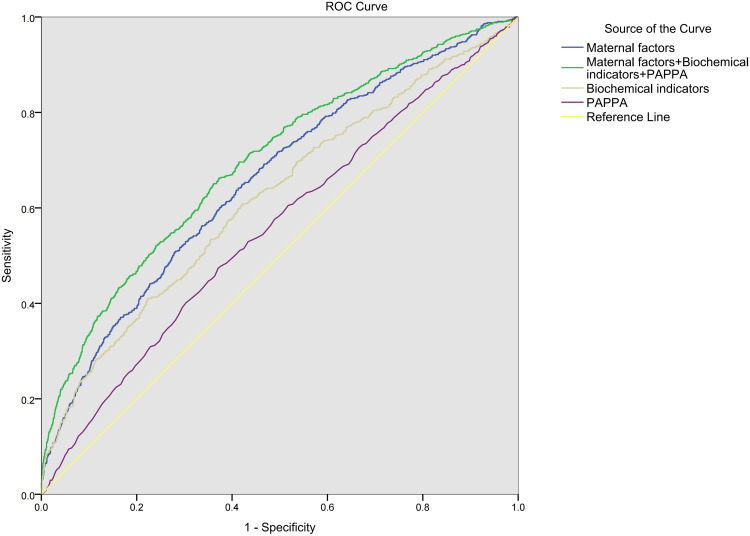
Methods: This study recruited 4872 pregnant women. PAPP-A, the free beta subunit of human chorionic gonadotropin (free β-HCG), fasting plasma glucose (FPG), total cholesterol (TC), triglycerides (TG), and high- and low-density lipoproteins (HDL, LDL) were measured at 11-13+ weeks of gestation. GDM was diagnosed based on a 75 g oral glucose tolerance test at 24-28 weeks of gestation. We performed stepwise logistic regression analysis to determine the odds ratio (OR) and the 95% confidence interval (CI) of GDM. We used Receiver Operating Characteristic (ROC) curves with the area under the curve (AUC) to evaluate the predictive value of PAPP-A, maternal factors, and biochemical markers. The significance of the differences between the AUC values was assessed using the DeLong test.
Results: GDM was diagnosed in 750 (15.39%) women. Independent factors for GDM were age, pre-gestational BMI, GWG before a diagnosis of GDM, previous history of GDM, family history of diabetes, FPG, TG, LDL, PAPP-A, and TC. The AUC of PAPP-A was 0.56 (95% CI 0.53-0.58). The AUC of a model based on combined maternal factors, biochemical markers, and PAPP-A was 0.70 (95% CI 0.68-0.72). Differences in AUC values between PAPP-A alone and the model based on combined maternal factors, biochemical markers, and PAPP-A were statistically significant (Z= 9.983, P<0.001).
Conclusion: A Low serum PAPP-A level in the first trimester is an independent risk factor for developing GDM later in pregnancy. However, it is not a good independent predictor although the predictive value of a low serum PAPP-A level increases when combined with maternal factors and biochemical markers.
Keywords: biochemical markers; gestational diabetes mellitus; maternal factors; predictive value; pregnancy-associated plasma protein-A.
© 2023 Cui et al.
Conflict of interest statement
The authors report that there are no conflicts of interest in this work.
Figures
References
-
- Hod M, Kapur A, Sacks DA, et al. The International Federation of Gynecology and Obstetrics (FIGO) Initiative on gestational diabetes mellitus: a pragmatic guide for diagnosis, management, and care. Int J Gynaecol Obstet. 2015;131(Suppl 3):S173–211. - PubMed
-
- ACOG Committee on Obstetric Practice. Practice bulletin ACOG. No. 190: gestational diabetes mellitus. Obstet Gynecol. 2018;131(2):e49–e64. - PubMed
-
- Zimmet P, Alberti KG, Magliano DJ, Bennett PH. Diabetes mellitus statistics on prevalence and mortality: facts and fallacies. Nat Rev Endocrinol. 2016;12(10):616–622. - PubMed
LinkOut - more resources
Full Text Sources
Miscellaneous
