


Inflammation and severity of depressive symptoms in physically active individuals after COVID-19 - An exploratory immunopsychological study investigating the effect of inflammation on depressive symptom severity
- PMID: 37033771
- PMCID: PMC10035808
- DOI: 10.1016/j.bbih.2023.100614
Inflammation and severity of depressive symptoms in physically active individuals after COVID-19 - An exploratory immunopsychological study investigating the effect of inflammation on depressive symptom severity
Abstract
Background: SARS-CoV-2 infection is a risk factor for the development of depressive symptoms such as lack of energy, loss of interest, and depressed mood. Inflammatory processes might underline this association. The aim of this study was to investigate the association between inflammatory markers and the severity of depression after SARS-CoV-2 infection and the predictive effect of inflammatory markers on the severity of depressive symptoms. Lifestyle factors and lifestyle-related diseases can influence inflammation and depressive symptoms. As these lifestyle factors and lifestyle-related diseases are less common in physically active individuals, they are a suitable population for investigating this research question.
Methods: We investigated 61 at least moderate physically active individuals on average ∼6 months (SD = 4.22, range = 0.5-19 months) after SARS-CoV-2 infection (t0) and performed a follow-up after 3 months (t1). Depressive symptoms and biomarkers of inflammation (interleukin [IL]-1β, IL-8, IL-10, Ferritin, Lipopolysaccharide-binding-protein [LBP], neutrophil-to-lymphocyte ratio [NLR], platelet-to-lymphocyte ratio [PLR], lymphocyte-to-monocyte ratio [LMR]) and kynurenine [KYN] were measured at both time points. Concentrations of inflammatory markers at t0 were used to predict the severity of depressive symptoms at t0 and t1.
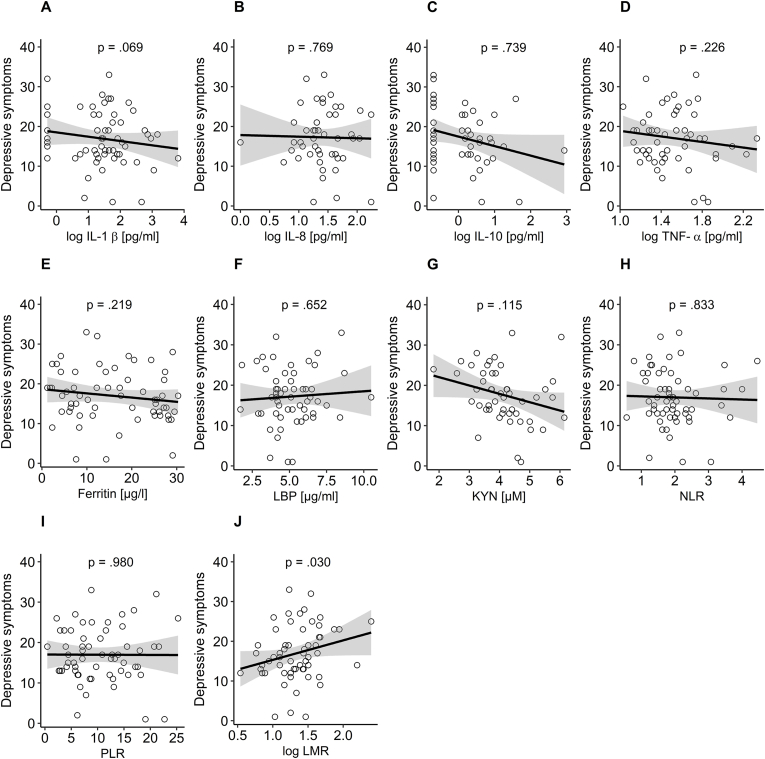
Results: Concentrations of KYN were negatively related to the severity of depressive symptoms at t0. Concentrations of LMR predicted higher depressive symptoms at t0 as well as at t1. Furthermore, individuals with lower concentrations of LBP at t0 showed a higher severity of depressive symptoms at t1. No correlation was found between severity of depressive symptoms and IL-1β, IL-8, IL-10, ferritin, NLR, and PLR at both time points.
Conclusions: KYN, LBP and LMR might be useful as a predictive factor of depressive symptoms in physically active individuals after SARS-CoV-2 infection. While the results for KYN confirm the current scientific evidence, our results highlight the importance of the innovative inflammatory markers LMR and LBP. LMR and LBP might be interesting targets for predicting the development of depressive symptoms in SARS-CoV-2 infected populations and should be further investigated in future studies.
Keywords: Cytokines; Depressiveness; Inflammatory cell ratios; Kynurenine; SARS-CoV-2.
© 2023 The Authors.
Conflict of interest statement
The authors declare that they have no known competing financial interests or personal relationships that could have appeared to influence the work reported in this paper.
Figures
References
-
- Al-Hakeim H.K., Al-Rubaye Haneen Tahseen, Al-Hadrawi Dhurgham Shihab, Almulla A.F., Maes M. 2022. Long-COVID Post-viral Chronic Fatigue Syndrome and Affective Symptoms Are Associated with Oxidative Damage, Lowered Antioxidant Defenses and Inflammation: A Proof of Concept and Mechanism Study. - DOI - PMC - PubMed
-
- Almulla A.F., Supasitthumrong T., Tunvirachaisakul C., Algon A.A.A., Al-Hakeim H.K., Maes M. The tryptophan catabolite or kynurenine pathway in COVID-19 and critical COVID-19: a systematic review and meta-analysis [Preprint] Infect. Dis. (except HIV/AIDS) 2022 doi: 10.1101/2022.02.01.22270268. - DOI - PMC - PubMed
-
- Alvarez-Mon M.A., Gómez A.M., Orozco A., Lahera G., Sosa M.D., Diaz D., Auba E., Albillos A., Monserrat J., Alvarez-Mon M. Abnormal distribution and function of circulating monocytes and enhanced bacterial translocation in major depressive disorder. Front. Psychiatr. 2019;10:812. doi: 10.3389/fpsyt.2019.00812. - DOI - PMC - PubMed
LinkOut - more resources
Full Text Sources
Research Materials
Miscellaneous
