Review
. 2023 Jan 27;4(4):271-291.
doi: 10.1039/d2cb00231k. eCollection 2023 Apr 5.

A primer to directed evolution: current methodologies and future directions

Affiliations
Review

A primer to directed evolution: current methodologies and future directions

Lara Sellés Vidal et al. RSC Chem Biol. .

Abstract

Directed evolution is one of the most powerful tools for protein engineering and functions by harnessing natural evolution, but on a shorter timescale. It enables the rapid selection of variants of biomolecules with properties that make them more suitable for specific applications. Since the first in vitro evolution experiments performed by Sol Spiegelman in 1967, a wide range of techniques have been developed to tackle the main two steps of directed evolution: genetic diversification (library generation), and isolation of the variants of interest. This review covers the main modern methodologies, discussing the advantages and drawbacks of each, and hence the considerations for designing directed evolution experiments. Furthermore, the most recent developments are discussed, showing how advances in the handling of ever larger library sizes are enabling new research questions to be tackled.


Conflict of interest statement

There are no conflicts to declare.

Figures
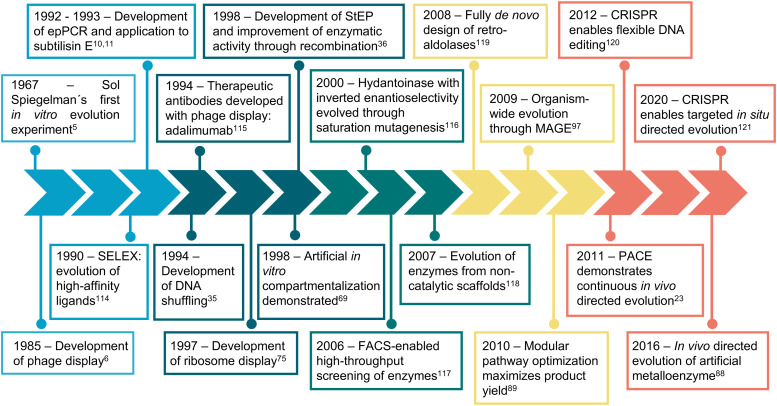
Fig. 1
Fig. 1. Timeline of directed evolution major developments. Representative examples of some of the most relevant developments and achievements in directed evolution are shown.
Fig. 2
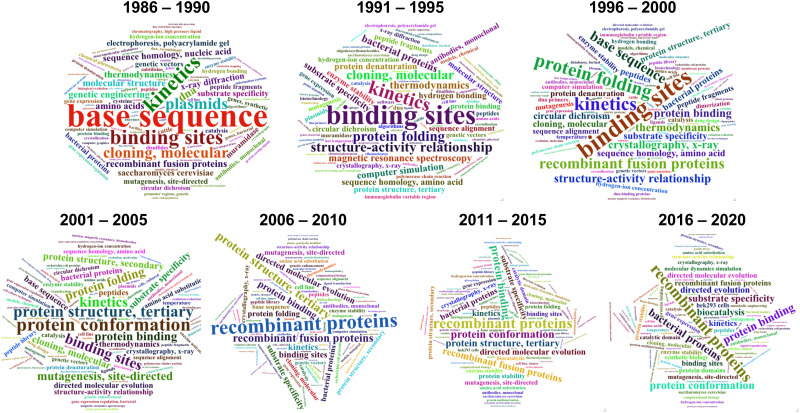
Fig. 2. Evolution of keywords associated to directed evolution articles. Wordclouds of the keywords associated to directed evolution articles since 1985 are shown. Articles were grouped in blocks of five years. The wordclouds reveal a change over time of the focus and scope of directed evolution, with the most recent decade showing a larger variety of targeted properties and biomolecules. Data was retrieved, analysed and visualised with R.
Fig. 3
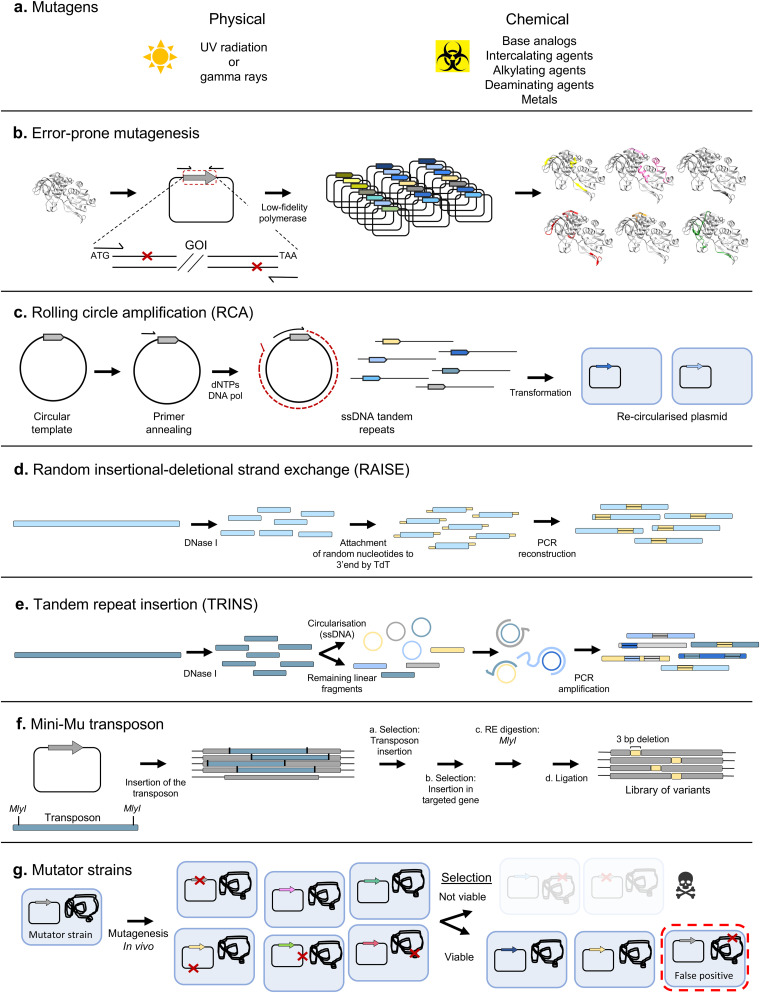
Fig. 3. Random mutagenesis techniques. Some of the most widely applied random mutagenesis approaches are represented. (a) Chemical and physical mutagens were the basis of many genome-wide screening experiments, but have not been extensively used in directed evolution. (b) In error-prone PCR, random mutations are introduced by a low fidelity polymerase, resulting in linear DNA fragments with point mutations, which generally require further manipulation to be inserted into an appropriate vector. (c) RCA based methods bypass the need for further manipulation, since the products can be automatically recircularized by the host cells. (d) RAISE was one of the first methodologies designed to introduce random insertions in the sequence to be mutated. Random small extensions are attached to digested fragments of the parental sequence, and full-length genes are reconstructed through PCR. (e) TRINS aims to generate repeats of random short fragments of the parental sequence. First, the parental sequence is digested with DNase I. Part of the obtained fragments are circularized and mixed with the remaining linear fragments. An assembly PCR reaction is then performed. When a linear fragment anneals with a circular fragment, a reaction similar to RCA takes place, leading to the replication of multiple copies of the region corresponding to the circularized fragment. (f) Several mutagenesis techniques based on the mini-Mu transposon have been devised. Such techniques allow the generation of random insertions or even deletions while preserving the appropriate reading frame. (g) Mutator strains were the first tool enabling in vivo random mutagenesis. However, the increased mutagenesis rate applies to the whole genetic material, and not only to the sequence of interest. More sophisticated approaches where only the gene of interest is targeted have been developed. GOI: gene of interest.
Fig. 4
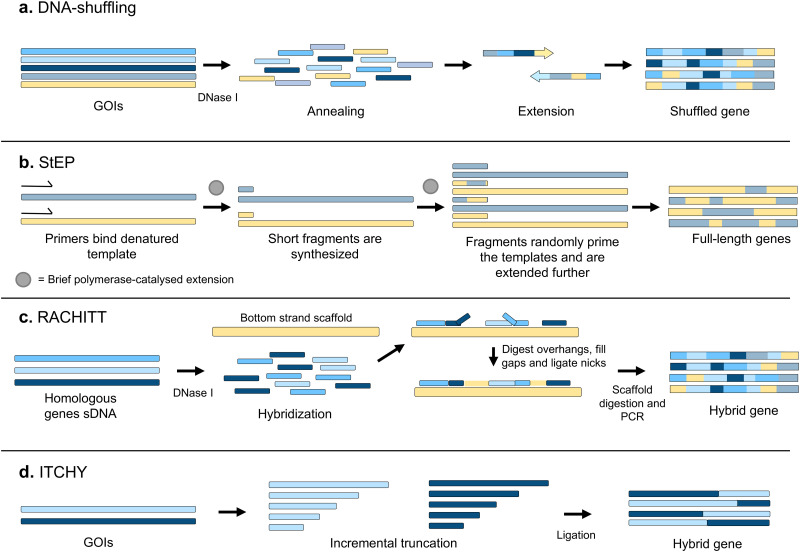
Fig. 4. Recombination-based mutagenesis techniques. A set of some of the main mutagenesis techniques based on recombination is displayed. (a) DNA shuffling was the first recombination-based in vitro mutagenesis technique to be developed. A set of homologous sequences is treated with DNase I, and the resulting mix of fragments is used to reassemble full-length sequences through self-priming PCR. (b) In StEP, a set of homologous sequences is used as templates for a series of cycles of annealing with primers and extension of the primers by a DNA polymerase. In each cycle, the growing primers can anneal with a different template, resulting in chimeric full-length sequences. (c) RACHITT requires less homology between parental sequences than DNA shuffling and StEP. A set of fragments obtained by treatment with DNase I of the complementary strands of the sequences to be recombined is hybridized to a single-stranded copy of one of the parental sequences. After digesting overhangs, filling the gaps and ligating the nicks, the scaffold strands are digested, and double-stranded chimeric sequences are obtained by means of PCR. (d) ITCHY decreases even further the sequence homology requirements, but it is limited to a single crossover per variant. Exonuclease III is used to incrementally truncate one of the parental genes from its 3′ end, and the other one from its 5′ end. Then, random-length fragments of each gene are ligated. GOI: gene of interest.
Fig. 5
Fig. 5. Site-saturation and site-directed mutagenesis. Site-saturation mutagenesis allows the introduction of a large range of point-mutations at specific sites, while site-directed mutagenesis introduces a specific set of mutations. In both cases, mutagenic primers, which contain mismatches with the parental sequence in the positions to be mutated, are used for PCR reactions with the parental sequence as the template. The amplification products are the mutated variants. In the case of site-directed mutagenesis, primers carrying specific mutations are used. For site-saturation mutagenesis, degenerated primers containing a range of possible mutations are employed. GOI: gene of interest.
Fig. 6
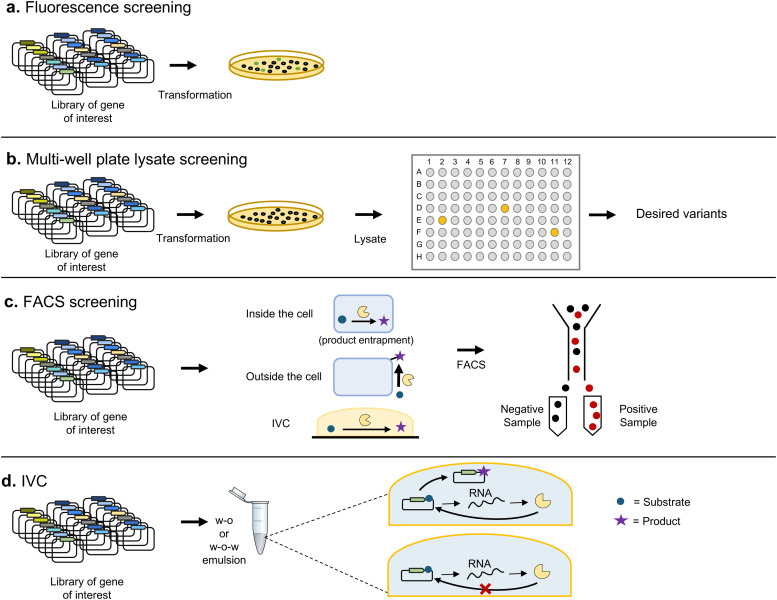
Fig. 6. Screening techniques. Some of the most frequent screening techniques are depicted. (a) Variants of proteins that confer fluorescence can be screened by analysing with digital imaging techniques cultures in solid media. (b) For proteins whose activity can be linked to a colorimetric assay or to the generation of fluorescence, it is possible to automatically transfer individual colonies to liquid cultures by means of automated multi-well liquid culture devices. The liquid cultures or their lysates can then be screened by colorimetric or fluorescent-based assays. (c) FACS enables the physical separation of individual cells based on their fluorescence properties, allowing for a higher throughput and reduced material and physical requirements. However, it is limited to biomolecules whose activity can be linked to a change in fluorescence. (d) IVC techniques replace the compartmentalization provided by cells with artificial compartmentalization, most frequently provided by emulsions of water and oil. This allows to bypass the limitation imposed by transformation efficiency, but incompatibilities between the conditions required for transcription and translation and those required for the activity of the biomolecule of interest reduce its scope of application. IVC: in vitro compartmentalization; w–o: water-in-oil; w-o-w: water-in-oil-in-water.
Fig. 7
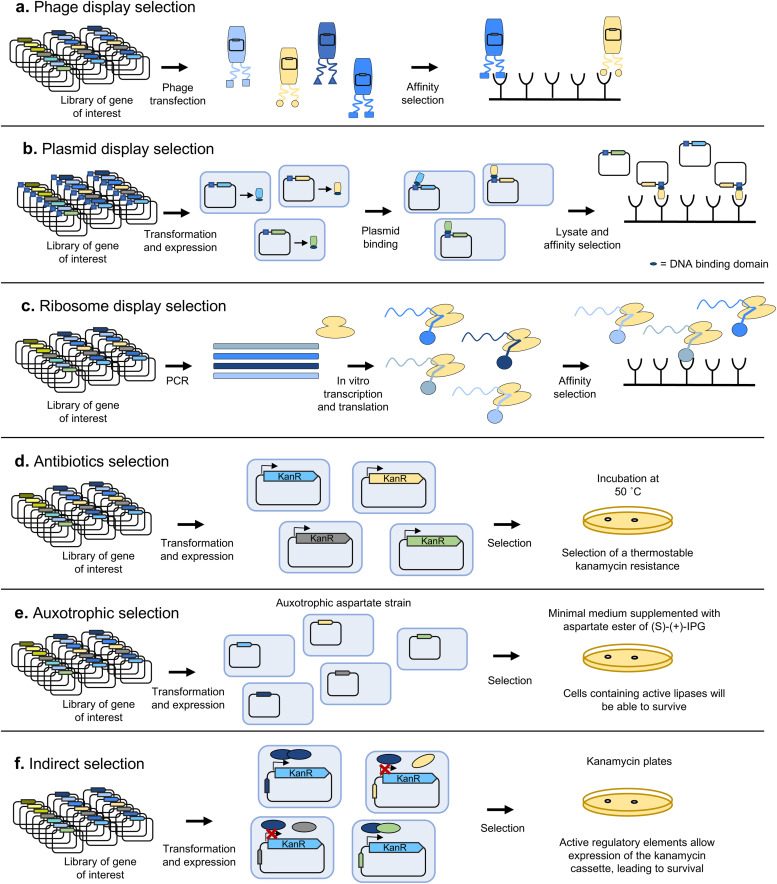
Fig. 7. Selection techniques. Some of the most frequent selection techniques are represented. (a) In phage display, protein or peptide variants are exposed on the surface of phages, and selected based on their binding affinity to a target binding partner. (b) In plasmid display, a DNA-binding protein is fused to each variant. The encoding plasmid contains the target sequence for the DNA-binding protein. After lysing cells, variants can be selected based on their binding affinity to specific target interactors. Variant sequence can then be determined from the associated plasmid thanks to the linkage provided by the DNA-binding protein. (c) Ribosome display can be used to link protein variants to their corresponding mRNA. Translation is stopped by cooling on ice, and protein–ribosome–mRNA complexes are stabilized through the addition of magnesium, enabling affinity selection and amplification of the sequence of selected variants by treatment with reverse transcriptase, followed by PCR. (d) Antibiotic resistance selection is one of the most basic types of growth complementation selection techniques. Cells are transformed with a library of variants and grown in selective medium supplemented with a certain antibiotic. Only cells expressing a variant able to confer resistance for the added antibiotic and functional under the selection conditions (such as high temperature) will survive. (e) In auxotrophy-based selections, cells auxotrophic for a certain metabolite are grown in minimal medium without said metabolite but with a precursor that can yield the required compound upon transformation by a certain enzymatic activity. Cells are transformed with a library of variants, such that only those carrying a variant able to catalyse the conversion of the precursor will be able to survive. (f) In indirect growth-complementation based selection techniques, the activity of the gene of interest is not directly responsible for an increased survival rate. Instead, its activity (such as activation of transcription) leads to an increased expression or activity of the biomolecule directly responsible for it, such as an antibiotic resistance.
Fig. 8
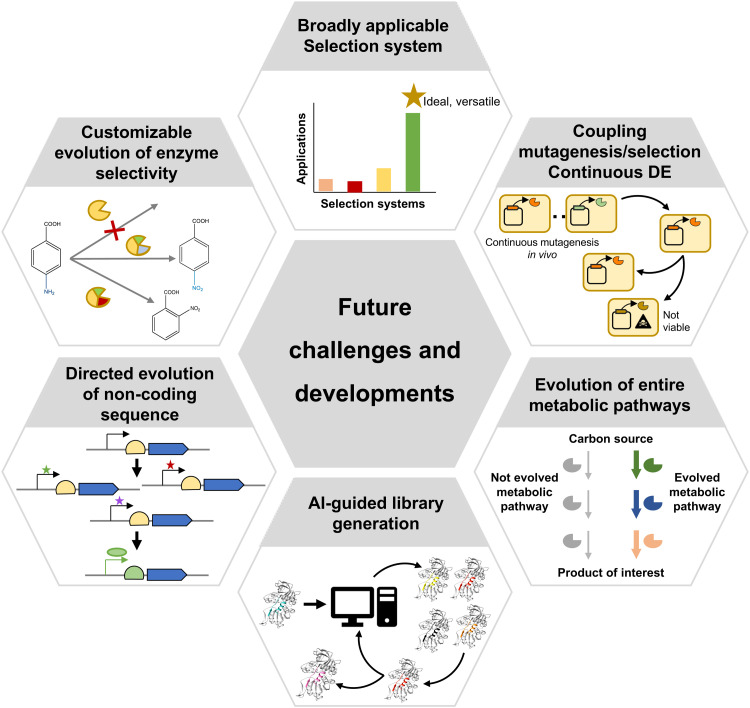
Fig. 8. Summary of main challenges and future developments of directed evolution.

References

    1. Johannes T., Simurdiak M. R. and Zhao H., Biocatalysis, in Encyclopedia of Chemical Processing, CRC Press, 2005, pp. 101–110
    1. Callaway E. It will change everything’: DeepMind's AI makes gigantic leap in solving protein structures. Nature. 2020;588(7837):203–204. doi: 10.1038/d41586-020-03348-4. - DOI - PubMed
    1. Schwede T. Protein modeling: what happened to the ‘protein structure gap’? Structure. 2013;21(9):1531–1540. doi: 10.1016/j.str.2013.08.007. - DOI - PMC - PubMed
    1. Arnold F. H. Innovation by evolution: bringing new chemistry to life (Nobel lecture) Angew. Chem., Int. Ed. 2019;58(41):14420–14426. doi: 10.1002/anie.201907729. - DOI - PubMed
    1. Wang Y. Xue P. Cao M. Yu T. Lane S. T. Zhao H. Directed evolution: methodologies and applications. Chem. Rev. 2021;121(20):12384–12444. doi: 10.1021/acs.chemrev.1c00260. - DOI - PubMed