


Effect of anesthesia assistance on the detection rate of precancerous lesions and early esophageal squamous cell cancer in esophagogastroduodenoscopy screening: A retrospective study based on propensity score matching
- PMID: 37035346
- PMCID: PMC10078984
- DOI: 10.3389/fmed.2023.1039979
Effect of anesthesia assistance on the detection rate of precancerous lesions and early esophageal squamous cell cancer in esophagogastroduodenoscopy screening: A retrospective study based on propensity score matching
Abstract
Background: Esophagogastroduodenoscopy (EGD) screening is vital for the early diagnosis of esophageal squamous cell cancer (ESCC). However, improvement in the detection rate of precancerous lesions and early ESCC with anesthesia assistance (AA) has not yet been investigated. This retrospective study aimed to evaluate the effect of AA on the detection rate of precancerous lesions and early ESCC in patients undergoing EGD screening and identify risk factors affecting the detection rate.
Methods: We reviewed patients' electronic medical records who underwent EGD screening between May 2019 and August 2020. Patients were divided into two groups based on whether they received AA: those in Group A underwent EGD screening with AA, and patients in Group O underwent EGD screening without AA. Propensity score matching (PSM) was used to account for differences in baseline characteristics. Detection rates of precancerous lesions and early ESCC were compared between the two groups following PSM. Binary logistic regression was used to identify risk factors affecting the detection rate.
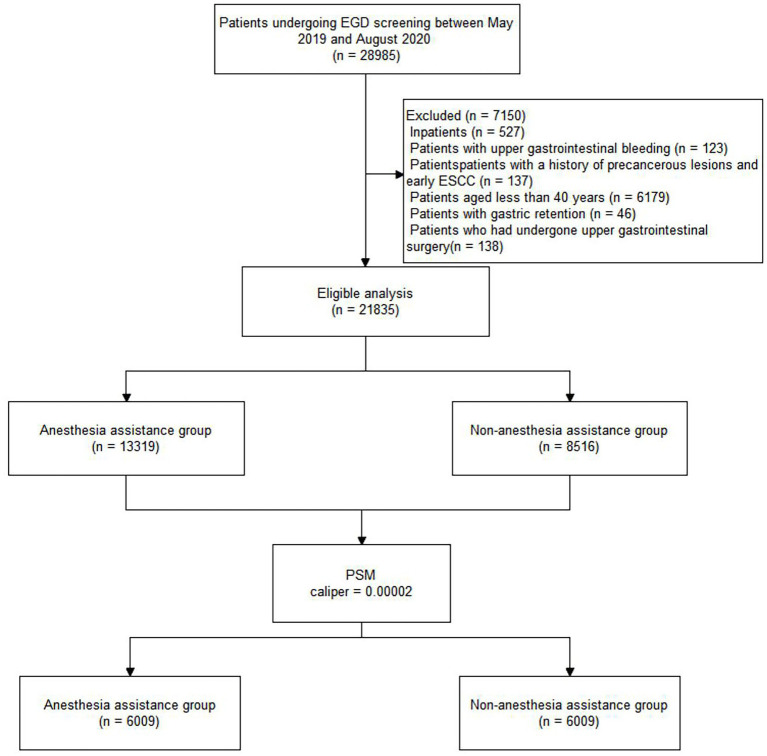
Results: The final analysis included 21,835 patients (Group A = 13,319, Group O = 8,516) from 28,985 patients who underwent EGD screening during the study period. Following PSM, 6009 patients remained in each group for analysis. There was no significant difference in the detection rate of precancerous lesions and early ESCC between Groups A and O (1.1% vs. 0.8%, p > 0.05). Binary logistic regression showed that age (50-59 years, 60-69 years and 70-79 years), higher endoscopist seniority, high-definition (HD) endoscopy, narrow-band imaging (NBI), and number of endoscopic images were all independent risk factors that affected the detection rate of precancerous lesions and early ESCC.
Conclusion: There was no statistically significant difference in the detection rate of precancerous lesions and early ESCC between patients who underwent EGD screening with and without AA. All independent risk factors that affected the detection rate of precancerous lesions and early ESCC included the following: age (50-59 years, 60-69 years and 70-79 years), higher endoscopist seniority, HD endoscopy, NBI, and number of endoscopic images. Endoscopists should consider all these factors as much as possible when performing EGD screening.
Keywords: anesthesia assistance; detection rate; esophageal squamous cell cancer; esophagogastroduodenoscopy; retrospective; propensity score matching.
Copyright © 2023 Liang, Xu, Zhang, Zhang and Cao.
Conflict of interest statement
The authors declare that the research was conducted in the absence of any commercial or financial relationships that could be construed as a potential conflict of interest.
Figures
References
LinkOut - more resources
Full Text Sources
Miscellaneous
