


Wheelchair users' satisfaction after provision using the WHO 8-step guidelines: A pilot study
- PMID: 37036293
- PMCID: PMC11378656
- DOI: 10.1080/10790268.2023.2171627
Wheelchair users' satisfaction after provision using the WHO 8-step guidelines: A pilot study
Abstract
Background: Wheelchairs are vital for the successful rehabilitation and inclusion of people with mobility disabilities; 10% of the population with disabilities needs a wheelchair, but only 15% have access to an adequate one. Not user-configured wheelchairs may lead to postural deformities and pressure ulcers, thus negatively impact user satisfaction, wheelchair skills, and quality of life.
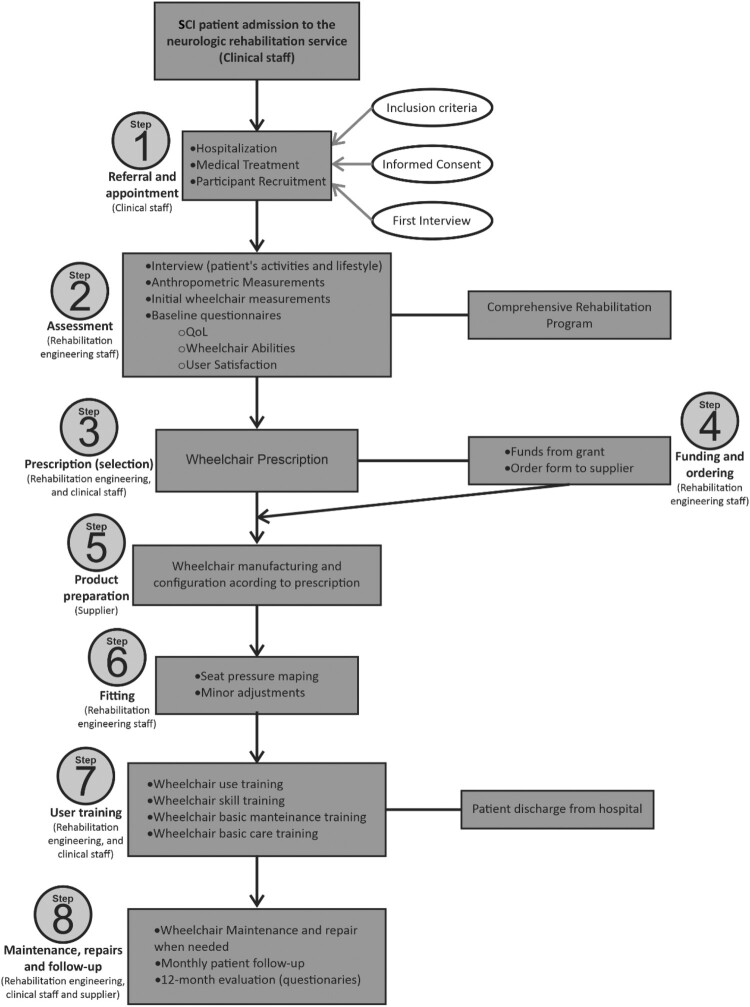
Objective: To assess the impact of the 8-step "Guidelines on the provision of manual wheelchairs in less-resourced settings" from the World Health Organization (WHO) on user satisfaction, wheelchair skills, and quality of life of Mexican manual wheelchair users.
Methods: 12 wheelchair users with spinal cord injury that received rehabilitation were recruited. Volunteers were provided a wheelchair and cushion following the WHO 8-step guidelines. Assessment of QUEST, WHOQOL-Bref, and WST-Q was performed at the beginning of the study and 12 months later.
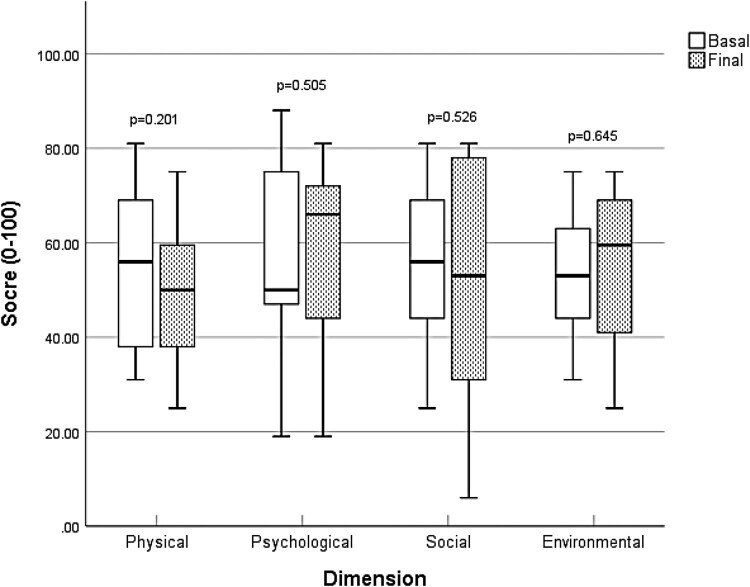
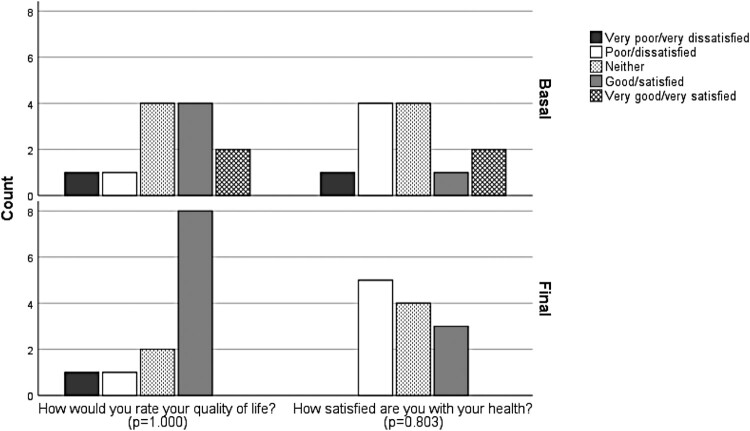
Results: Significant improvement was observed in terms of satisfaction (QUEST; P = 0.009) after receiving the wheelchair and the foam cushion (QUEST; P = 0.004). WHOQol-Bref did not denote significant differences. For the dimensions assessed by the WST-Q scores, a significant 10.9% improvement was observed in both, capacity (P = 0.022) and performance (P = 0.009).
Conclusions: The application of the WHO 8-step guidelines for wheelchair provision may contribute to increase user satisfaction regarding the wheelchair and cushion devices as well as the prescription process as determined by the QUEST. According to the WST-Q, functional capacity and mobility may also be improved by following the 8-step guidelines.
Keywords: QUEST; Quality of life; User satisfaction; WHO 8-step guidelines for wheelchair provision; Wheelchair prescription.
Figures
References
-
- Borg J, Östergren PO, Larsson S, Rahman AA, Bari N, Khan AN.. Assistive technology use is associated with reduced capability poverty: a cross-sectional study in Bangladesh. Disabil Rehabil Assist Technol. 2012;7(2):112–121. - PubMed
-
- United Nations . Convention on the rights of persons with disabilities and optional protocol. Treaty series. New York: United Nations; 2006.
-
- Skempes D, Stucki G, Bickenbach J.. Health-related rehabilitation and human rights: analyzing states’ obligations under the United Nations Convention on the Rights of Persons with Disabilities. Arch Phys Med Rehabil. 2015;96:163–173. - PubMed
-
- Scherer MJ, Sax C, Vanbiervliet A, Cushman LA, Scherer JV.. Predictors of assistive technology use: the importance of personal and psychosocial factors. Disabil Rehabil. 2005;27(21):1321–1331. - PubMed
-
- Scherer M, Jutai J, Fuhrer M, Demers L, Deruyter F.. A framework for modelling the selection of assistive technology devices (ATDs). Disabil Rehabil Assist Technol. 2007;2:1–8. - PubMed
MeSH terms
LinkOut - more resources
Full Text Sources
Medical
