Clinical impact of cryopreservation of allogeneic hematopoietic cell grafts during the onset of the COVID-19 pandemic
- PMID: 37036959
- PMCID: PMC10580174
- DOI: 10.1182/bloodadvances.2023009786
Clinical impact of cryopreservation of allogeneic hematopoietic cell grafts during the onset of the COVID-19 pandemic
Abstract
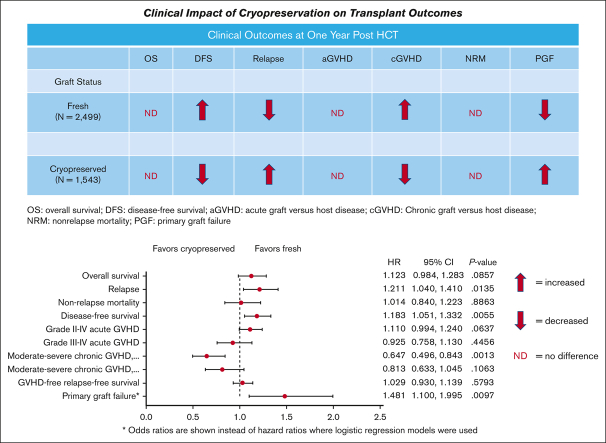
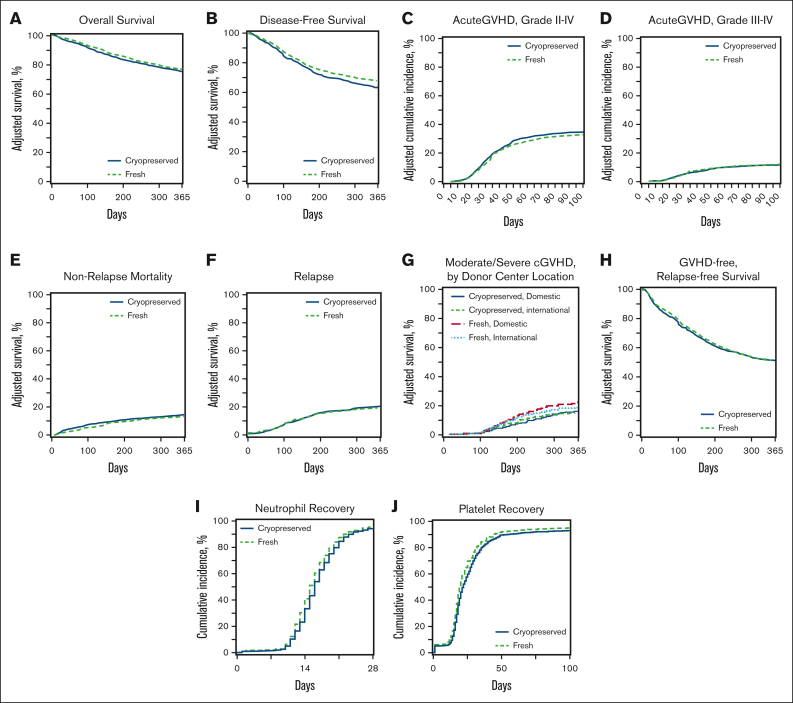
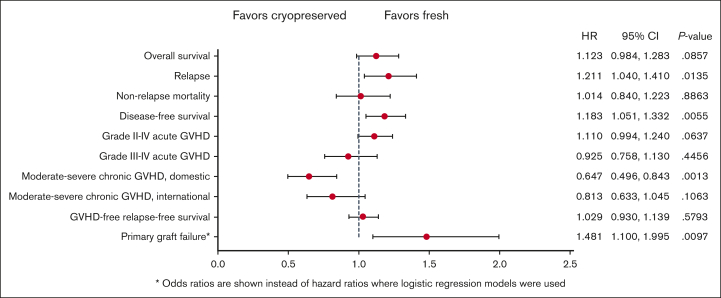
At the onset of the COVID-19 pandemic, the National Marrow Donor Program mandated the cryopreservation of hematopoietic cell grafts from volunteer unrelated donors because of numerous patient and donor safety concerns and logistical hurdles. Using the Center for International Blood and Marrow Transplant Research outcomes database, we report the impact of cryopreservation on overall survival (OS) and other outcomes within 1 year after hematopoietic cell transplantation (HCT). We analyzed 1543 recipients of cryopreserved allografts receiving HCT at US centers during the first 6 months of the pandemic and compared them with 2499 recipients of fresh allografts during a 6-month period in 2019. On multivariable regression analysis, we observed no difference in the OS (P = .09), nonrelapse mortality (P = .89), graft-versus-host disease (GVHD), or GVHD- and relapse-free survival (P = .58) in recipients of cryopreserved vs fresh allografts. Disease-free survival (DFS) was lower in the cryopreserved allograft recipients (P = .006) because of a higher risk of relapse (P = .01) compared with the fresh allograft recipients. Primary graft failure was higher (P = .01), and the risk of chronic GVHD was lower (P = .001) with cryopreservation compared with fresh grafts. In conclusion, although there was no negative impact of cryopreservation on OS, relapse was higher, and DFS was lower than that with no cryopreservation. Fresh grafts are recommended as the pandemic-related logistical hurdles resolve. Cryopreservation should be considered an option for patients when fresh grafts are not feasible.
© 2023 by The American Society of Hematology. Licensed under Creative Commons Attribution-NonCommercial-NoDerivatives 4.0 International (CC BY-NC-ND 4.0), permitting only noncommercial, nonderivative use with attribution. All other rights reserved.
Conflict of interest statement
Conflict-of-interest disclosure: H.E.S. is on the advisory board and speakers bureau for Novartis. S.M.D. claims Orca Bio for consultancy. B.E.S. declares consultancy for Orca Bio and Mallinkrodt. The remaining authors declare no competing financial interests.
Figures
Comment in
-
Blood stem cell grafts: frozen is fine, but fresh is best.Blood Adv. 2023 Oct 10;7(19):5994-5995. doi: 10.1182/bloodadvances.2023010372. Blood Adv. 2023. PMID: 37815816 Free PMC article. No abstract available.
References
-
- Alotaibi AS, Prem S, Chen S, et al. Fresh vs. frozen allogeneic peripheral blood stem cell grafts: a successful timely option. Am J Hematol. 2021;96(2):179–187. - PubMed
-
- Frey NV, Lazarus HM, Goldstein SC. Has allogeneic stem cell cryopreservation been given the ‘cold shoulder’? An analysis of the pros and cons of using frozen versus fresh stem cell products in allogeneic stem cell transplantation. Bone Marrow Transplant. 2006;38(6):399–405. - PubMed
MeSH terms
Grants and funding
LinkOut - more resources
Full Text Sources
Medical