. 2023 Mar;42(2):174-187.
doi: 10.23876/j.krcp.22.159. Epub 2023 Mar 31.

An update on renal fibrosis: from mechanisms to therapeutic strategies with a focus on extracellular vesicles

Affiliations

An update on renal fibrosis: from mechanisms to therapeutic strategies with a focus on extracellular vesicles

Cui Wang et al. Kidney Res Clin Pract. 2023 Mar.

Abstract

The increasing prevalence of chronic kidney disease (CKD) is a major global public health concern. Despite the complicated pathogenesis of CKD, renal fibrosis represents the most common pathological condition, comprised of progressive accumulation of extracellular matrix in the diseased kidney. Over the last several decades, tremendous progress in understanding the mechanism of renal fibrosis has been achieved, and corresponding potential therapeutic strategies targeting fibrosis-related signaling pathways are emerging. Importantly, extracellular vesicles (EVs) contribute significantly to renal inflammation and fibrosis by mediating cellular communication. Increasing evidence suggests the potential of EV-based therapy in renal inflammation and fibrosis, which may represent a future direction for CKD therapy.

Keywords: Chronic kidney disease; Extracellular vesicles; Mechanism; Renal fibrosis; Therapy.


Conflict of interest statement

Conflicts of interest

All authors have no conflicts of interest to declare.

Figures
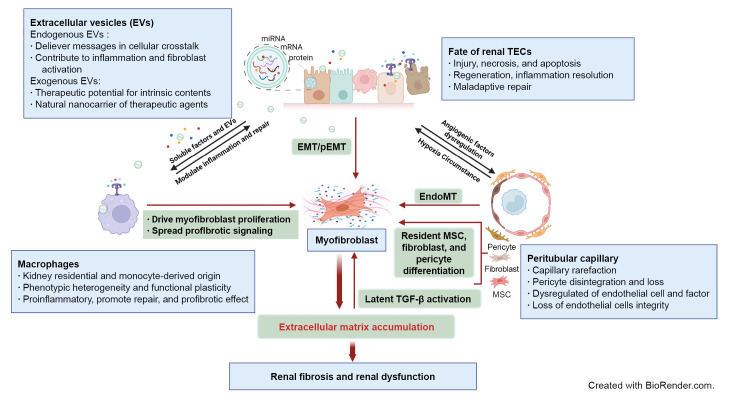
Figure 1.
Figure 1.. Schematic elucidation of cellular and signaling events in renal fibrosis.
Renal tubule injury acts as a driving force in fibrosis progression through communication with immune cells, peritubular capillary (PTC), and interstitial stroma cells via soluble or extracellular vesicle (EV) signaling. Persistent or severe injury leads to maladaptive repair of tubular epithelial cells (TECs) and subsequent EMT or pEMT, contributing to renal fibrosis. PTC rarefaction generates a hypoxic environment that promotes tubular atrophy. The phenotypic heterogeneity and functional plasticity elucidate the versatile roles of macrophages during inflammation, tissue repair, and fibrosis. Excessive accumulation of ECM components contributes to overactivation of myofibroblasts originating from multiple cellular sources and provides a substrate for latent transforming growth factor β (TGF-β) activation. Endogenous EVs play a notable role in delivery of messages in cellular communication, while exogenous EVs are being developed as new therapeutic agents for renal fibrosis. AKI, acute kidney injury; ECM, extracellular matrix; EMT, epithelial-mesenchymal transition; EndoMT, endothelial-mesenchymal transition; MSC, mesenchymal stem cell; pEMT, partial epithelial-mesenchymal transition.
Figure 2.
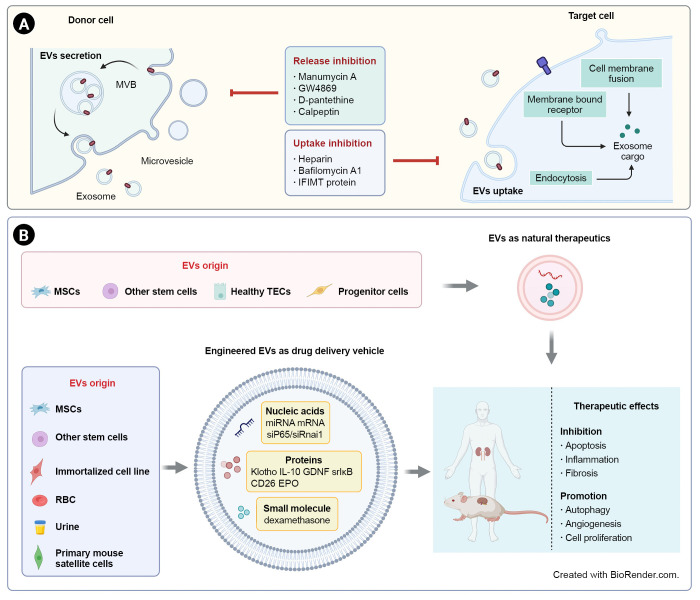
Figure 2.. EV-based therapeutic strategies for renal fibrosis.
(A) Due to the pathological effects of EVs in renal inflammation and fibrosis, inhibition of EV secretion or uptake is a potential strategy for kidney diseases. (B) EVs derived from stem cells or healthy renal intrinsic cells could act as direct natural therapeutics. EVs can also be used as delivery vehicles for a variety of drugs, including nucleic acids, proteins, and small molecules. EV-based treatments have shown therapeutic effects on renal fibrosis through inhibition of apoptosis, inflammation, and fibrosis and promotion of autophagy, angiogenesis, and proliferation. EVs, extracellular vesicles; EPO, erythropoietin; GDNF, glial-derived neurotrophic factor; IL, interleukin; miRNA, microRNA; mRNA, messenger RNA; MSCs, mesenchymal stem cells; MVB, multivesicular body; RBC, red blood cell; srIκB, super-repressor IκB; TECs, tubular epithelial cells.

References

    1. Kalantar-Zadeh K, Jafar TH, Nitsch D, Neuen BL, Perkovic V. Chronic kidney disease. Lancet. 2021;398:786–802. - PubMed
    1. GBD Chronic Kidney Disease Collaboration. Global, regional, and national burden of chronic kidney disease, 1990-2017: a systematic analysis for the Global Burden of Disease Study 2017. Lancet. 2020;395:709–733. - PMC - PubMed
    1. Yu SM, Bonventre JV. Acute kidney injury and maladaptive tubular repair leading to renal fibrosis. Curr Opin Nephrol Hypertens. 2020;29:310–318. - PMC - PubMed
    1. Ferenbach DA, Bonventre JV. Mechanisms of maladaptive repair after AKI leading to accelerated kidney ageing and CKD. Nat Rev Nephrol. 2015;11:264–276. - PMC - PubMed
    1. Liu BC, Tang TT, Lv LL, Lan HY. Renal tubule injury: a driving force toward chronic kidney disease. Kidney Int. 2018;93:568–579. - PubMed

LinkOut - more resources