Reductions in Depression and Anxiety Among Autistic Adults Participating in an Intervention to Promote Healthy Relationships
- PMID: 37040101
- PMCID: PMC10137597
- DOI: 10.5014/ajot.2023.050108
Reductions in Depression and Anxiety Among Autistic Adults Participating in an Intervention to Promote Healthy Relationships
Abstract
Importance: Some autistic adults experience depression and anxiety related to their social relationships. There is a need for evidence-based occupational therapy interventions that decrease depression and anxiety and improve the health of social relationships for autistic adults.
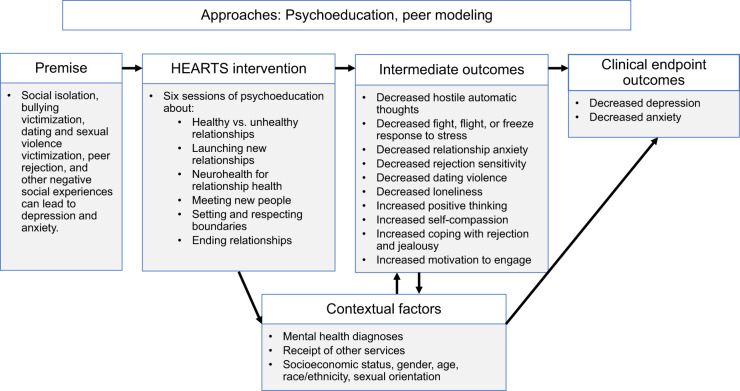
Objective: To determine the feasibility and preliminary effectiveness of the Healthy Relationships on the Autism Spectrum (HEARTS) intervention, a six-session, group-based psychoeducational intervention for the improvement of relationship health.
Design: One-group pretest-posttest design with a 3-mo follow-up after baseline.
Setting: United States; online intervention through community organization.
Participants: Fifty-five adults, ages 20 to 43 yr, with a professional or self-diagnosis of autism and the capacity to independently participate in an online, group-based, participatory class.
Intervention: Participants received 6 90-min weekly sessions that addressed healthy relationship topics, including recognizing abuse, meeting people, maintaining relationships, setting interpersonal boundaries, neurohealth for relationships, and ending relationships. A psychoeducational approach that provided education and involved guided discovery and strategy acquisition was used.
Outcomes and measures: All measures were self-administered through an online survey. Depression and anxiety were assessed using instruments from the Patient-Reported Outcomes Measurement Information System.
Results: Fifty-five participants completed the intervention. Postintervention scores revealed statistically significant improvements in depression and anxiety.
Conclusions and relevance: HEARTS is a promising intervention for improving depression and anxiety among autistic adults and should be investigated further. What This Article Adds: HEARTS offers a potentially effective, nonpharmacological, psychoeducational group-based intervention option to promote healthy relationships for autistic adults. Positionality Statement: This article uses identity-first language (autistic person) in accordance with the preference of autistic self-advocates (Autistic Self Advocacy Network, 2020; Kenny et al., 2016; Lord et al., 2022).
Copyright © 2023 by the American Occupational Therapy Association, Inc.
Figures
References
-
- Adams, R., Bishop, S., & Taylor, J. L. (2017). Negative peer experiences in adolescents with autism spectrum disorders. In Fisher M. H. (Ed.), International review of research in developmental disabilities (Vol. 52, pp. 75–107). Academic Press.
-
- Autistic Self Advocacy Network. (2020). Identify-first language. https://autisticadvocacy.org/about-asan/identity-first-language/
-
- Autistic Self Advocacy Network. (2022). About autism. https://autisticadvocacy.org/about-asan/about-autism/