


Scalable, economical, and stable sequestration of agricultural fixed carbon
- PMID: 37040411
- PMCID: PMC10120047
- DOI: 10.1073/pnas.2217695120
Scalable, economical, and stable sequestration of agricultural fixed carbon
Abstract
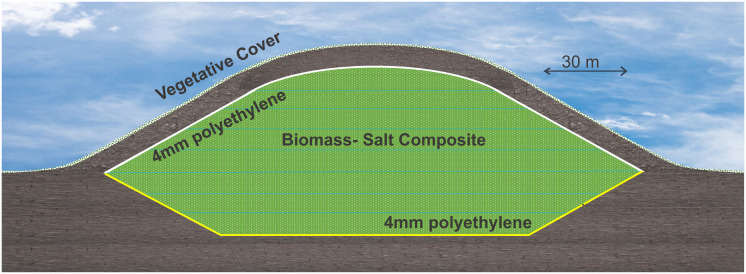
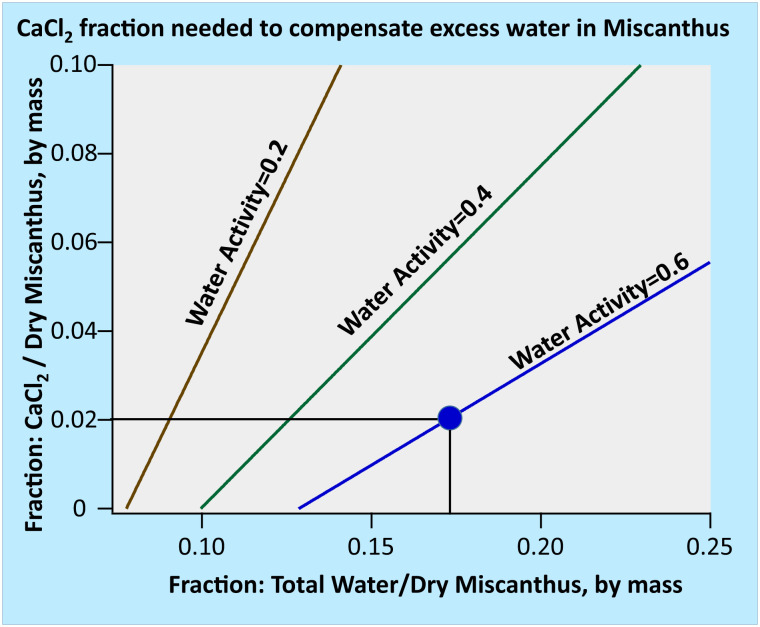
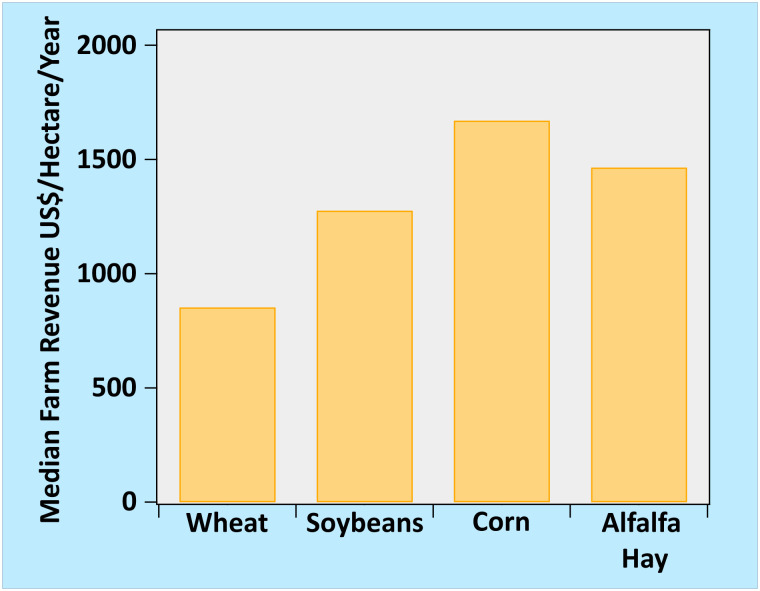
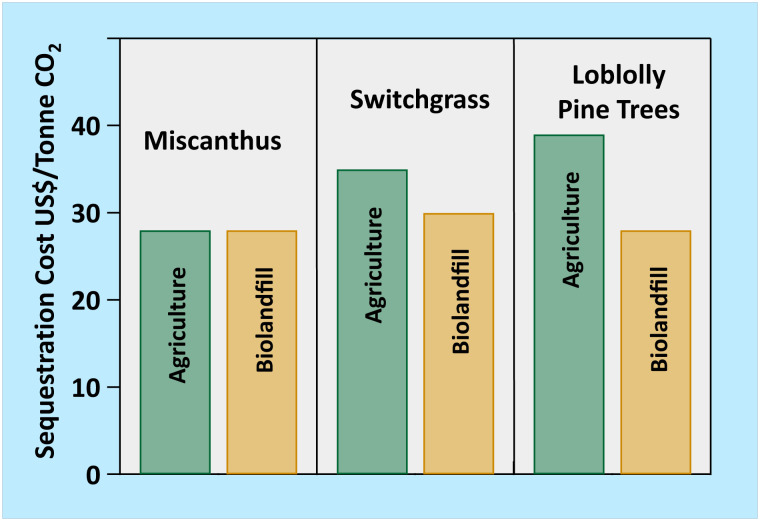
We describe a scalable, economical solution to the carbon dioxide problem. CO2 is captured from the atmosphere by plants, and the harvested vegetation is then buried in an engineered dry biolandfill. Plant biomass can be preserved for hundreds to thousands of years by burial in a dry environment with sufficiently low thermodynamic "Water Activity," which is the relative humidity in equilibrium with the biomass. Maintaining a dry environment within the engineered dry biolandfill is assisted by salt that preserves biomass, which has been known since Biblical times. A "Water Activity" <60%, assisted by salt, will not support life, suppressing anaerobic organisms, thus preserving the biomass for thousands of years. Current agricultural costs, and biolandfill costs, indicate US$60/tonne of sequestered CO2 which corresponds to ~US$0.53 per gallon of gasoline. The technology is scalable owing to the large area of land available for nonfood biomass sources. If biomass production is scaled to the level of a major crop, existing CO2 can be extracted from the atmosphere, and will simultaneously sequester a significant fraction of world CO2 emissions.
Keywords: agriculture; anaerobic; biolandfill; carbon capture; sequestration.
Conflict of interest statement
Patents have been filed on certain aspects related to the sequestration procedure.
Figures
References
-
- Zeder M., The origins of agriculture in the near East. Curr. Anthropol. 52, 221–235 (2011), 10.1086/659307. - DOI
-
- Johnson W., Weimer P. K., Williams R., Albert Rose Obituary. Phys. Today 44, 98 (1991), 10.1063/1.2810377. - DOI
-
- Rose A., A global view of solar energy in rational units. Phys. Stat. Sol. (a) 56, 11–26 (1979), 10.1002/pssa.221056010. Agricultural energy cost versus petroleum energy cost, are similar: One mole of carbohydrate is 180 grams, storing 686 kcal≈2.87MJ. A bushel of maize =56lbs = 25.45kg =141.4moles containing 405MJ. As of August 2022, maize is US$7/bushel on the Chicago Board of Trade, (CBOT). Therefore the maize energy price is US$1.72/100MJ. There is an additional correction since commercial maize has ~15% water content. A barrel of oil has 5.8 million-British Thermal Units = 6119MJ. At US$100/barrel petroleum, the energy cost is US$1.64/100MJ. Fluctuating prices mean that the energy price of maize is sometimes lower or higher than the energy price of petroleum. - DOI
-
- Chu S., Majumdar A., Opportunities and challenges for a sustainable energy future. Nature 488, 294–303 (2012). - PubMed
-
- Dyson F. J., Can we control the carbon dioxide in the atmosphere? Energy 2, 217–291 (1977).
Grants and funding
LinkOut - more resources
Full Text Sources
Other Literature Sources
