


The return of the lesion for localization and therapy
- PMID: 37040563
- PMCID: PMC10393408
- DOI: 10.1093/brain/awad123
The return of the lesion for localization and therapy
Abstract
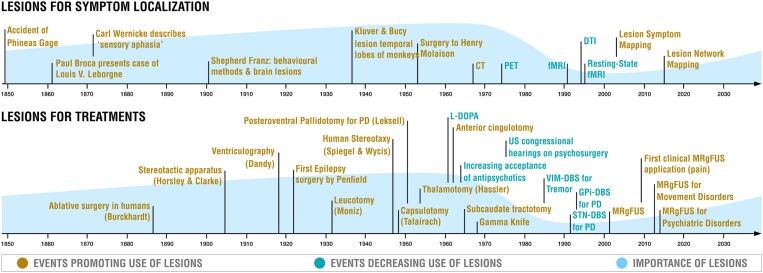
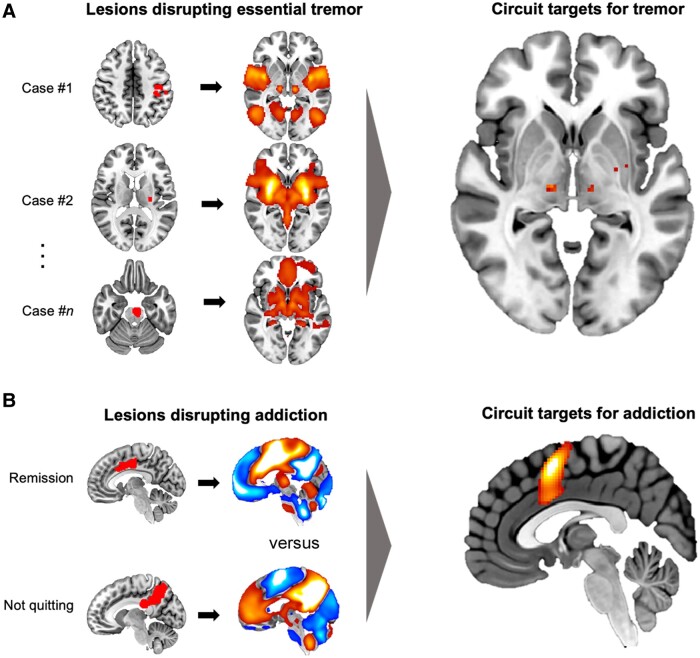
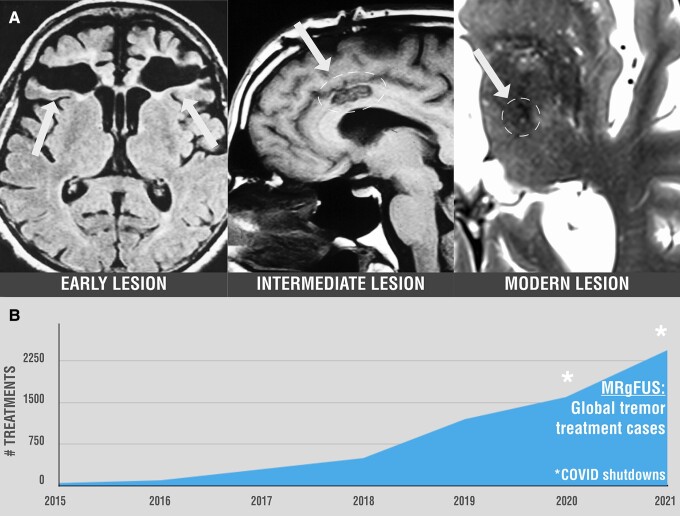
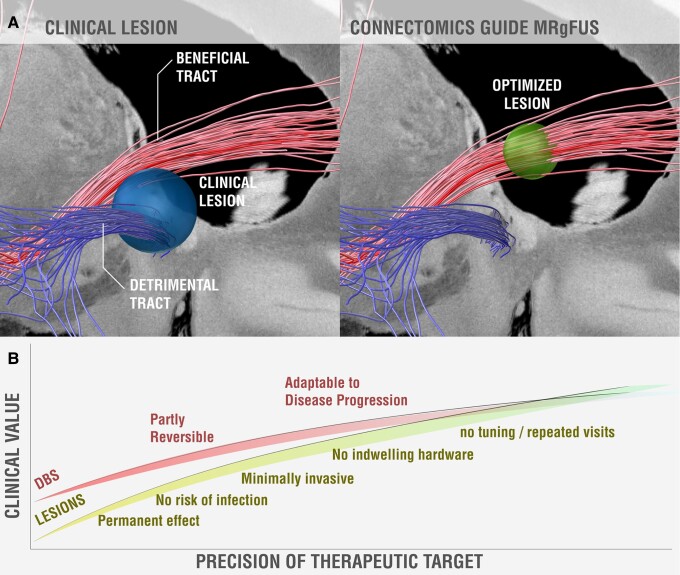
Historically, pathological brain lesions provided the foundation for localization of symptoms and therapeutic lesions were used as a treatment for brain diseases. New medications, functional neuroimaging and deep brain stimulation have led to a decline in lesions in the past few decades. However, recent advances have improved our ability to localize lesion-induced symptoms, including localization to brain circuits rather than individual brain regions. Improved localization can lead to more precise treatment targets, which may mitigate traditional advantages of deep brain stimulation over lesions such as reversibility and tunability. New tools for creating therapeutic brain lesions such as high intensity focused ultrasound allow for lesions to be placed without a skin incision and are already in clinical use for tremor. Although there are limitations, and caution is warranted, improvements in lesion-based localization are refining our therapeutic targets and improved technology is providing new ways to create therapeutic lesions, which together may facilitate the return of the lesion.
Keywords: MRgFUS; connectivity; lesion mapping; lesion network mapping; stroke.
© The Author(s) 2023. Published by Oxford University Press on behalf of the Guarantors of Brain.
Conflict of interest statement
J.J. has received conference travel support from Abbvie and Abbott and lecturer honoraria from Lundbeck and Novartis. N.L. reports grants from Weston Brain Institute Focused Ultrasound Foundation and serves as an expert in the Steering Committee by Focused Ultrasound Foundation. A.H. reports lecture fees from Boston Scientific unrelated to the present work. G.R.C. is a consultant for Insightec Inc. and Clearpoint Neuro Inc. M.D.F. is a consultant for Magnus Medical, Soterix and Boston Scientific, and has one existing and one submitted patent on using brain connectivity to find targets for brain stimulation–no royalties.
Figures
References
-
- Blomstedt P, Hariz MI. Deep brain stimulation for movement disorders before DBS for movement disorders. Parkinsonism Relat Disord. 2010;16:429–433. - PubMed
-
- Hariz MI, Blomstedt P, Zrinzo L. Deep brain stimulation between 1947 and 1987: the untold story. Neurosurg Focus. 2010;29:E1. - PubMed
-
- Bergman H, Wichmann T, DeLong MR. Reversal of experimental parkinsonism by lesions of the subthalamic nucleus. Science. 1990;249:1436–1438. - PubMed
-
- Goodale MA, Milner AD, Jakobson LS, Carey DP. A neurological dissociation between perceiving objects and grasping them. Nature. 1991;349:154–156. - PubMed
-
- Damasio H, Damasio A. Lesion analysis in neuropsychology: Oxford University Press; 1989.
Publication types
MeSH terms
Grants and funding
LinkOut - more resources
Full Text Sources
Medical
Miscellaneous
