


Levothyroxine use and longitudinal changes in thigh muscles in at-risk participants for knee osteoarthritis: preliminary analysis from Osteoarthritis Initiative cohort
- PMID: 37041609
- PMCID: PMC10088133
- DOI: 10.1186/s13075-023-03012-y
Levothyroxine use and longitudinal changes in thigh muscles in at-risk participants for knee osteoarthritis: preliminary analysis from Osteoarthritis Initiative cohort
Abstract
Background: We examined the association between levothyroxine use and longitudinal MRI biomarkers for thigh muscle mass and composition in at-risk participants for knee osteoarthritis (KOA) and their mediatory role in subsequent KOA incidence.
Methods: Using the Osteoarthritis Initiative (OAI) data, we included the thighs and corresponding knees of participants at risk but without established radiographic KOA (baseline Kellgren-Lawrence grade (KL) < 2). Levothyroxine users were defined as self-reported use at all annual follow-up visits until the 4th year and were matched with levothyroxine non-users for potential confounders (KOA risk factors, comorbidities, and relevant medications covariates) using 1:2/3 propensity score (PS) matching. Using a previously developed and validated deep learning method for thigh segmentation, we assessed the association between levothyroxine use and 4-year longitudinal changes in muscle mass, including cross-sectional area (CSA) and muscle composition biomarkers including intra-MAT (within-muscle fat), contractile percentage (non-fat muscle CSA/total muscle CSA), and specific force (force per CSA). We further assessed whether levothyroxine use is associated with an 8-year risk of standard KOA radiographic (KL ≥ 2) and symptomatic incidence (incidence of radiographic KOA and pain on most of the days in the past 12 months). Finally, using a mediation analysis, we assessed whether the association between levothyroxine use and KOA incidence is mediated via muscle changes.
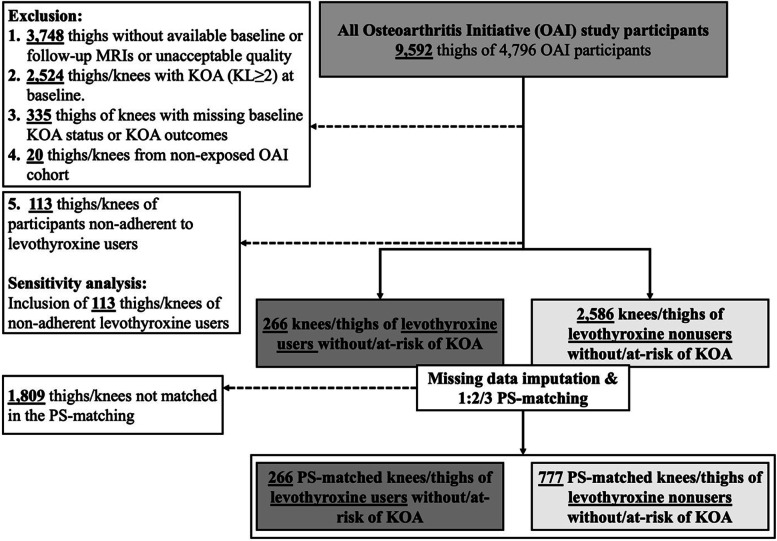
Results: We included 1043 matched thighs/knees (266:777 levothyroxine users:non-users; average ± SD age: 61 ± 9 years, female/male: 4). Levothyroxine use was associated with decreased quadriceps CSAs (mean difference, 95%CI: - 16.06 mm2/year, - 26.70 to - 5.41) but not thigh muscles' composition (e.g., intra-MAT). Levothyroxine use was also associated with an increased 8-year risk of radiographic (hazard ratio (HR), 95%CI: 1.78, 1.15-2.75) and symptomatic KOA incidence (HR, 95%CI: 1.93, 1.19-3.13). Mediation analysis showed that a decrease in quadriceps mass (i.e., CSA) partially mediated the increased risk of KOA incidence associated with levothyroxine use.
Conclusions: Our exploratory analyses suggest that levothyroxine use may be associated with loss of quadriceps muscle mass, which may also partially mediate the increased risk of subsequent KOA incidence. Study interpretation should consider underlying thyroid function as a potential confounder or effect modifier. Therefore, future studies are warranted to investigate the underlying thyroid function biomarkers for longitudinal changes in the thigh muscles.
Keywords: Knee osteoarthritis; Levothyroxine; MRI; Muscle degeneration; Thyroid.
© 2023. The Author(s).
Conflict of interest statement
DJH is the co-director of the Sydney Musculoskeletal Health Flagship. In addition, DJH is the editor of the osteoarthritis section for UpToDate and co-Editor in Chief of Osteoarthritis and Cartilage. DJH provides consulting advice on scientific advisory boards for Pfizer, Lilly, TLCBio, Novartis, Tissuegene, and Biobone. AG reported receiving funding from Pfizer, TissueGene, Novartis, Medipost, Coval, TrialSpark, and ICM (for consultation), and Boston Imaging Core Lab, LLC (as the president and stockholder). SD reported that he received funding from Toshiba Medical Systems (for consultation) and grants from GERRAF and Carestream Health (for a clinical trial study). None of the authors has any conflicting personal or financial relationships that could have influenced the results of this study. Other authors declare that they did not have any competing interests.
Figures

References
Publication types
MeSH terms
Substances
Grants and funding
LinkOut - more resources
Full Text Sources
Miscellaneous
