


Cellular senescence in skin-related research: Targeted signaling pathways and naturally occurring therapeutic agents
- PMID: 37042069
- PMCID: PMC10265178
- DOI: 10.1111/acel.13845
Cellular senescence in skin-related research: Targeted signaling pathways and naturally occurring therapeutic agents
Abstract
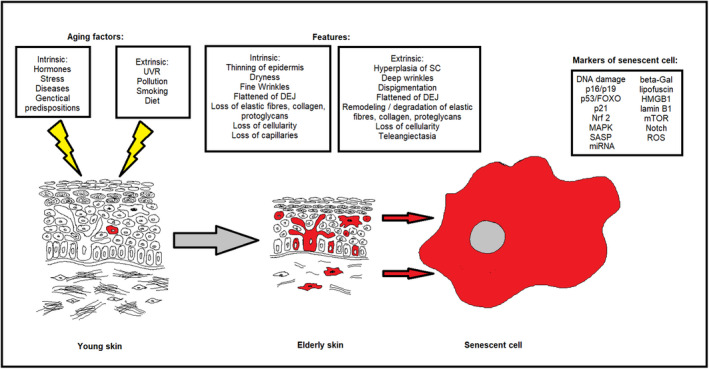
Despite the growing interest by researchers into cellular senescence, a hallmark of cellular aging, its role in human skin remains equivocal. The skin is the largest and most accessible human organ, reacting to the external and internal environment. Hence, it is an organ of choice to investigate cellular senescence and to target root-cause aging processes using senolytic and senomorphic agents, including naturally occurring plant-based derivatives. This review presents different aspects of skin cellular senescence, from physiology to pathology and signaling pathways. Cellular senescence can have both beneficial and detrimental effects on the skin, indicating that both prosenescent and antisenescent therapies may be desirable, based on the context. Knowledge of molecular mechanisms involved in skin cellular senescence may provide meaningful insights for developing effective therapeutics for senescence-related skin disorders, such as wound healing and cosmetic skin aging changes.
Keywords: cellular senescence; senescence-related skin disorders; senolytic agents; senomorphic agents; skin aging.
© 2023 The Authors. Aging Cell published by Anatomical Society and John Wiley & Sons Ltd.
Conflict of interest statement
TT and JLK have a financial interest related to this research, including patents and pending patents covering senolytic drugs and their uses that are held by Mayo Clinic. This research has been reviewed by the Mayo Clinic Conflict of Interest Review Board and was conducted in compliance with Mayo Clinic conflict of interest policies. All other authors declare no conflict of interest.
Figures
References
-
- Acosta, J. C. , Banito, A. , Wuestefeld, T. , Georgilis, A. , Janich, P. , Morton, J. P. , Athineos, D. , Kang, T. W. , Lasitschka, F. , Andrulis, M. , Pascual, G. , Morris, K. J. , Khan, S. , Jin, H. , Dharmalingam, G. , Snijders, A. P. , Carroll, T. , Capper, D. , Pritchard, C. , … Gil, J. (2013). A complex secretory program orchestrated by the inflammasome controls paracrine senescence. Nature Cell Biology, 15, 978–990. 10.1038/ncb2784 - DOI - PMC - PubMed
-
- Alimirah, F. , Pulido, T. , Valdovinos, A. , Alptekin, S. , Chang, E. , Jones, E. , Diaz, D. A. , Flores, J. , Velarde, M. C. , Demaria, M. , Davalos, A. R. , Wiley, C. D. , Limbad, C. , Desprez, P. Y. , & Campisi, J. (2020). Cellular senescence promotes skin carcinogenesis through p38MAPK and p44/p42 MAPK signaling. Cancer Research, 80, 3606–3619. 10.1158/0008-5472.CAN-20-0108 - DOI - PMC - PubMed
Publication types
MeSH terms
Grants and funding
LinkOut - more resources
Full Text Sources
Other Literature Sources
Medical
