


Digital Adherence Technologies and Mobile Money Incentives for Management of Tuberculosis Medication Among People Living With Tuberculosis: Mixed Methods Formative Study
- PMID: 37043263
- PMCID: PMC10134020
- DOI: 10.2196/45301
Digital Adherence Technologies and Mobile Money Incentives for Management of Tuberculosis Medication Among People Living With Tuberculosis: Mixed Methods Formative Study
Abstract
Background: Although there is an increasing use of digital adherence technologies (DATs), such as real-time monitors and SMS reminders in tuberculosis medication adherence, suboptimal patient engagement with various DATs has been reported. Additionally, financial constraints can limit DAT's utility. The perceived usefulness and the design mechanisms of DATs linked to mobile money financial incentives for tuberculosis medication management remain unclear.
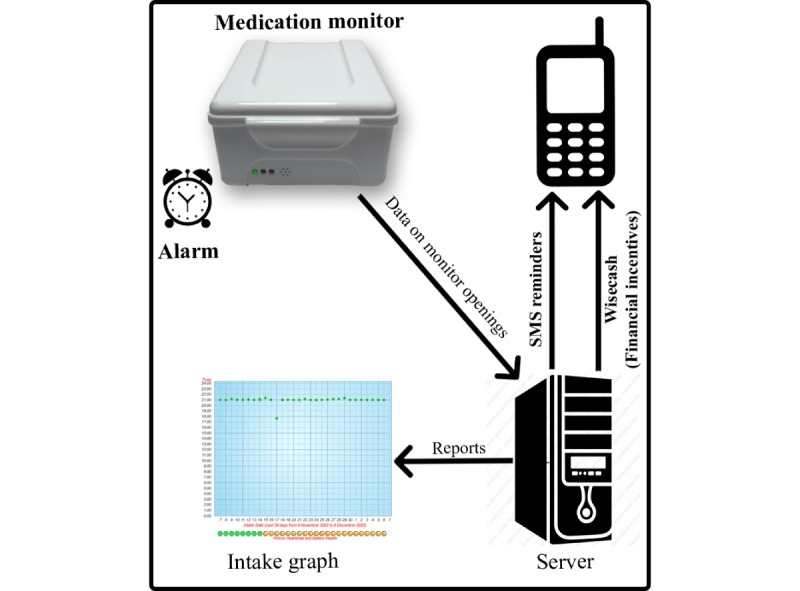
Objective: The aim of this study is to describe the perceived usefulness and design mechanisms for a DAT intervention called My Mobile Wallet, which is composed of real-time adherence monitors, SMS reminders, and mobile money incentives to support tuberculosis medication adherence in a low-income setting.
Methods: This study used mixed methods approaches among persons with tuberculosis recruited from the Tuberculosis Clinic in the Mbarara Regional Referral Hospital. We purposively sampled 21 persons with tuberculosis aged 18 years and older, who owned cell phones and were able to use SMS text messaging interventions. We also enrolled 9 participants who used DATs in our previous study. We used focus group discussions with the 30 participants to solicit perceptions about the initial version of the My Mobile Wallet intervention, and then iteratively refined subsequent versions of the intervention following a user-centered design approach until the beta version of the intervention that suited their needs was developed. Surveys eliciting information about participants' cell phone use and perceptions of the intervention were also administered. Content analysis was used to inductively analyze qualitative data to derive categories describing the perceived usefulness of the intervention, concerns, and design mechanisms. Stata (version 13; StataCorp) was used to analyze survey data.
Results: Participants expressed the perceived usefulness of the My Mobile Wallet intervention in terms of being reminded to take medication, supported with transport to the clinic, and money to meet other tuberculosis medication-related costs, all of which were perceived to imply care, which could create a sense of connectedness to health care workers. This could consequently cause participants to develop a self-perceived need to prove their commitment to adherence to health care workers who care for them, thereby motivating medication adherence. For fear of unintended tuberculosis status disclosure, 20 (67%) participants suggested using SMS language that is confidential-not easily related to tuberculosis. To reduce the possibilities of using the money for other competing demands, 25 (83%) participants preferred sending the money 1-2 days before the appointment to limit the time lag between receiving the money and visiting the clinic.
Conclusions: DATs complemented with mobile money financial incentives could potentially provide acceptable approaches to remind, support, and motivate patients to adhere to taking their tuberculosis medication.
Trial registration: ClinicalTrials.gov NCT05656287; https://clinicaltrials.gov/ct2/show/NCT05656287.
Keywords: SMS reminders; digital adherence technologies; financial incentives; medication adherence; mobile money; mobile phone; mobile wallet; real-time monitoring; support medication; tuberculosis; user-centered approach.
©Angella Musiimenta, Wilson Tumuhimbise, Esther Atukunda, Aaron Mugaba, Sebastian Linnemayr, Jessica Haberer. Originally published in JMIR Formative Research (https://formative.jmir.org), 12.04.2023.
Conflict of interest statement
Conflicts of Interest: JH has been a paid consultant for Merck.
Figures


References
-
- TB kills more people per year than HIV and malaria combined, says professor. Eyewitness News. [2022-11-17]. https://ewn.co.za/2022/03/24/tb-kills-more-people-per-year-than-hiv-and-... .
-
- Global tuberculosis control: WHO report 2000. World Health Organizaion. [2023-03-24]. https://apps.who.int/iris/bitstream/handle/10665/63835/WHO_CDS_TB_2000.2... .
-
- Adane AA, Alene KA, Koye DN, Zeleke BM. Non-adherence to anti-tuberculosis treatment and determinant factors among patients with tuberculosis in northwest Ethiopia. PLoS One. 2013;8(11):e78791. doi: 10.1371/journal.pone.0078791. https://dx.plos.org/10.1371/journal.pone.0078791 PONE-D-13-31718 - DOI - PMC - PubMed
-
- Ridho A, Alfian SD, van Boven JFM, Levita J, Yalcin EA, Le L, Alffenaar J, Hak E, Abdulah R, Pradipta IS. Digital health technologies to improve medication adherence and treatment outcomes in patients with tuberculosis: systematic review of randomized controlled trials. J Med Internet Res. 2022;24(2):e33062. doi: 10.2196/33062. https://www.jmir.org/2022/2/e33062/ v24i2e33062 - DOI - PMC - PubMed
Associated data
Grants and funding
LinkOut - more resources
Full Text Sources
Medical
