. 2023 Apr;11(4):e006365.
doi: 10.1136/jitc-2022-006365.

Characterization of the endotheliopathy, innate-immune activation and hemostatic imbalance underlying CAR-T cell toxicities: laboratory tools for an early and differential diagnosis

Affiliations

Characterization of the endotheliopathy, innate-immune activation and hemostatic imbalance underlying CAR-T cell toxicities: laboratory tools for an early and differential diagnosis

Ana Belen Moreno-Castaño et al. J Immunother Cancer. 2023 Apr.

Abstract

Background: Chimeric antigen receptor (CAR)-T cell-based immunotherapy constitutes a revolutionary advance for treatment of relapsed/refractory hematological malignancies. Nevertheless, cytokine release and immune effector cell-associated neurotoxicity syndromes are life-threatening toxicities in which the endothelium could be a pathophysiological substrate. Furthermore, differential diagnosis from sepsis, highly incident in these patients, is challenging. Suitable laboratory tools could be determinant for their appropriate management.

Methods: Sixty-two patients treated with CAR-T cell immunotherapy for hematological malignancies (n=46 with CD19-positive diseases, n=16 with multiple myeloma) were included. Plasma samples were obtained: before CAR-T cell infusion (baseline); after 24-48 hours; at suspicion of any toxicity onset and 24-48 hours after immunomodulatory treatment. Biomarkers of endothelial dysfunction (soluble vascular cell adhesion molecule 1 (sVCAM-1), soluble TNF receptor 1 (sTNFRI), thrombomodulin (TM), soluble suppression of tumorigenesis-2 factor (ST2), angiopoietin-2 (Ang-2)), innate immunity activation (neutrophil extracellular traps (NETs), soluble C5b-9 (sC5b-9)) and hemostasis/fibrinolysis (von Willebrand Factor antigen (VWF:Ag), ADAMTS-13 (A13), α2-antiplasmin (α2-AP), plasminogen activator inhibitor-1 antigen (PAI-1 Ag)) were measured and compared with those in cohorts of patients with sepsis and healthy donors.

Results: Patients who developed CAR-T cell toxicities presented increased levels of sVCAM-1, sTNFRI and ST2 at the clinical onset versus postinfusion values. Twenty-four hours after infusion, ST2 levels were good predictors of any CAR-T cell toxicity, and combination of ST2, Ang-2 and NETs differentiated patients requiring intensive care unit admission from those with milder clinical presentations. Association of Ang-2, NETs, sC5b-9, VWF:Ag and PAI-1 Ag showed excellent discrimination between severe CAR-T cell toxicities and sepsis.

Conclusions: This study provides relevant contributions to the current knowledge of the CAR-T cell toxicities pathophysiology. Markers of endotheliopathy, innate immunity activation and hemostatic imbalance appear as potential laboratory tools for their prediction, severity and differential diagnosis.

Keywords: antineoplastic protocols; cytotoxicity, immunologic; hematologic neoplasms; immunity, cellular; immunotherapy.


Conflict of interest statement

Competing interests: MD-R and EC have been granted by and received honoraria from Jazz Pharmaceuticals. SF and PC have collaborated with Jansen, Gilead, Kite, MSD, Alexion and Pfizer, outside of the submitted work. MP received speaker’s fee from Jazz Pharmaceuticals. The rest of authors have no competing interests to declare.

Figures
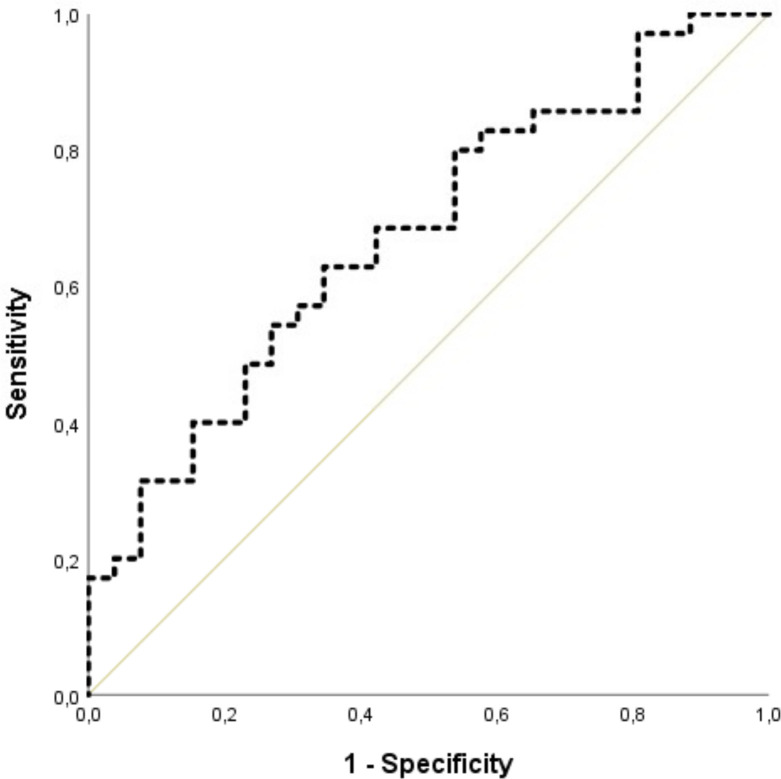
Figure 1
Figure 1
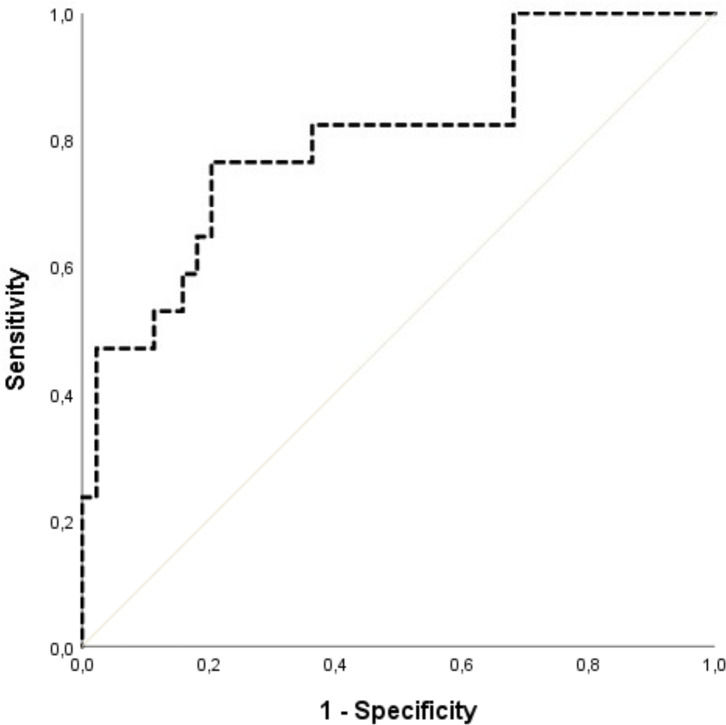
Prediction of toxicity. Predictive model of soluble suppression of tumorigenesis-2 factor (ST2) at sample collected 24–48 hours after infusion (24-INF) point for the outcome ‘presence of any chimeric antigen receptor (CAR)-T cell-related toxicity’ meant as clinical detection of cytokine release syndrome (CRS) and/or immune effector cell-associated neurotoxicity (ICANS) of any severity grade. Area under the curve (AUC) 0.7 (95% CI 0.54 to 0.81, p=0.020).
Figure 2
Figure 2
Prediction of severity. Receiver operating characteristic (ROC) curve after the application of a regression model for the predictive value of the composed variable created from soluble suppression of tumorigenesis-2 factor (ST2), angiopoietin-2 (Ang-2) and neutrophil extracellular traps (NETs) levels at sample collected 24–48 hours after infusion (24-INF) point for the outcome ‘intensive care unit (ICU) admission’. Area under the curve (AUC) 0.8 (95% CI 0.67 to 0.93, p<0.001). The values of the AUC and 95% CI, and the proposed cutoffs for each biomarker are shown below (graph not shown): Ang-2: AUC 0.7 (95% CI 0.501 to 0.835, p=0.043). Levels of Ang-2 >1877 pg/mL have a sensitivity of 70% and a specificity of 57% for the prediction of ‘ICU admission’. ST2: AUC 0.8 (95% CI 0.626 to 0.93, p=0.001). Levels of ST2 >38.7 ng/mL have a sensitivity of 82% and a specificity of 70% for the prediction of ‘ICU admission’. NETs: AUC 0.7 (95% CI 0.559 to 0876, p=0.009). Levels of NETs >7.5 µg/mL have a sensitivity of 70% and a specificity of 88% for the prediction of ‘ICU admission’.
Figure 3
Figure 3
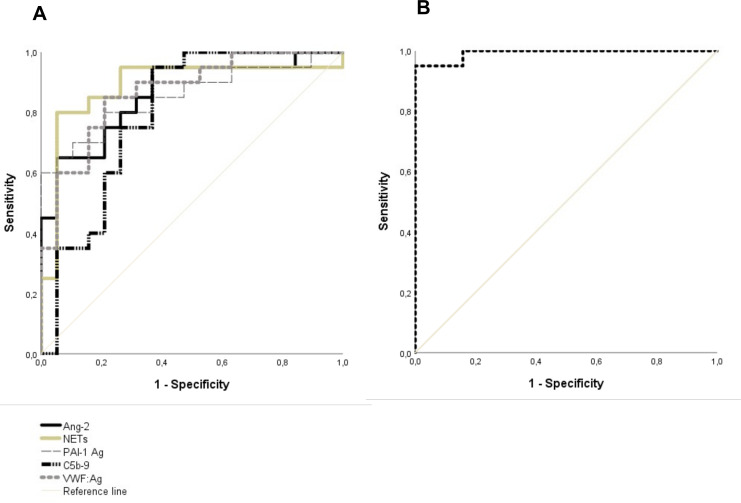
Differential diagnosis: toxicity versus sepsis. (A) Receiver operating characteristic (ROC) curve for the diagnostic value of angiopoietin-2 (Ang-2), neutrophil extracellular traps (NETs), soluble C5b9 (sC5b-9), von Willebrand Factor antigen (VWF:Ag) and plasminogen activator inhibitor-1 (PAI-1) at Tox-onset point, for the outcome ‘sepsis’. The values of the area under the curve (AUC) and 95% CI, and the proposed cutoffs for each variable are shown below: Ang-2: AUC 0.861 (95% CI 0.744 to 0.977). Levels of Ang-2 >4823 pg/mL have a sensitivity of 80% and a specificity of 74% for the diagnosis of sepsis over chimeric antigen receptor (CAR)-T toxicity. NETs: AUC 0.887 (95% CI 0.76 to 1); p<0.001. Levels of NETs >16.5 µg/mL have a sensitivity of 80% and specificity of 84% for the diagnosis of sepsis over CAR-T toxicity. sC5b-9: AUC 0.795 (95% CI 0.64 to 0.943); p=0.002. Levels of sC5b-9 >1109 ng/mL have a sensitivity of 75% and specificity of 73% for the diagnosis of sepsis over CAR-T toxicity. VWF:Ag: AUC 0.868 (95% CI 0.757 to 0.898); p<0.001. Levels of VWF:Ag >345% have a sensitivity of 75% and specificity of 84% for the diagnosis of sepsis over CAR-T toxicity. PAI-1 Ag: AUC 0.853 (95% CI 0.73 to 0.975); p<0.001. Cut-off value of PAI-1 Ag >73.6 ng/mL have a sensitivity 70% and specificity of 90% for the diagnosis of sepsis over CAR-T toxicity. (B) Predictive model for the outcome ‘sepsis’ with the composed variable created from Ang-2, NETs, sC5b-9, VWF:Ag and PAI-1 Ag at the onset of the toxicity in CAR-T cell-patients (Tox-onset point) or at the onset of sepsis. AUC 0.992 (95% CI 0.934 to 1); p<0.001.

References

    1. Brudno JN, Kochenderfer JN. Recent advances in car T-cell toxicity: mechanisms, manifestations and management. Blood Rev 2019;34:45–55. 10.1016/j.blre.2018.11.002 - DOI - PMC - PubMed
    1. Azoulay É, Castro P, Maamar A, et al. . Outcomes in patients treated with chimeric antigen receptor T-cell therapy who were admitted to intensive care (CARTTAS): an international, multicentre, observational cohort study. Lancet Haematol 2021;8:e355–64. 10.1016/S2352-3026(21)00060-0 - DOI - PubMed
    1. Lee DW, Gardner R, Porter DL, et al. . Current concepts in the diagnosis and management of cytokine release syndrome. Blood 2014;124:188–95. 10.1182/blood-2014-05-552729 - DOI - PMC - PubMed
    1. Sievers S, Watson G, Johncy S, et al. . Recognizing and grading CAR T-cell toxicities: an advanced practitioner perspective. Front Oncol 2020;10:885. 10.3389/fonc.2020.00885 - DOI - PMC - PubMed
    1. Hong R, Zhao H, Wang Y, et al. . Clinical characterization and risk factors associated with cytokine release syndrome induced by COVID-19 and chimeric antigen receptor T-cell therapy. Bone Marrow Transplant 2021;56:570–80. 10.1038/s41409-020-01060-5 - DOI - PMC - PubMed

Publication types

Substances