


Prevalence and risk factors of chronic respiratory symptoms in public and private school teachers in north-western Ethiopia: results from a multicentre cross-sectional study
- PMID: 37045568
- PMCID: PMC10106045
- DOI: 10.1136/bmjopen-2022-069159
Prevalence and risk factors of chronic respiratory symptoms in public and private school teachers in north-western Ethiopia: results from a multicentre cross-sectional study
Abstract
Objective: This study aimed to investigate the prevalence and risk factors of chronic respiratory symptoms among school teachers in Gondar city, north-western Ethiopia.
Design: A school-based cross-sectional study was conducted from April to May 2019. A self-administered British Medical Research Council Questionnaire was used to assess chronic respiratory symptoms. Data were entered into Epi Info V.7 and Stata V.14 was used for analysis. A multivariable logistic regression analysis was conducted to identify factors associated with chronic respiratory symptoms. The association was determined using adjusted OR (AOR) with a 95% CI at a value of p<0.05.
Setting: The study was conducted in public and private schools in Gondar city.
Participants: A total of 822 teachers participated in this study.
Outcome measures: The primary outcome is the prevalence of chronic respiratory symptoms.
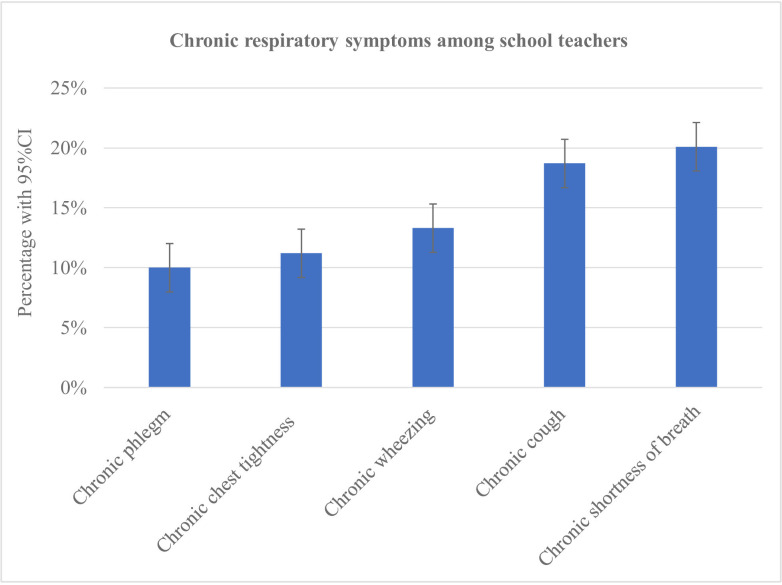
Results: The total response rate was 97.4%. The majority, 532 (64.7%) of the participants, were male. The mean age (±SD) of the respondents was 36.69 (±6.93) years. The total prevalence of chronic respiratory symptoms in the previous 12 months among teachers in Gondar city was found to be 31.14% (95% CI 27.99% to 34.43%). A family history of respiratory problems (AOR=1.90; 95% CI 1.07 to 3.37), an overweight body mass index (AOR=2.57; 95% CI 1.57 to 4.21), exposure to secondhand cigarette smoke at home (AOR=9.85; 95% CI 4.77 to 20.33), use of chalk (AOR=1.97; 95% CI 1.25 to 3.09), and failure to open windows during class (AOR=2.15; 95% CI 1.02 to 4.52) were risk factors for chronic respiratory symptoms.
Conclusion: This study concluded that the prevalence of chronic respiratory symptoms was high among teachers. Making a smoking-free zone, avoiding smoking in public places, improving the ventilation conditions of the classrooms and controlling the chalk dust are all necessary actions to take to reduce chronic respiratory symptoms.
Keywords: Epidemiology; RESPIRATORY MEDICINE (see Thoracic Medicine); Respiratory infections; Respiratory physiology; Respiratory tract tumours.
© Author(s) (or their employer(s)) 2023. Re-use permitted under CC BY-NC. No commercial re-use. See rights and permissions. Published by BMJ.
Conflict of interest statement
Competing interests: None declared.
Figures
References
-
- Cruz AA. Global surveillance, prevention and control of chronic respiratory diseases: a comprehensive approach. World Health Organization; 2007.
Publication types
MeSH terms
LinkOut - more resources
Full Text Sources
Miscellaneous
