. 2023 Jul 7;192(7):1181-1191.
doi: 10.1093/aje/kwad076.

The Effect of HIV Treatment Interruption on Subsequent Immunological Response

The Effect of HIV Treatment Interruption on Subsequent Immunological Response

Christos Thomadakis et al. Am J Epidemiol. .

Abstract

Recovery of CD4-positive T lymphocyte count after initiation of antiretroviral therapy (ART) has been thoroughly examined among people with human immunodeficiency virus infection. However, immunological response after restart of ART following care interruption is less well studied. We compared CD4 cell-count trends before disengagement from care and after ART reinitiation. Data were obtained from the East Africa International Epidemiology Databases to Evaluate AIDS (IeDEA) Collaboration (2001-2011; n = 62,534). CD4 cell-count trends before disengagement, during disengagement, and after ART reinitiation were simultaneously estimated through a linear mixed model with 2 subject-specific knots placed at the times of disengagement and treatment reinitiation. We also estimated CD4 trends conditional on the baseline CD4 value. A total of 10,961 patients returned to care after disengagement from care, with the median gap in care being 2.7 (interquartile range, 2.1-5.4) months. Our model showed that CD4 cell-count increases after ART reinitiation were much slower than those before disengagement. Assuming that disengagement from care occurred 12 months after ART initiation and a 3-month treatment gap, CD4 counts measured at 3 years since ART initiation would be lower by 36.5 cells/μL than those obtained under no disengagement. Given that poorer CD4 restoration is associated with increased mortality/morbidity, specific interventions targeted at better retention in care are urgently required.

Keywords: CD4 cell count; HIV; antiretroviral therapy; disengagement from care; human immunodeficiency virus; linear mixed models; reengagement in care; treatment interruption.


Figures

Figure 1
Figure 1
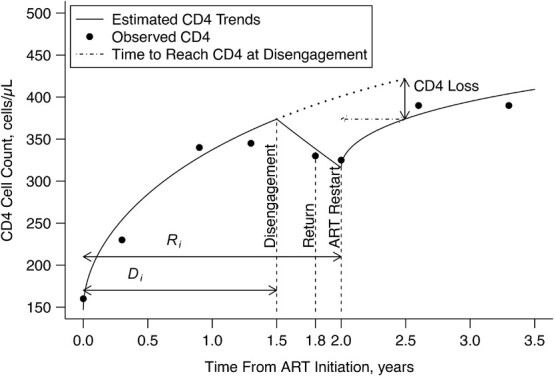
Estimated CD4 cell-count trajectory (based on a linear mixed model including subject-specific knots at time from antiretroviral therapy (ART) initiation to disengagement from care formula image and resumption of treatment formula image, fitted to data from the IeDEA Collaboration) among individuals who disengaged from and subsequently reengaged in care, East Africa, 2001–2011. Shown is the estimated evolution of CD4 cell count (back-transformed from the square-root scale) assuming that the time from ART initiation to disengagement is formula image years and the time gap from disengagement from care to ART reinitiation is formula image months, along with the observed CD4 cell counts (black dots). Also shown is the amount of time it takes to reach the predisengagement CD4 levels and the difference between the CD4 levels 6 months after treatment reinitiation and the CD4 levels that would have been observed had disengagement not happened by that time. AIDS, acquired immunodeficiency syndrome; IeDEA, East Africa International Epidemiology Databases to Evaluate AIDS.
Figure 2
Figure 2
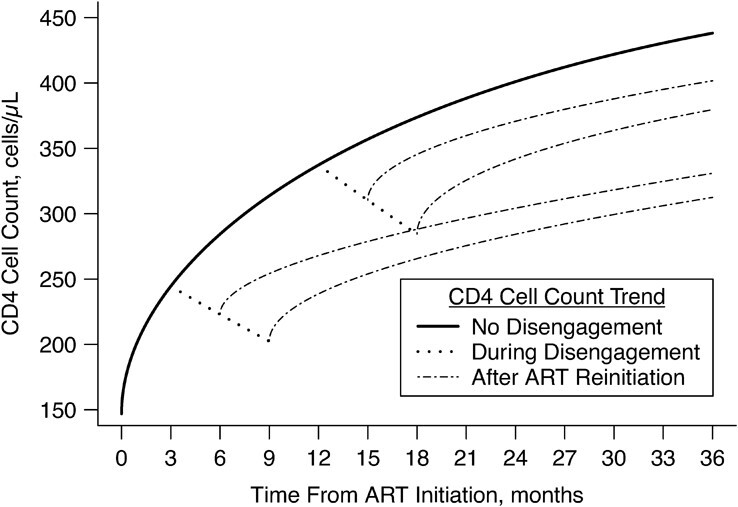
Estimated CD4 cell-count trajectory (based on a linear mixed model including subject-specific knots at time from antiretroviral therapy (ART) initiation to disengagement from care formula image and ART reinitiation formula image, fitted to data from the IeDEA Collaboration) among individuals who disengaged from and subsequently reengaged in care, East Africa, 2001–2011. It is estimated assuming that formula image months or formula image months, with the time gap from disengagement to ART reinitiation being formula image months or formula image months. For comparison, the estimated CD4 evolution assuming no disengagement (solid line) is also presented. AIDS, acquired immunodeficiency syndrome; IeDEA, East Africa International Epidemiology Databases to Evaluate AIDS.
Figure 3
Figure 3
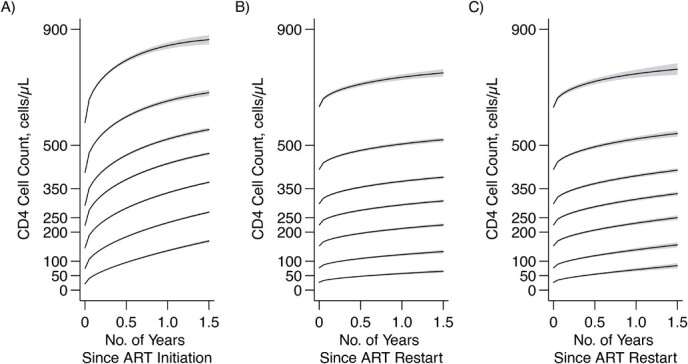
Estimated evolution of CD4 cell count since initiation of antiretroviral therapy (ART) (A) and after reinitiation of ART (B and C) among individuals who disengaged from care and subsequently reengaged in care, conditional on being on the same CD4 category at ART initiation and ART reinitiation, East Africa, 2001–2011. Data from the IeDEA Collaboration were used. B) All CD4 data at/after reengagement in care (ignoring any subsequent disengagement from care); C) censorship of CD4 data at the time of the second disengagement. Shaded regions correspond to the 95% pointwise confidence intervals of the estimated CD4 trajectories. AIDS, acquired immunodeficiency syndrome; IeDEA, East Africa International Epidemiology Databases to Evaluate AIDS.
Figure 4
Figure 4
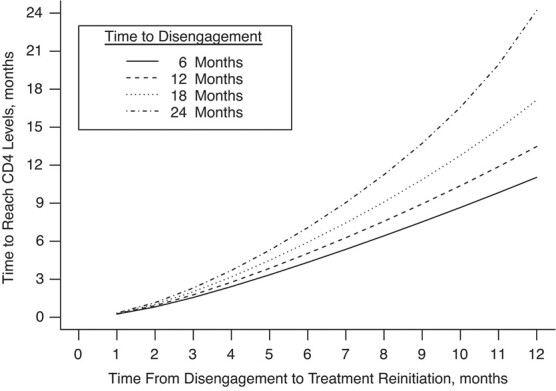
Time needed from reinitiation of antiretroviral therapy (ART) to reaching the CD4 cell count observed at disengagement from care in relation to time from ART initiation to disengagement from care (formula image) and time from disengagement from care to treatment reinitiation (formula image), East Africa, 2001–2011. Data from the IeDEA Collaboration were used. AIDS, acquired immunodeficiency syndrome; IeDEA, East Africa International Epidemiology Databases to Evaluate AIDS.

References

    1. Fahey JL, Taylor JMG, Detels R, et al. . The prognostic value of cellular and serologic markers in infection with human immunodeficiency virus type 1. N Engl J Med. 1990;322(3):166–172. - PubMed
    1. Pantazis N, Porter K, Costagliola D, et al. . Temporal trends in prognostic markers of HIV-1 virulence and transmissibility: an observational cohort study. Lancet HIV. 2014;1(3):e119–e126. - PubMed
    1. Balestre E, Eholié SP, Lokossue A, et al. . Effect of age on immunological response in the first year of antiretroviral therapy in HIV-1-infected adults in West Africa. AIDS. 2012;26(8):951–957. - PMC - PubMed
    1. Pantazis N, Papastamopoulos V, Paparizos V, et al. . Long-term evolution of CD4+ cell count in patients under combined antiretroviral therapy. AIDS. 2019;33(10):1645–1655. - PubMed
    1. Stirrup OT, Copas AJ, Phillips AN, et al. . Predictors of CD4 cell recovery following initiation of antiretroviral therapy among HIV-1 positive patients with well-estimated dates of seroconversion. HIV Med. 2018;19(3):184–194. - PMC - PubMed

Publication types