


Quantitative assessment can stabilize indirect reciprocity under imperfect information
- PMID: 37045828
- PMCID: PMC10097696
- DOI: 10.1038/s41467-023-37817-x
Quantitative assessment can stabilize indirect reciprocity under imperfect information
Abstract
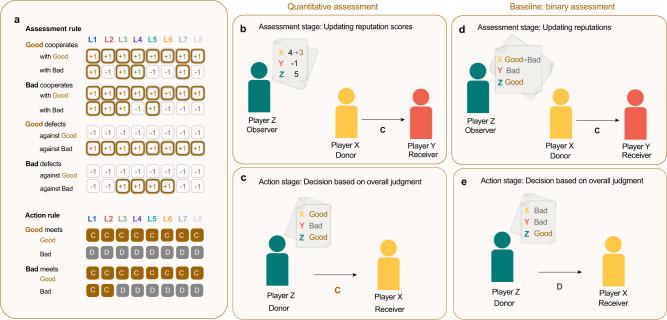
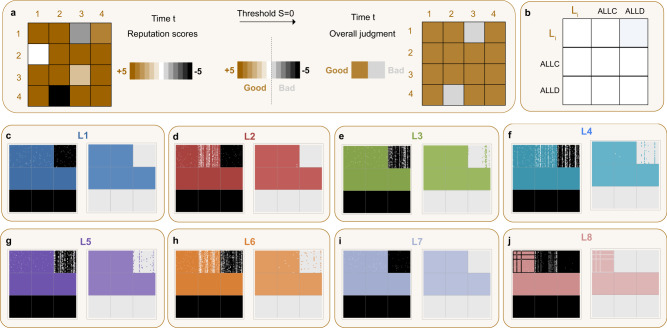
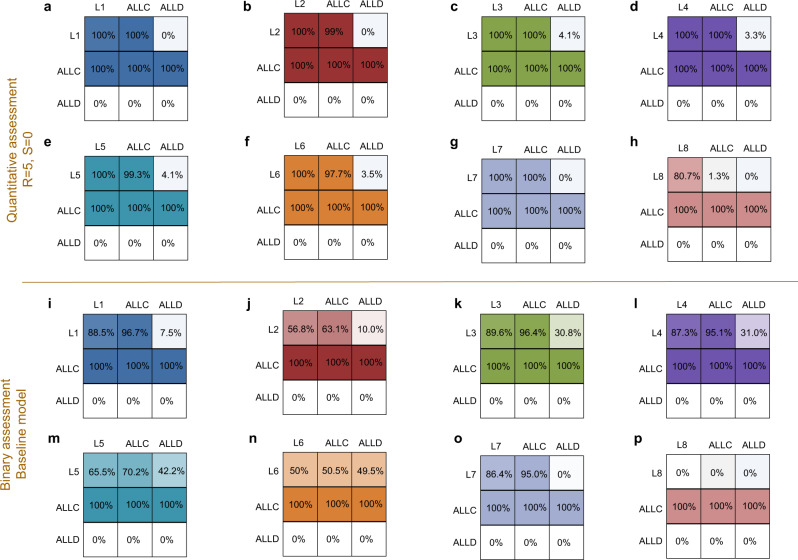
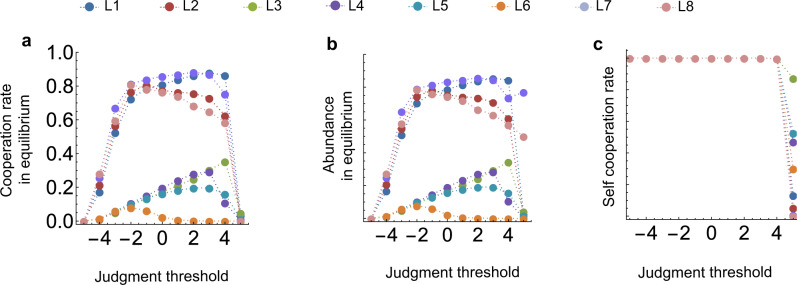
The field of indirect reciprocity investigates how social norms can foster cooperation when individuals continuously monitor and assess each other's social interactions. By adhering to certain social norms, cooperating individuals can improve their reputation and, in turn, receive benefits from others. Eight social norms, known as the "leading eight," have been shown to effectively promote the evolution of cooperation as long as information is public and reliable. These norms categorize group members as either 'good' or 'bad'. In this study, we examine a scenario where individuals instead assign nuanced reputation scores to each other, and only cooperate with those whose reputation exceeds a certain threshold. We find both analytically and through simulations that such quantitative assessments are error-correcting, thus facilitating cooperation in situations where information is private and unreliable. Moreover, our results identify four specific norms that are robust to such conditions, and may be relevant for helping to sustain cooperation in natural populations.
© 2023. The Author(s).
Conflict of interest statement
The authors declare no competing interests.
Figures
References
-
- Alexander, R. The Biology of Moral Systems (Aldine de Gruyter, 1987).
-
- Bolton GE, Katok E, Ockenfels A. Cooperation among strangers with limited information about reputation. J. Public Econ. 2005;89:1457–68. doi: 10.1016/j.jpubeco.2004.03.008. - DOI
Publication types
MeSH terms
LinkOut - more resources
Full Text Sources
Research Materials
