


Early and mid-term outcomes of off-pump versus on-pump coronary artery bypass surgery in patients with triple-vessel coronary artery disease: a randomized controlled trial
- PMID: 37046338
- PMCID: PMC10099835
- DOI: 10.1186/s13019-023-02258-6
Early and mid-term outcomes of off-pump versus on-pump coronary artery bypass surgery in patients with triple-vessel coronary artery disease: a randomized controlled trial
Abstract
Background and aim of the study: Several studies have compared early and late outcomes of on-pump coronary artery bypass grafting (CABG) and off-pump CABG. However, there is still an ongoing debate on this matter, especially in patients with triple-vessel coronary artery disease (3VD).
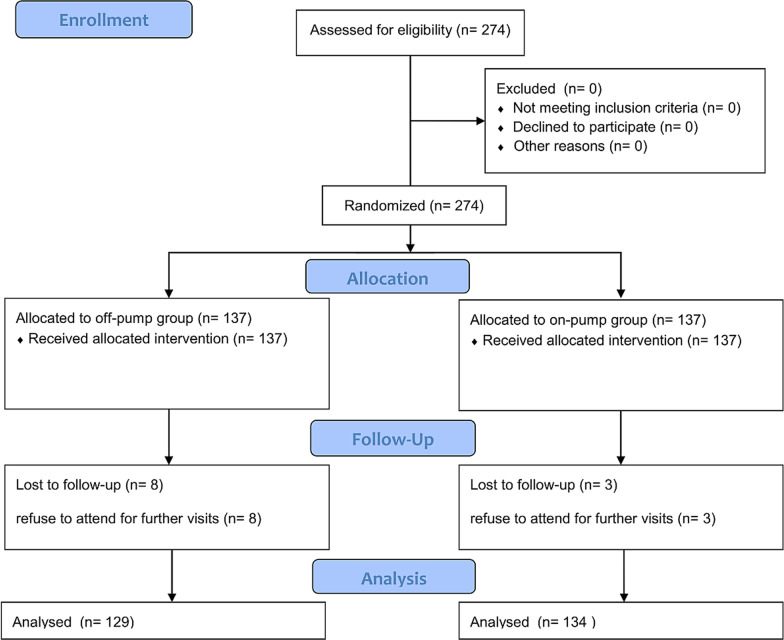
Methods: We randomly assigned 274 consecutive patients with 3VD to two equal groups to undergo on-pump CABG or off-pump CABG. The primary outcome was major adverse cardiac and cerebrovascular events (MACCE), including all-cause mortality, acute coronary syndrome, stroke or transient ischemic attack, and the need for repeat revascularization. The secondary outcomes were postoperative infection, ventilation time, ICU admission duration, hospital stay length, and renal failure after surgery.
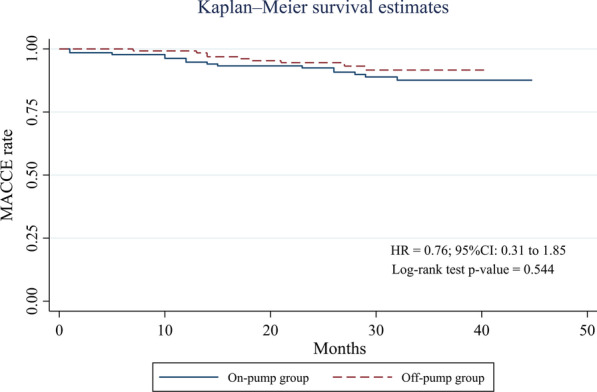
Results: The median follow-up duration was 31.2 months (range 24.6-35.2 months). The mean age of patients was 61.4 ± 9.3 years (range: 38-86), and 207 (78.7%) were men. There were 15 (11.2%) and 9 (7.0%) MACCE occurrences in on-pump and off-pump groups, respectively (P value = 0.23). MACCE components including all-cause death, non-fatal MI, CVA, and revascularization did not significantly differ between on-pump and off-pump groups. We observed no difference in the occurrence of MACCE between off-pump and on-pump groups in multivariable regression analysis (HR = 0.57; 95% CI 0.24-1.32; P value = 0.192). There were no statistical differences in postoperative outcomes between the off-pump and on-pump CABG groups.
Conclusions: Off-pump CABG is an equal option to on-pump CABG for 3VD patients with similar rates of MACCE and postoperative complications incidence when surgery is performed in the same setting by an expert surgeon in both methods. (IRCT20190120042428N1).
Keywords: Cardiopulmonary bypass; Coronary artery bypass grafting; Coronary artery bypass, off-pump; Major adverse cardiac events; Mortality.
© 2023. The Author(s).
Conflict of interest statement
The authors declare that they have no competing interests.
Figures

References
-
- Kowalewski M, Pawliszak W, Malvindi PG, Bokszanski MP, Perlinski D, Raffa GM, et al. Off-pump coronary artery bypass grafting improves short-term outcomes in high-risk patients compared with on-pump coronary artery bypass grafting: meta-analysis. J Thorac Cardiovasc Surg. 2016;151(1):60–77. doi: 10.1016/j.jtcvs.2015.08.042. - DOI - PubMed
-
- Deppe A-C, Arbash W, Kuhn EW, Slottosch I, Scherner M, Liakopoulos OJ, et al. Current evidence of coronary artery bypass grafting off-pump versus on-pump: a systematic review with meta-analysis of over 16 900 patients investigated in randomized controlled trials. Eur J Cardiothorac Surg. 2016;49(4):1031–1041. doi: 10.1093/ejcts/ezv268. - DOI - PubMed
-
- Puskas JD, Williams WH, Duke PG, Staples JR, Glas KE, Marshall JJ, et al. Off-pump coronary artery bypass grafting provides complete revascularization with reduced myocardial injury, transfusion requirements, and length of stay: a prospective randomized comparison of two hundred unselected patients undergoing off-pump versus conventional coronary artery bypass grafting. J Thorac Cardiovasc Surg. 2003;125(4):797–808. doi: 10.1067/mtc.2003.324. - DOI - PubMed
Publication types
MeSH terms
LinkOut - more resources
Full Text Sources
Medical
Research Materials
