


The Role of Oxidative Stress Enhanced by Adiposity in Cardiometabolic Diseases
- PMID: 37047352
- PMCID: PMC10094567
- DOI: 10.3390/ijms24076382
The Role of Oxidative Stress Enhanced by Adiposity in Cardiometabolic Diseases
Abstract
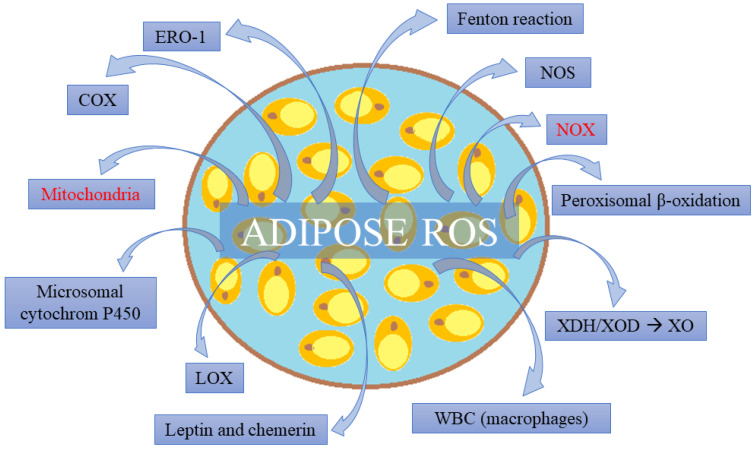
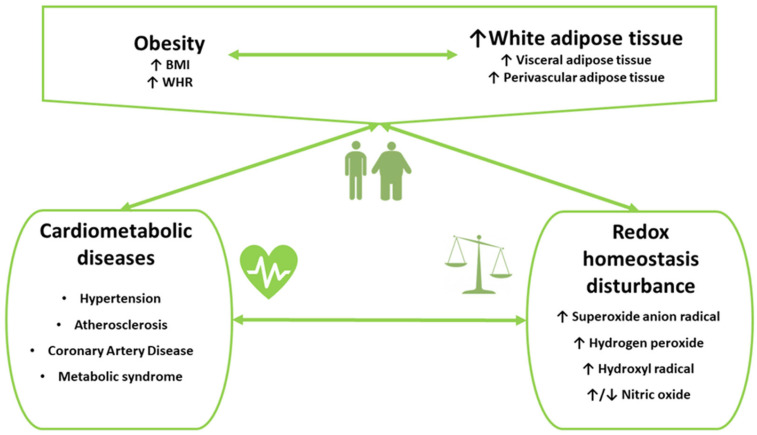
Cardiometabolic diseases (CMDs), including cardiovascular disease (CVD), metabolic syndrome (MetS), and type 2 diabetes (T2D), are associated with increased morbidity and mortality. The growing prevalence of CVD is mostly attributed to the aging population and common occurrence of risk factors, such as high systolic blood pressure, elevated plasma glucose, and increased body mass index, which led to a global epidemic of obesity, MetS, and T2D. Oxidant-antioxidant balance disorders largely contribute to the pathogenesis and outcomes of CMDs, such as systemic essential hypertension, coronary artery disease, stroke, and MetS. Enhanced and disturbed generation of reactive oxygen species in excess adipose tissue during obesity may lead to increased oxidative stress. Understanding the interplay between adiposity, oxidative stress, and cardiometabolic risks can have translational impacts, leading to the identification of novel effective strategies for reducing the CMDs burden. The present review article is based on extant results from basic and clinical studies and specifically addresses the various aspects associated with oxidant-antioxidant balance disorders in the course of CMDs in subjects with excess adipose tissue accumulation. We aim at giving a comprehensive overview of existing knowledge, knowledge gaps, and future perspectives for further basic and clinical research. We provide insights into both the mechanisms and clinical implications of effects related to the interplay between adiposity and oxidative stress for treating and preventing CMDs. Future basic research and clinical trials are needed to further examine the mechanisms of adiposity-enhanced oxidative stress in CMDs and the efficacy of antioxidant therapies for reducing risk and improving outcome of patients with CMDs.
Keywords: cardiometabolic diseases; cardiovascular disease; coronary artery disease; metabolic syndrome; obesity; oxidative stress; type 2 diabetes.
Conflict of interest statement
The authors declare no conflict of interest.
Figures
References
-
- Vos T., Lim S.S., Abbafati C., Abbas K.M., Abbasi M., Abbasifard M., Abbasi-Kangevari M., Abbastabar H., Abd-Allah F., Abdelalim A., et al. Global burden of 369 diseases and injuries in 204 countries and territories, 1990–2019: A systematic analysis for the Global Burden of Disease Study 2019. Lancet. 2020;396:1204–1222. doi: 10.1016/S0140-6736(20)30925-9. - DOI - PMC - PubMed
-
- Virani S.S., Alonso A., Benjamin E.J., Bittencourt M.S., Callaway C.W., Carson A.P., Chamberlain A.M., Chang A.R., Cheng S., Delling F., et al. Heart Disease and Stroke Statistics—2020 Update. A Report From The American Heart Association. Circulation. 2020;141:e139–e596. doi: 10.1161/CIR.0000000000000757. - DOI - PubMed
-
- Lewington S., Clarke R., Qizilbash N., Peto R., Collins R., Collaboration P.S. Age-specific relevance of usual blood pressure to vascular mortality: A meta-analysis of individual data for one million adults in 61 prospective studies. Lancet. 2002;360:1903–1913. doi: 10.1016/S0140-6736(02)11911-8. - DOI - PubMed
-
- Alberti K.G.M.M., Eckel R.H., Grundy S.M., Zimmet P.Z., Cleeman J.I., Donato K.A., Fruchart J.C., James W.P.T., Loria C.M., Smith S.C. Harmonizing the metabolic syndrome: A joint interim statement of the international diabetes federation task force on epidemiology and prevention; National heart, lung, and blood institute; American heart association; World heart federation; International. Circulation. 2009;120:1640–1645. doi: 10.1161/CIRCULATIONAHA.109.192644. - DOI - PubMed
Publication types
MeSH terms
Substances
LinkOut - more resources
Full Text Sources
Medical
