


Uses of Papaya Leaf and Seaweed Supplementations for Controlling Glucose Homeostasis in Diabetes
- PMID: 37047820
- PMCID: PMC10095424
- DOI: 10.3390/ijms24076846
Uses of Papaya Leaf and Seaweed Supplementations for Controlling Glucose Homeostasis in Diabetes
Abstract
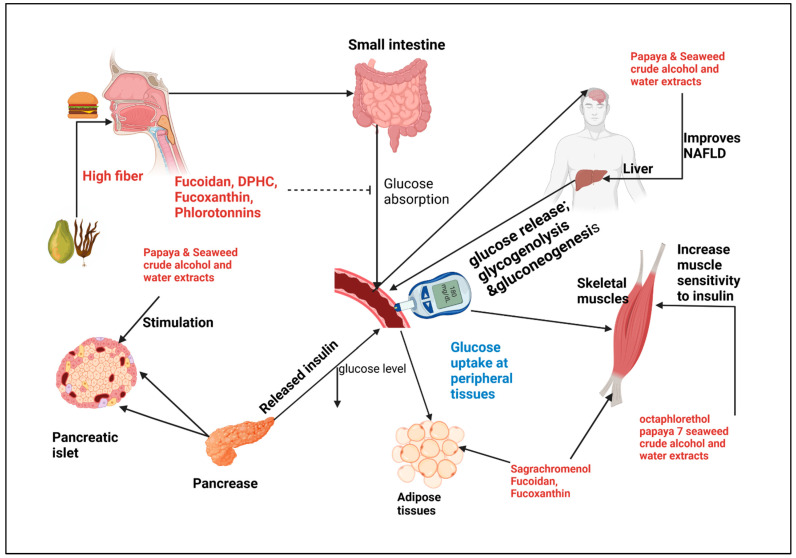
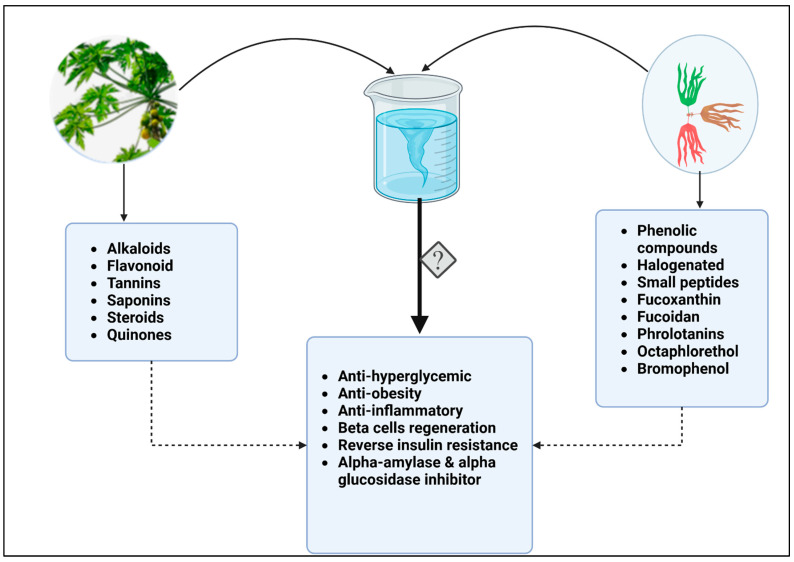
Studies from laboratory animal models and complementary medical practices have implied that nutrients from special plants or herbs contain antidiabetic, antioxidant, anti-obese, anti-hypertensive, and anti-inflammatory properties. Seaweed and tropical papaya, which are widely available in Asian and Pacific countries, have been used as home remedies for centuries. The bioactive extracts from these plants contain vitamins A, C, B and E complexes, as well as polysaccharides, phenolic compounds, essential fatty acids, flavonoids, saponins, fucoidan, and phlorotannin. In this review, the authors examine the pathogenesis of diabetes characterized by hyperglycemia due to the dysregulation of glucose homeostasis, antidiabetic/antihyperglycemic seaweed or/and papaya derived bioactive phytochemicals and their proposed mechanisms of action in the management of Type 2 Diabetes Mellitus (T2DM). The authors also propose combining papaya and seaweed to enhance their antidiabetic effects, leveraging the advantages of herb-to-herb combination. Papaya and seaweed have demonstrated antidiabetic effects through in vitro assays, cellular models, and animal studies despite the limited clinical trials. Nutraceuticals with antidiabetic effects, such as secondary metabolites isolated from seaweed and papaya, could be combined for a synergistic effect on T2DM management. However, the application of these compounds in their purified or mixed forms require further scientific studies to evaluate their efficacy against diabetes-related complications, such as hyperlipidemia, elevated free radicals, pro-inflammatory molecules, insulin insensitivity, and the degeneration of pancreatic beta cells.
Keywords: Carica papaya; bioactive compound; diabetes; glucose uptake; herbs; hyperglycemia; insulin resistance; natural products; seaweed; secondary metabolites; type 2 diabetes.
Conflict of interest statement
The authors declare no conflict of interest.
Figures
References
-
- Ogurtsova K., Da Rocha Fernandes J.D., Huang Y., Linnenkamp U., Guariguata L., Cho N.H., Cavan D., Shaw J.E., Makaroff L.E. IDF Diabetes Atlas: Global estimates for the prevalence of diabetes for 2015 and 2040. Diabetes Res. Clin. Pract. 2017;128:40–50. doi: 10.1016/j.diabres.2017.03.024. - DOI - PubMed
-
- Zhao C., Yang C., Liu B., Lin L., Sarker S.D., Nahar L., Yu H., Cao H., Xiao J. Bioactive compounds from marine macroalgae and their hypoglycemic benefits. Trends Food Sci. Technol. 2018;72:1–12. doi: 10.1016/j.tifs.2017.12.001. - DOI
Publication types
MeSH terms
Substances
Grants and funding
LinkOut - more resources
Full Text Sources
Medical
