


Analysis of Clinical Factors Associated with Medical Burden and Functional Status in Pyogenic Spine Infection
- PMID: 37048635
- PMCID: PMC10095451
- DOI: 10.3390/jcm12072551
Analysis of Clinical Factors Associated with Medical Burden and Functional Status in Pyogenic Spine Infection
Abstract
Background and purpose: Pyogenic spinal infection (PSI) has recently been on the rise due to aging and increasing degenerative spinal disease related procedures. PSI requires long-term antibiotic treatment and is followed by sustained functional disability even after successful treatment. This study aimed to analyze the clinical factors associated with medical burden and functional status of PSI.
Methods: This retrospective study involved patients with non-postoperative PSI of thoraco-lumbo-sacral area in a single tertiary hospital. The length/cost of hospitalization with an antibiotic therapy and severity of back pain using the short form 36 (SF-36) were defined as the medical burden and functional status, respectively. We analyzed the clinical factors associated with medical burden and functional status.
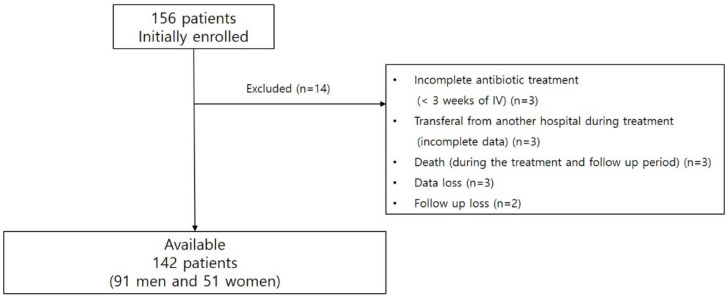
Results: We enrolled 142 patients (91 males and 51 females). The length and cost of hospitalization were 55.56 ± 27.09 (7-172) days and $14,070.17 ± 9289.39 (1611.87-48,722.35), respectively. A recurrence rate of 7.7% (11/142) and significant improvement of SF-36 at six months after completion of antibiotic treatment were noted (p < 0.05). Procedure-related (OR 2.702), C-reactive protein (CRP; OR 1.062), bacteremia (OR 4.966), additional surgical treatment (OR 6.524), recurrence (OR 12.453), and paraspinal abscess (OR 5.965) for above-average length of hospitalization were observed; female (OR 4.438), CRP (OR 1.071), bacteremia (OR 4.647), additional surgical treatment (OR 6.737), recurrence (OR 22.543), and extent of lesion (OR 1.431) for above-average cost of hospitalization; leg weakness (OR 15.966), white blood cell (WBC; OR 1.116), Charlson's comorbidity index (CCI, OR 1.485), and identification of causative bacteria (OR 2.913) for below-average initial SF-36 were observed; leg weakness (OR 7.975) and WBC (OR 1.094) for below-average 6-month SF-36 were the statistically significant clinical factors in the multivariable logistic regression analysis (p < 0.05).
Conclusion: Recurrence and leg weakness were identified as the most important clinical factors for medical burden and functional status in PSI, respectively. We think that it is necessary to actively suppress recurrence and manage neurological deficits for decreasing medical burden and achieving favorable functional outcome in the treatment of PSI.
Keywords: burden; disability; pyogenic; spine infection; vertebral osteomyelitis.
Conflict of interest statement
The authors declare no conflict of interest.
Figures
References
-
- Colmenero J.D., Jimenez-Mejias M.E., Sanchez-Lora F.J., Reguera J.M., Palomino-Nicas J., Martos F., Garcia de las Heras J., Pachon J. Pyogenic, tuberculous, and brucellar vertebral osteomyelitis: A descriptive and comparative study of 219 cases. Ann. Rheum. Dis. 1997;56:709–715. doi: 10.1136/ard.56.12.709. - DOI - PMC - PubMed
-
- Adam D., Papacocea T., Hornea I., Croitoru R. Postoperative spondylodiscitis. A review of 24 consecutive patients. Chirurgia. 2014;109:90–94. - PubMed
Grants and funding
LinkOut - more resources
Full Text Sources
Research Materials
Miscellaneous
