. 2023 Mar 28;13(7):1206.
doi: 10.3390/nano13071206.

Advanced Cellulose-Nanocarbon Composite Films for High-Performance Triboelectric and Piezoelectric Nanogenerators

Affiliations

Advanced Cellulose-Nanocarbon Composite Films for High-Performance Triboelectric and Piezoelectric Nanogenerators

Jaime González et al. Nanomaterials (Basel). .

Abstract

Natural polymers such as cellulose have interesting tribo- and piezoelectric properties for paper-based energy harvesters, but their low performance in providing sufficient output power is still an impediment to a wider deployment for IoT and other low-power applications. In this study, different types of celluloses were combined with nanosized carbon fillers to investigate their effect on the enhancement of the electrical properties in the final nanogenerator devices. Cellulose pulp (CP), microcrystalline cellulose (MCC) and cellulose nanofibers (CNFs) were blended with carbon black (CB), carbon nanotubes (CNTs) and graphene nanoplatelets (GNPs). The microstructure of the nanocomposite films was characterized by scanning electron and probe microscopies, and the electrical properties were measured macroscopically and at the local scale by piezoresponse force microscopy. The highest generated output voltage in triboelectric mode was obtained from MCC films with CNTs and CB, while the highest piezoelectric voltage was produced in CNF-CNT films. The obtained electrical responses were discussed in relation to the material properties. Analysis of the microscopic response shows that pulp has a higher local piezoelectric d33 coefficient (145 pC/N) than CNF (14 pC/N), while the macroscopic response is greatly influenced by the excitation mode and the effective orientation of the crystals relative to the mechanical stress. The increased electricity produced from cellulose nanocomposites may lead to more efficient and biodegradable nanogenerators.

Keywords: cellulose; nanocarbon; nanocomposite; nanogenerator; piezoelectricity; piezoresponse force microscopy; triboelectricity.


Conflict of interest statement

The authors declare no conflict of interest.

Figures

Figure 1
Figure 1
Morphology of starting nanomaterials. SEM image of cellulose pulp and high magnification of the fiber surface (inset) (a), TEM image of microcrystalline cellulose (b), AFM image of cellulose nanofibers (c), SEM image of graphene nanoplatelets (d), TEM images of multiwalled carbon nanotubes (e) and carbon black (f). High-magnification images are inset. The nanocarbon materials were sonicated and stabilized with 0.4 mg/mL CTAB prior to observation.
Figure 2
Figure 2
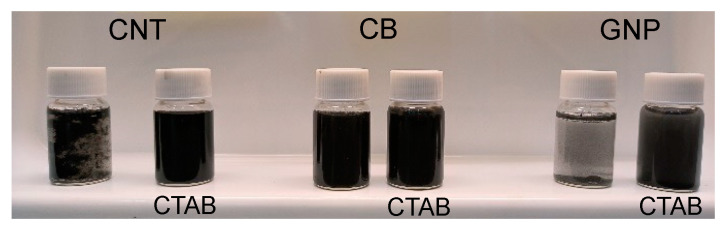
Probe-sonicated nanocarbon dispersions (0.2 mg/mL) without (left vials) and with (right vials) 0.4 mg/mL CTAB.
Figure 3
Figure 3
Digital photographs of nanocomposite films. Images of MCC-1%CB (a), CP-0.05%CNT (b), CNF-1%CB (c) and MCC-5%CNT (d).
Figure 4
Figure 4
Microstructure of the nanocomposite films. SEM images of CP-0.2%CNT (inset at low magnification) (a), CP-0.3%GNP (b), MCC-0.1%CB (c), MCC-0.2%CNT (d), CNF-0.3%CB (e) and CNF-0.4%CNT (f).
Figure 5
Figure 5
Triboelectric harvesting measurements. Illustration of the contact–separation mode TENG with MCE and the cellulose–nanocarbon (Cell-NC) nanocomposite films as triboactive components (a). Triboelectric output voltage of MCC as a function of the CNT filler content (b). Power and current density curves of MCC-0.2%CNT (c). Output voltage of all cellulose–nanocarbon combinations (d). Heat map of the maximum triboelectric output voltage at the optimum nanocarbon content of each cellulose–nanocarbon combination (e).
Figure 6
Figure 6
Piezoelectric harvesting measurements. Illustration of a PENG in tapping mode with the nanocomposite film between current collectors (a). Piezoelectric output voltage of pulp as a function of the GNP filler content (b). Voltage as a function of the tapping frequency of pulp-0.2%CNT (c). Current density and mean power density curves of pulp-0.3%GNP (d). Piezoelectric output voltage of all cellulose–nanocarbon combinations (e). Heat map of the maximum piezoelectric output voltage at the optimum nanocarbon content of each cellulose–nanocarbon combination (f).
Figure 7
Figure 7
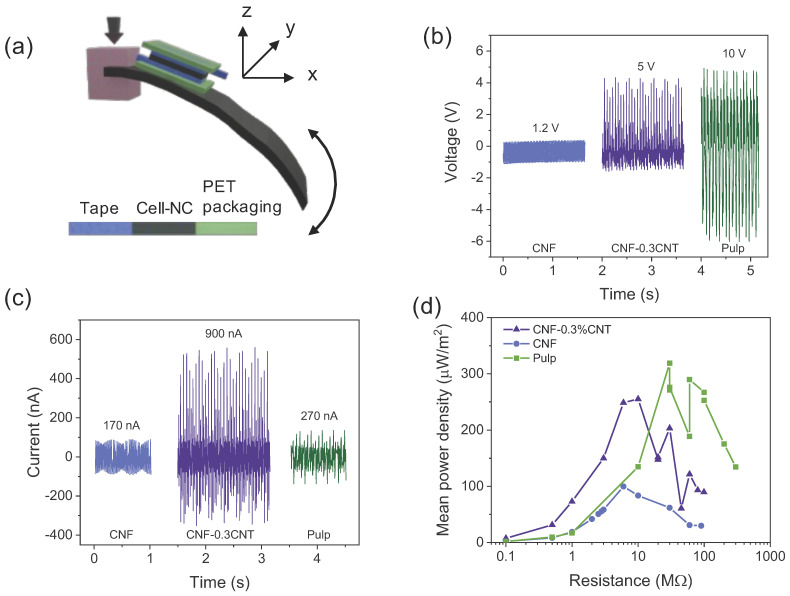
Cantilever excitation of piezoelectric response. Illustration of cantilever setup with sandwiched film between current collectors (a). Piezoelectric open-circuit voltage (b), short-circuit current (c) and power–load curves (d) obtained from pulp, CNF and CNF-0.3%CNT films.
Figure 8
Figure 8
AFM images of the topography (a,d,g) as well as out-of-plane (b,e,h) and in-plane (c,f,i) PFM images of pulp fiber, CNF and CNF-0.3%CNT samples, respectively.
Figure 9
Figure 9
Topography and surface charge measurements obtained on the CNF-0.3%CNT sample (a). Force spectroscopy measurements showing the magnitude and phase of the local piezoelectric loop acquired on the CP sample (b,c).

References

    1. Aubin C.A., Gorissen B., Milana E., Buskohl P.R., Lazarus N., Slipher G.A., Keplinger C., Bongard J., Iida F., Lewis J.A., et al. Towards Enduring Autonomous Robots via Embodied Energy. Nature. 2022;602:393–402. doi: 10.1038/s41586-021-04138-2. - DOI - PubMed
    1. Wu C., Wang A.C., Ding W., Guo H., Wang Z.L. Triboelectric Nanogenerator: A Foundation of the Energy for the New Era. Adv. Energy Mater. 2019;9:1802906. doi: 10.1002/aenm.201802906. - DOI
    1. Sezer N., Koç M. A Comprehensive Review on the State-of-the-Art of Piezoelectric Energy Harvesting. Nano Energy. 2021;80:105567. doi: 10.1016/j.nanoen.2020.105567. - DOI
    1. Li J., Shepelin N.A., Sherrell P.C., Ellis A.V. Poly(Dimethylsiloxane) for Triboelectricity: From Mechanisms to Practical Strategies. Chem. Mater. 2021;33:4304–4327. doi: 10.1021/acs.chemmater.1c01275. - DOI
    1. Zou H., Zhang Y., Guo L., Wang P., He X., Dai G., Zheng H., Chen C., Wang A.C., Xu C., et al. Quantifying the Triboelectric Series. Nat. Commun. 2019;10:1427. doi: 10.1038/s41467-019-09461-x. - DOI - PMC - PubMed

LinkOut - more resources