. 2023 Mar 23;15(7):1559.
doi: 10.3390/nu15071559.

Acute Administration of Ojeok-san Ameliorates Pain-like Behaviors in Pre-Clinical Models of Inflammatory Bowel Diseases

Affiliations

Acute Administration of Ojeok-san Ameliorates Pain-like Behaviors in Pre-Clinical Models of Inflammatory Bowel Diseases

Emma A Patton et al. Nutrients. .

Abstract

(1) Background: Gastrointestinal pain and fatigue are the most reported concerns of patients with inflammatory bowel disease (IBD). Commonly prescribed drugs focus on decreasing excessive inflammation. However, up to 20% of IBD patients in an "inactive" state experience abdominal pain. The medicinal herb Ojeok-san (OJS) has shown promise in the amelioration of visceral pain. However, no research on OJS has been conducted in preclinical models of IBD. The mechanism by which OJS promotes analgesia is still elusive, and it is unclear if OJS possesses addictive properties. (2) Aims: In this study, we examined the potential of OJS to promote analgesic effects and rewarding behavior. Additionally, we investigated if tumor necrosis factor alpha (TNFα) from macrophages is a primary culprit of IBD-induced nociception. (3) Methods: Multiple animal models of IBD were used to determine if OJS can reduce visceral nociception. TNFα-macrophage deficient mice were used to investigate the mechanism of action by which OJS reduces nociceptive behavior. Mechanical sensitivity and operant conditioning tests were used to determine the analgesic and rewarding effects of OJS. Body weight, colon length/weight, blood in stool, colonic inflammation, and complete blood count were assessed to determine disease progression. (4) Results: OJS reduced the evoked mechanical nociception in the dextran sulphate sodium model of colitis and IL-10 knockout (KO) mice and delayed aversion to colorectal distension in C57BL/6 mice. No rewarding behavior was observed in OJS-treated IL-10 KO and mdr1a KO mice. The analgesic effects of OJS are independent of macrophage TNFα levels and IBD progression. (5) Conclusions: OJS ameliorated elicited mechanical and visceral nociception without producing rewarding effects. The analgesic effects of OJS are not mediated by macrophage TNFα.

Keywords: TNFα; aversion; colorectal distension; conditioning place preference; mechanical sensitivity.


Conflict of interest statement

The authors declare no conflict of interest.

Figures

Figure 1
Figure 1
Macrophage deletion of TNFα and Ojeok-san administration does not impact disease progression in a chemical model of acute colitis. (A) Graphical depiction of the experimental design, (B) body weight, (C) water intake in control animals, (D) water intake in DSS-treated mice, (E) disease activity index in control animals, and (F) disease activity index in DSS-treated mice. Values are represented as mean ± SEM; n = 10–18 mice per group. Three-way ANOVA for B. Letters indicate statistical significance (p < 0.05) from a TNFα fl/fl Control-Vehicle, b TNFα fl/fl DSS-Vehicle, c TNFα fl/fl LysMcre Control-Vehicle, d TNFα fl/fl LysMcre DSS-Vehicle, e TNFα fl/fl Control-OJS, f TNFα fl/fl DSS-OJS, g TNFα fl/fl LysMcre Control-OJS. Mixed-effects model followed by an uncorrected Fisher’s LSD post hoc test for C–F. * Indicates statistical difference from the TNFα fl/fl DSS-Vehicle group on day 1.
Figure 2
Figure 2
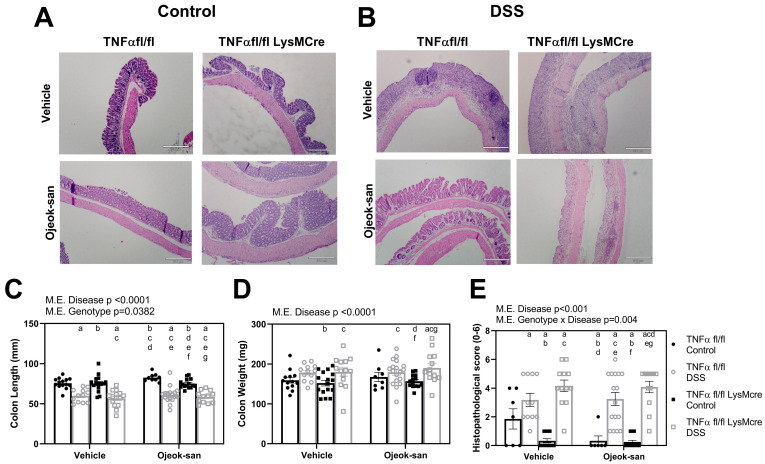
Ojeok-san administration does not impact colon size and histopathology in a chemical model of acute colitis. (A) Representative H&E staining of colonic tissue from control and (B) DSS-treated mice, (C) colon length, (D) colon weight, and (E) colonic histopathological score following acute DSS administration and OJS treatment in TNFα fl/fl and TNFα fl/fl-LysMCre mice. Values are represented as mean ± SEM; n = 8–18 mice per group. Three-way ANOVA followed by uncorrected Fisher’s LSD post hoc test. Letters indicate statistical significance (p < 0.05) from a TNFα fl/fl Control-Vehicle, b TNFα fl/fl DSS-Vehicle, c TNFα fl/fl LysMcre Control-Vehicle, d TNFα fl/fl LysMcre DSS-Vehicle, e TNFα fl/fl Control-OJS, f TNFα fl/fl DSS-OJS, g TNFα fl/fl LysMcre Control-OJS.
Figure 3
Figure 3
Macrophage deletion of TNFα influences villus length, and Ojeok-san administration influences goblet cell number and colonic IL6 expression. (A) Representative Alcian blue staining of colonic tissue from control and (B) DSS-treated mice; (C) Villus length, (D) goblet cell count, (E) IL-6 gene expression, and (F) NOD2 gene expression following acute DSS administration and OJS treatment in TNFα fl/fl and TNFα fl/fl-LysMCre mice. Values are represented as mean ± SEM; n = 6–16 mice per group. Three-way ANOVA followed by an uncorrected Fisher’s LSD post hoc test. Letters indicate statistical significance (p < 0.05) from a TNFα fl/fl Control-Vehicle, b TNFα fl/fl DSS-Vehicle, c TNFα fl/fl LysMcre Control-Vehicle, d TNFα fl/fl LysMcre DSS-Vehicle, e TNFα fl/fl Control-OJS, f TNFα fl/fl DSS-OJS, g TNFα fl/fl LysMcre Control-OJS.
Figure 4
Figure 4
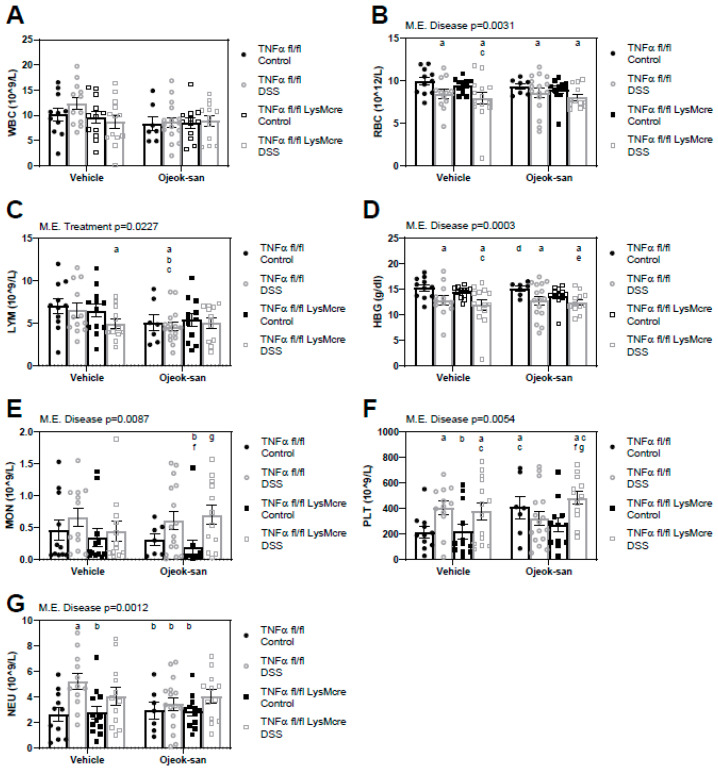
Macrophage deletion of TNFα does not impact blood profile, but Ojeok-san administration diminishes lymphocyte levels in mice with colitis. (A) WBC, (B) RBC, (C) LYM, (D) HGB, (E) MON, (F) PLT, (G) NEU following acute DSS administration and OJS treatment in TNFα fl/fl and TNFα fl/fl-LysMCre mice. Values are represented as mean ± SEM; n = 7–18 mice per group. Three-way ANOVA followed by uncorrected Fisher’s LSD post hoc test. Letters indicate statistical significance (p < 0.05) from a TNFα fl/fl Control-Vehicle, b TNFα fl/fl DSS-Vehicle, c TNFα fl/fl LysMcre Control-Vehicle, d TNFα fl/fl LysMcre DSS-Vehicle, e TNFα fl/fl Control-OJS, f TNFα fl/fl DSS-OJS, g TNFα fl/fl LysMcre Control-OJS.
Figure 5
Figure 5
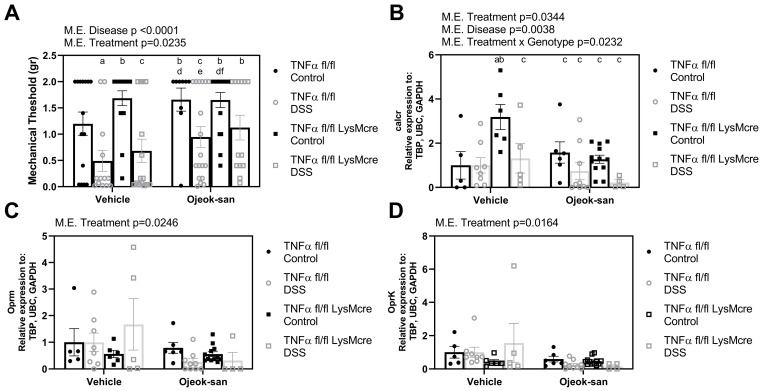
Macrophage deletion of TNFα does not impact mechanical sensitivity, but Ojeok-san administration improves mechanical hyperalgesia in mice with colitis. (A) Mechanical threshold to stimuli with von Frey filaments; gene expression of (B) calcr, (C) oprm, and (D) oprk following acute DSS administration and OJS treatment in TNFα fl/fl and TNFα fl/fl-LysMCre mice. Values are represented as mean ± SEM; n = 4–18 mice per group. Three-way ANOVA followed by uncorrected Fisher’s LSD post hoc test. Letters indicate statistical significance (p < 0.05) from a TNFα fl/fl Control-Vehicle, b TNFα fl/fl DSS-Vehicle, c TNFα fl/fl LysMcre Control-Vehicle, d TNFα fl/fl LysMcre DSS-Vehicle, e TNFα fl/fl Control-OJS, f TNFα fl/fl DSS-OJS, g TNFα fl/fl LysMcre Control-OJS.
Figure 6
Figure 6
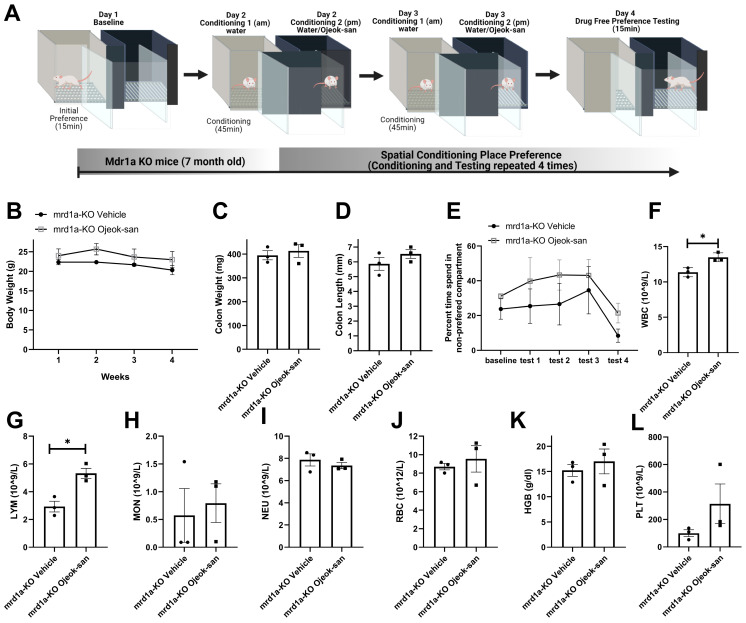
Four-week administration of OJS does not impact disease progression or show rewarding properties in the mdr1a KO mouse model of spontaneous colitis. (A) Graphical depiction of spatial conditioning place-preference protocol; (B) body weight, (C) colon length, (D) colon weight, (E) percent time spend on the OJS-paired side compartment during the test sessions, (F) WBC, (G) LYM, (H) MON, (I) NEU, (J) RBC, (K) HGB, and (L) PLT in vehicle- and OJS-treated mrd1a KO mice. Values are represented as mean ± SEM; n = 3 mice per group. Two-way RM AVOVA was conducted for (A,E). Two-tail unpaired t-test was conducted for (C,D), and (FL). * Indicates statistical significance between groups, p < 0.05.
Figure 7
Figure 7
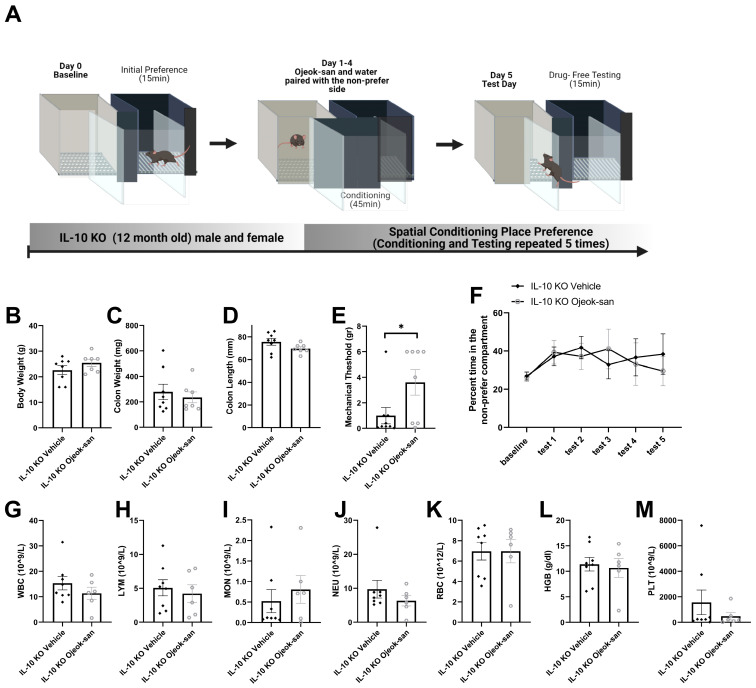
Five-week administration of OJS does not impact disease progression, but improves mechanical hyperalgesia, without promoting reward-seeking behavior in the IL-10 KO mouse model of spontaneous colitis. (A) A graphical depiction of spatial conditioning place-preference protocol, (B) body weight, (C) colon length, (D) colon weight, (E) mechanical threshold to stimuli with von Frey filaments, (F) percentage of time spent on the OJS-paired side compartment during the test sessions, (G) WBC, (H) LYM, (I) MON, (J) NEU, (K) RBC, (L) HGB, and (M) PLT in vehicle- and OJS-treated IL-10 KO mice. Values are represented as mean ± SEM; n = 8–9 mice per group. Two-way RM AVOVA was conducted for F. Two-tail unpaired t-test was conducted for (BE), and (GM). * Indicates statistical significance between groups, p < 0.05.
Figure 8
Figure 8
A single dose of OJS does not impact locomotor activity or sleep behavior in an IL-10 KO mouse model of spontaneous colitis. (A) Distance that IL-10 KO vehicle- and OJS-treated mice travelled in their home cage during the light and night cycle, (B) Time that the IL-10 KO vehicle- and OJS-treated mice spent sleeping during the light and night cycle. Values are represented as mean ± SEM; n = 8 mice per group. Two-way RM AVOVA. ^ p < 0.05 Indicates statistical significance between night and light cycle.
Figure 9
Figure 9
OJS reduces aversive behavior produced by colorectal balloon distension in C57BL6 mice. (A) Graphical depiction of spatial conditioning place-aversion protocol, (B) percentage of time spend in the preferred (non-OJS-paired side) compartment during the test sessions, (C) body weight, (D) WBC, (E) LYM, (F) MON, (G) NEU, (H) RBC, (I) HGB, and (J) PLT in vehicle- and OJS-treated C57BL6 mice. Values are represented as mean ± SEM; n = 7–10 mice per group. Two-way RM AVOVA for B. $ Indicates statistical significance from baseline in C57BL6 Vehicle mice. # Indicates statistical significance from baseline in C57BL6 OJS-treated mice. Two-tail unpaired t-test for (CJ), * p < 0.05.

References

    1. Dahlhamer J.M., Zammitti E.P., Ward B.W., Wheaton A.G., Croft J.B. Prevalence of Inflammatory Bowel Disease Among Adults Aged ≥18 Years—United States, 2015. MMWR Morb. Mortal. Wkly. Rep. 2016;65:1166–1169. doi: 10.15585/mmwr.mm6542a3. - DOI - PubMed
    1. Loftus E.V., Jr. Update on the Incidence and Prevalence of Inflammatory Bowel Disease in the United States. Gastroenterol. Hepatol. 2016;12:704–707. - PMC - PubMed
    1. Aghazadeh R., Zali M.R., Bahari A., Amin K., Ghahghaie F., Firouzi F. Inflammatory bowel disease in Iran: A review of 457 cases. J. Gastroenterol. Hepatol. 2005;20:1691–1695. doi: 10.1111/j.1440-1746.2005.03905.x. - DOI - PubMed
    1. Wagtmans M.J., Verspaget H.W., Lamers C.B., van Hogezand R.A. Crohn’s disease in the elderly: A comparison with young adults. J. Clin. Gastroenterol. 1998;27:129–133. doi: 10.1097/00004836-199809000-00005. - DOI - PubMed
    1. Hardy P.Y., Fikri J., Libbrecht D., Louis E., Joris J. Pain Characteristics in Patients with Inflammatory Bowel Disease: A Monocentric Cross-Sectional Study. J. Crohns Colitis. 2022;16:1363–1371. doi: 10.1093/ecco-jcc/jjac051. - DOI - PubMed