


Prevalence of Front-of-Pack Warning Signs among Commercial Complementary Foods in Seven High and Upper Middle-Income Countries
- PMID: 37049470
- PMCID: PMC10096843
- DOI: 10.3390/nu15071629
Prevalence of Front-of-Pack Warning Signs among Commercial Complementary Foods in Seven High and Upper Middle-Income Countries
Abstract
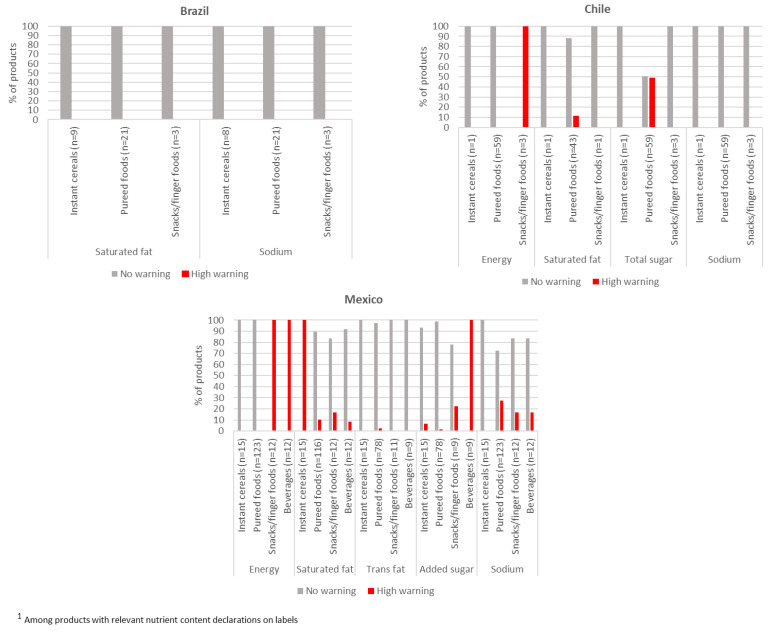
Front-of-pack nutrition labelling (FOPNL) can provide a mechanism for communicating the nutritional quality of commercially produced complementary foods (CPCF) to caregivers. To better understand the role FOPNL may provide for CPCF, this study aimed to evaluate CPCFs against national and global FOPNL systems to determine the proportion that would warrant warning or traffic light signs for high levels of concerning nutrients. A cross-sectional assessment was conducted to evaluate the levels of selected nutrients in CPCF available in Australia (n = 266), Brazil (n = 41), Chile (n = 73), Mexico (n = 164), the United States (n = 562), the United Arab Emirates (n = 135), and the United Kingdom (n = 643). The analysis was based on national FOPNL systems and the WHO Regional Office for Europe CPCF nutrient profiling model's 'high sugar' FOPNL warning. A substantial proportion of CPCFs contained excessive levels of total sugar, total fat or saturated fat that would warrant a red/amber traffic light or warning sign on product labels. Additionally, the high prevalence of added sugars and sweeteners identified in CPCFs was concerning. Based on these findings, the use of FOPNL among CPCFs could be beneficial to communicate the nutritional quality of these products to caregivers and trigger the reformulation of CPCFs with inappropriate nutrient profiles.
Keywords: complementary foods; food industry; food labelling/methods; food labelling/standards; infant and young child feeding; nutrient profiling.
Conflict of interest statement
The authors declare no conflict of interest.
Figures
References
-
- UNICEF . Improving Young Children’s Diets During the Complementary Feeding Period-UNICEF Programming Guidance. UNICEF; New York, NY, USA: 2020.
-
- Quinn V., Zehner E., Schofield D., Guyon A., Huffman S. Using the Code to Guide the Marketing of Complementary Foods to Protect Optimal Infant Feeding Practices: GAIN Working Paper Series. Global Alliance for Improved Nutrition (GAIN); Geneva, Switzerland: 2010.
-
- WHO . First Meeting of the WHO Scientific and Technical Advisory Group on Inappropriate Promotion of Foods for Infants and Young Children. WHO; Geneva, Switzerland: 2013.
-
- WHO Regional Office for Europe . In: Ending Inappropriate Promotion of Commercially Available Complementary Foods for Infants and Young Children between 6 and 36 Months in Europe. Copenhagen Ø., editor. WHO Regional Office for Europe; København, Denmark: 2019.
MeSH terms
Substances
Grants and funding
LinkOut - more resources
Full Text Sources
Medical
