Review
. 2023 Mar 31;15(7):1724.
doi: 10.3390/nu15071724.

Vitamin D and Calcium Supplementation and Urolithiasis: A Controversial and Multifaceted Relationship

Affiliations
Review

Vitamin D and Calcium Supplementation and Urolithiasis: A Controversial and Multifaceted Relationship

Piergiorgio Messa et al. Nutrients. .

Abstract

Patients with urolithiasis, and particularly those with hypercalciuria, frequently have a marked reduction of bone mineral content up to the levels of osteoporosis, with a significant increase in bone fracture risk. For these reasons, the indication to prescribe vitamin D and/or calcium supplementations is very frequent in such patients. On the other hand, both calcium supplementation, and even more vitamin D therapy, can worsen the risk of developing urolithiasis by increasing calcium, phosphate, and oxalate urinary excretion. Despite the clinical and practical relevance of this issue, the evidence on this topic is scarce and contradictory. Therefore, some concerns exist about how and whether to prescribe such supplements to a patient with a history of kidney stones. In this narrative review, we resume some pivotal pathophysiological concepts strictly related to the dealt topic, and we draw some considerations and personal opinions on the pros and cons of such prescriptions. Finally, we share with the reader our pragmatic algorithm for handling the urolithiasis risk in patients who have strong indications to be prescribed vitamin D and calcium supplementations.

Keywords: calcium; chronic kidney disease; dietary supplementation; urolithiasis; vitamin D.


Conflict of interest statement

The authors declare no conflict of interest.

Figures
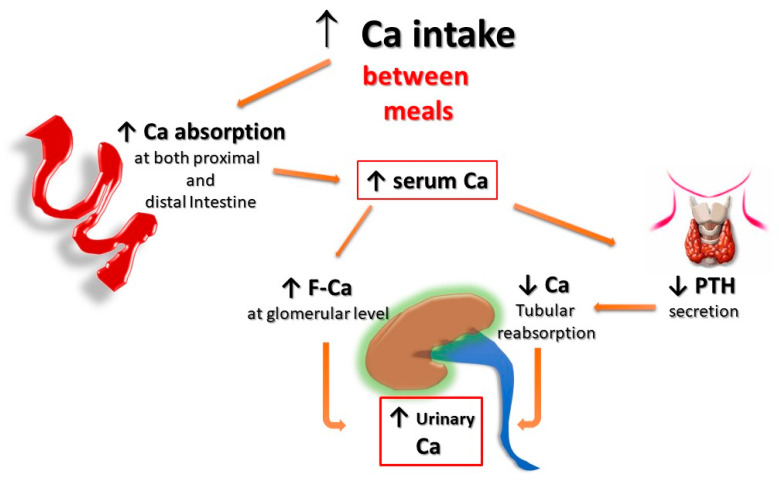
Figure 1
Figure 1
Potential effects of Ca supplementation outside the meals on UL risk. The amount of calcium absorbed is greater when calcium supplements are given outside meals, as calcium cannot bind to dietary anions (phosphate, oxalate, sulphate, etc.), and this leaves room for intestinal absorption an increased amount of both calcium and unbound anions, resulting in increased urinary excretion of calcium, oxalate, and phosphate. F-Ca: filtered Calcium; PTH: Parathyroid Hormone.
Figure 2
Figure 2
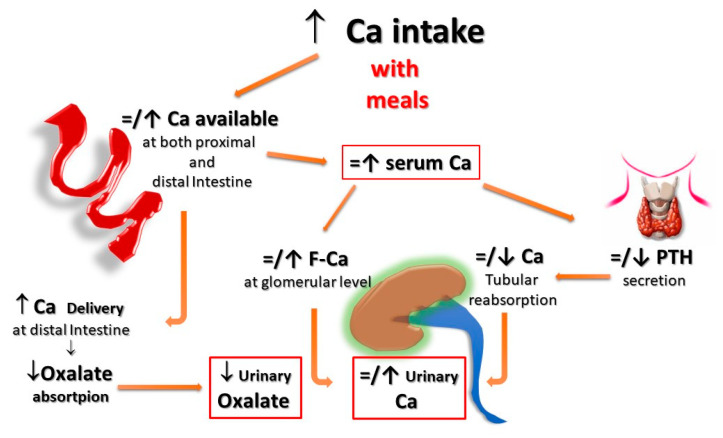
Potential effects of Ca supplementation with meals on UL risk. When calcium supplements are taken with meals, calcium can bind to dietary anions (phosphate, oxalate, sulphate, etc.), with a reduced absorption of calcium itself and the associated anions. Within the normal range of dietary calcium intake (800–1000 mg) and in the absence of elevated vitamin D levels, this could even translate into a reduction of the urinary lithogenic risk. F-Ca: filtered Calcium; PTH: Parathyroid Hormone.
Figure 3
Figure 3
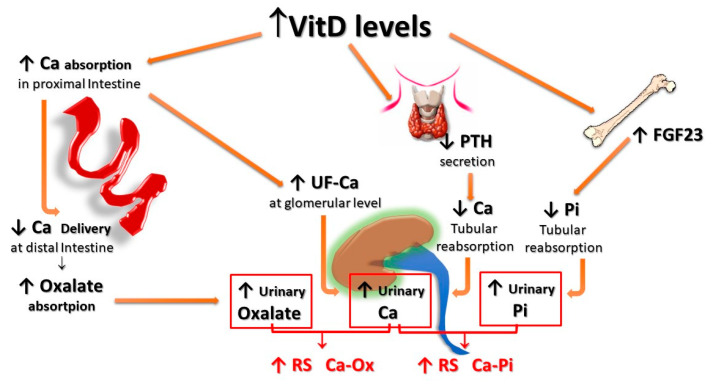
Potential effects of vitamin D supplementation on UL risk. Vitamin D stimulates active calcium transport, mainly in the proximal intestine, inducing HC even with calcium intake within the normal range; since less calcium reaches the distal gut, an increased amount of oxalate remains free for being absorbed in the distal tract; vitamin D also inhibits PTH production and stimulates FGF-23 production by osteocytes, with a resulting decrease of calcium and phosphate tubular reabsorption, respectively. All these effects translate into an increase in both the relative urinary supersaturations of calcium oxalate and calcium phosphate. FGF-23: Fibroblast Growth Factor-23; F-Ca: filtered Calcium; HC: Hypercalciuria; PTH: Parathyroid Hormone.
Figure 4
Figure 4
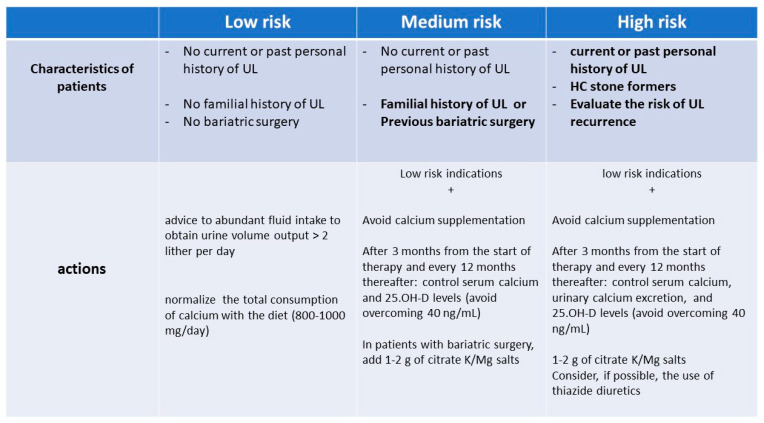
Definition of UL risk and suggested actions to be undertaken in subjects where there is a strong indication for prescribing vitamin D and/or calcium supplementation (see text).

References

    1. Heers H., Turney B.W. Trends in urological stone disease: A 5-year update of hospital episode statistics. BJU Int. 2016;118:785–789. doi: 10.1111/bju.13520. - DOI - PubMed
    1. Ziemba J.B., Matlaga B.R. Epidemiology and economics of nephrolithiasis. Investig. Clin. Urol. 2017;58:299–306. doi: 10.4111/icu.2017.58.5.299. - DOI - PMC - PubMed
    1. Borghi L., Meschi T., Guerra A., Novarini A. Randomized prospective study of a nonthiazide diuretic, indapamide, in preventing calcium stone recurrences. J. Cardiovasc. Pharmacol. 1993;22((Suppl. 6)):S78–S86. doi: 10.1097/00005344-199312050-00014. - DOI - PubMed
    1. Sorensen M.D., Harper J.D., Borofsky M.S., Hameed T.A., Smoot K.J., Burke B.H., Levchak B.J., Williams J.C., Jr., Bailey M.R., Liu Z., et al. Removal of Small, Asymptomatic Kidney Stones and Incidence of Relapse. N. Engl. J. Med. 2022;387:506–513. doi: 10.1056/NEJMoa2204253. - DOI - PMC - PubMed
    1. El-Zoghby Z.M., Lieske J.C., Foley R.N., Bergstralh E.J., Li X., Melton L.J., 3rd, Krambeck A.E., Rule A.D. Urolithiasis and the risk of ESRD. Clin. J. Am. Soc. Nephrol. 2012;7:1409–1415. doi: 10.2215/CJN.03210312. - DOI - PMC - PubMed