


The Importance of an Early Evaluation after Establishing a Gluten-Free Diet in Children with Celiac Disease
- PMID: 37049601
- PMCID: PMC10097184
- DOI: 10.3390/nu15071761
The Importance of an Early Evaluation after Establishing a Gluten-Free Diet in Children with Celiac Disease
Abstract
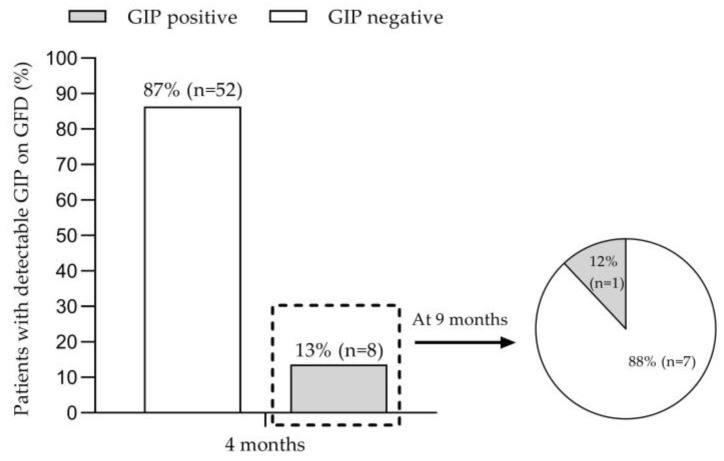
A gluten-free diet (GFD) is the only treatment available for celiac disease (CD); hence, it is important to ensure correct adherence to the diet and adequate monitoring of the diet. The present study aims to assess the importance of an early follow-up of celiac patients after diagnosis of the disease, identify the role of stool gluten immunogenic peptides (GIPs) in the assessment of GFD adherence, and analyze possible nutritional imbalances or deficiencies in the GFD. This is a cross-sectional study carried out in pediatric patients with newly diagnosed CD in a tertiary hospital in Spain. Of the 61 patients included, 14% had positive stool GIPS at 4 months after CD diagnosis, Among them, 88% had negative stool GIPS at 9 months after diagnosis, following dietary advice. We found nutritional deficiencies in the GFD, such as vitamin D (with only 27% of patients with adequate intakes), folate, calcium, magnesium, and fiber. Similarly, we found imbalances: excess protein and fat intakes and a high percentage of total daily energy intake came from ultra-processed foods (UPF). These findings emphasize the importance of early follow-up of children after diagnosis of CD. It is also crucial to identify patients with poor GFD compliance based on stool GIPS and analyze GFD nutritional imbalances and deficits. Our findings may contribute to the development of specific strategies for the early follow-up of patients with CD, including appropriate nutritional counselling.
Keywords: celiac disease; gluten immunogenic peptides; gluten-free diet; ultra-processed foods.
Conflict of interest statement
The authors declare no conflict of interest. The funders had no role in the design of the study; in the collection, analyses, or interpretation of data; in the writing of the manuscript, or in the decision to publish the results.
Figures


References
-
- Ruiz-Carnicer A., Garzon-Benavides M., Fombuena B., Segura V., Garcia-Fernandez F., Sobrino-Rodriguez S., Gomez-Izquierdo L., Montes-Cano M.A., Rodriguez-Herrera A., Millan R., et al. Negative Predictive Value of the Repeated Absence of Gluten Immunogenic Peptides in the Urisne of Treated Celiac Patients in Predicting Mucosal Healing: New Proposals for Follow-up in Celiac Disease. Am. J. Clin. Nutr. 2020;112:1240–1251. doi: 10.1093/ajcn/nqaa188. - DOI - PubMed
-
- King J.A., Jeong J., Underwood F.E., Quan J., Panaccione N., Windsor J.W., Coward S., Debruyn J., Ronksley P.E., Shaheen A.A., et al. Incidence of Celiac Disease Is Increasing Over Time: A Systematic Review and Meta-Analysis. Am. J. Gastroenterol. 2020;115:507–525. doi: 10.14309/ajg.0000000000000523. - DOI - PubMed
MeSH terms
Substances
Grants and funding
- Project No B-AGR-658/FEDER/Junta de Andalucía-Consejería de Transformación Económica, Industria, Conocimiento y Universidades/ Project No B-AGR-658
- Investigation grant program by the Association of Celiacs and Sensitive to Gluten of the Com-munity of Madrid
- FPU17/03715/Spanish Ministry of Education, Culture, and Sports
- BIOMEDAL S.L.
LinkOut - more resources
Full Text Sources
Medical
