


Design of Digital-Twin Human-Machine Interface Sensor with Intelligent Finger Gesture Recognition
- PMID: 37050567
- PMCID: PMC10098945
- DOI: 10.3390/s23073509
Design of Digital-Twin Human-Machine Interface Sensor with Intelligent Finger Gesture Recognition
Abstract
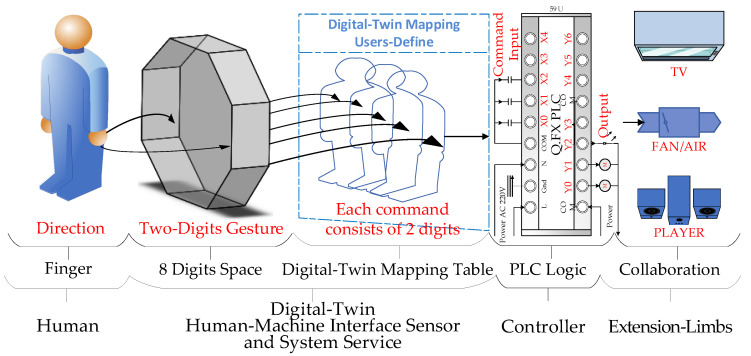
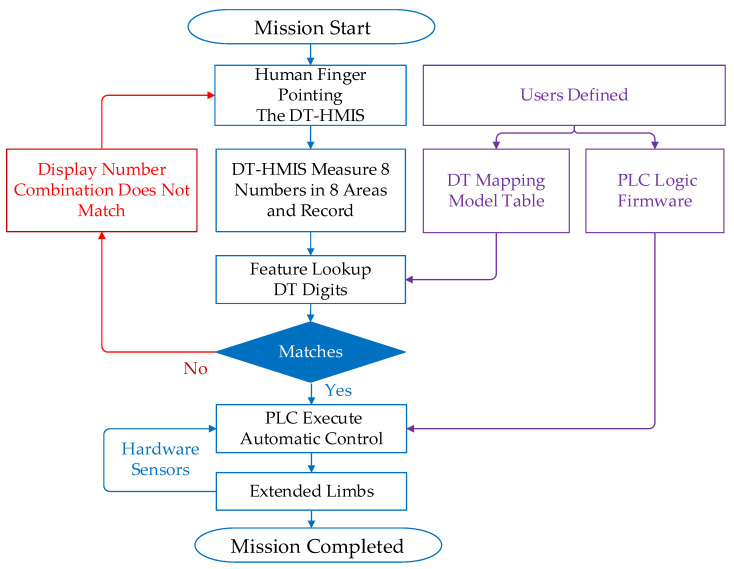
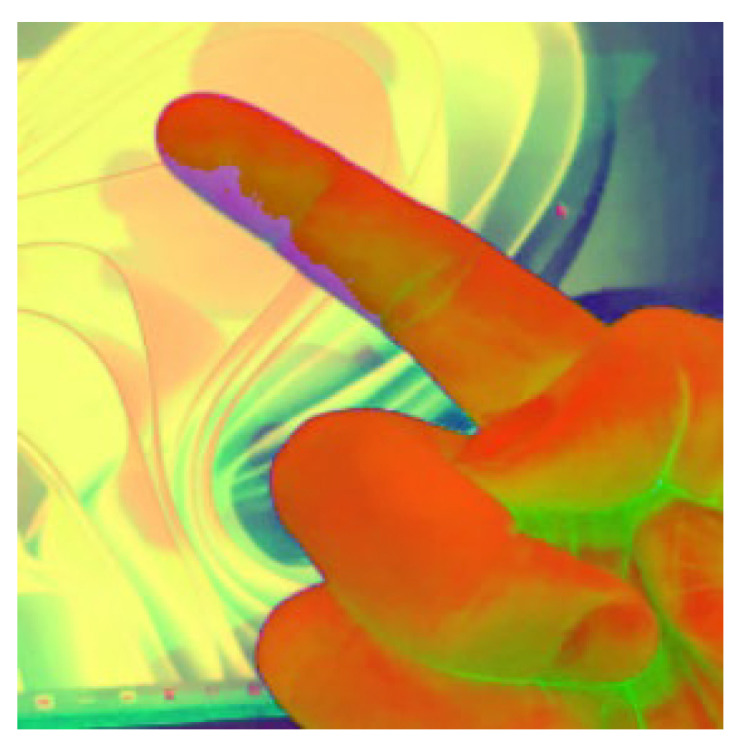
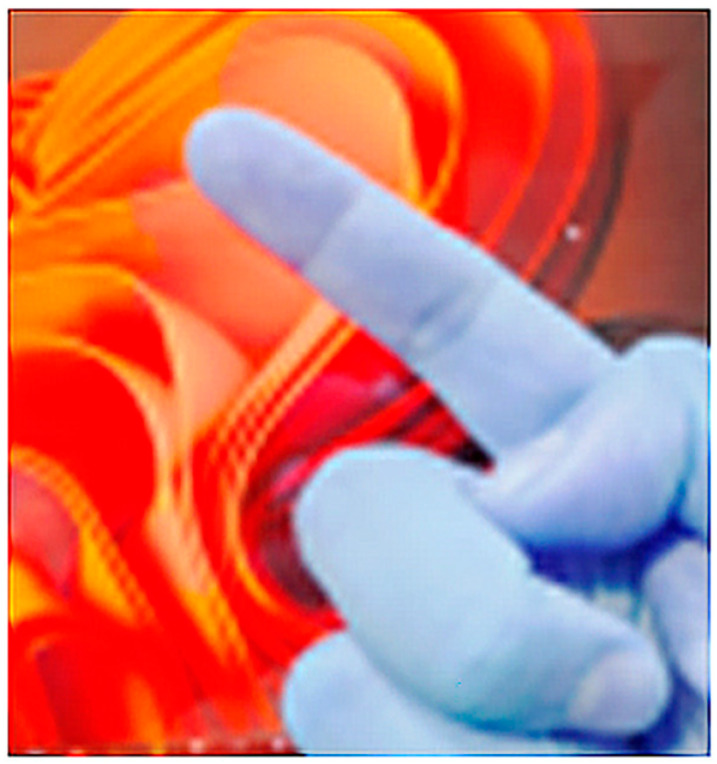
In this study, the design of a Digital-twin human-machine interface sensor (DT-HMIS) is proposed. This is a digital-twin sensor (DT-Sensor) that can meet the demands of human-machine automation collaboration in Industry 5.0. The DT-HMIS allows users/patients to add, modify, delete, query, and restore their previously memorized DT finger gesture mapping model and programmable logic controller (PLC) logic program, enabling the operation or access of the programmable controller input-output (I/O) interface and achieving the extended limb collaboration capability of users/patients. The system has two main functions: the first is gesture-encoded virtual manipulation, which indirectly accesses the PLC through the DT mapping model to complete control of electronic peripherals for extension-limbs ability by executing logic control program instructions. The second is gesture-based virtual manipulation to help non-verbal individuals create special verbal sentences through gesture commands to improve their expression ability. The design method uses primitive image processing and eight-way dual-bit signal processing algorithms to capture the movement of human finger gestures and convert them into digital signals. The system service maps control instructions by observing the digital signals of the DT-HMIS and drives motion control through mechatronics integration or speech synthesis feedback to express the operation requirements of inconvenient work or complex handheld physical tools. Based on the human-machine interface sensor of DT computer vision, it can reflect the user's command status without the need for additional wearable devices and promote interaction with the virtual world. When used for patients, the system ensures that the user's virtual control is mapped to physical device control, providing the convenience of independent operation while reducing caregiver fatigue. This study shows that the recognition accuracy can reach 99%, demonstrating practicality and application prospects. In future applications, users/patients can interact virtually with other peripheral devices through the DT-HMIS to meet their own interaction needs and promote industry progress.
Keywords: DT-Sensor; Industry 5.0; PLC; computer vision; digital-twin; digital-twin human-machine interface sensor (DT-HMIS); extension-limbs; finger gesture; mechatronics; virtual manipulation.
Conflict of interest statement
The authors declare no conflict of interest.
Figures
References
-
- Wang H., Lv L., Li X., Li H., Leng J., Zhang Y., Thomson V., Liu G., Wen X., Sun C., et al. A safety management approach for Industry 5.0’s human-centered manufacturing based on digital-twin. J. Manuf. Syst. 2023;66:1–12. doi: 10.1016/j.jmsy.2022.11.013. - DOI
-
- Hultman H., Cedergren S., Wärmefjord K., Söderberg R. Predicting Geometrical Variation in Fabricated Assemblies Using a Digital-twin Approach Including a Novel Non-Nominal Welding Simulation. Aerospace. 2022;9:512. doi: 10.3390/aerospace9090512. - DOI
-
- Ghandar A., Ahmed A., Zulfiqar S., Hua Z., Hanai M., Theodoropoulos G. A Decision Support System for Urban Agriculture Using Digital-twin: A Case Study with Aquaponics. IEEE Access. 2021;9:35691–35708. doi: 10.1109/ACCESS.2021.3061722. - DOI
-
- Sasikumar A., Vairavasundaram S., Kotecha K., Indragandhi V., Ravi L., Selvachandran G., Abraham A. Blockchain-based trust mechanism for digital-twin empowered Industrial Internet of Things. Future Gener. Comput. Syst. 2023;141:16–27.
MeSH terms
Grants and funding
LinkOut - more resources
Full Text Sources
