


PROTOCOL: Strengthening women's empowerment and gender equality in fragile contexts towards peaceful and inclusive societies: A systematic review and meta-analysis
- PMID: 37051446
- PMCID: PMC8988660
- DOI: 10.1002/cl2.1180
PROTOCOL: Strengthening women's empowerment and gender equality in fragile contexts towards peaceful and inclusive societies: A systematic review and meta-analysis
Abstract
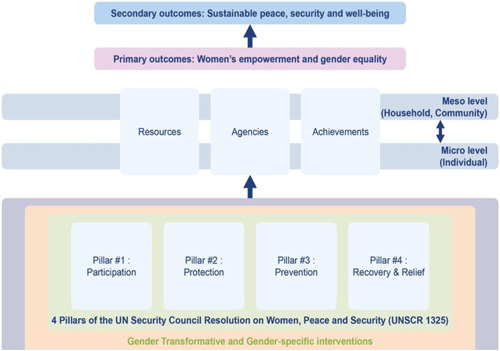
This review builds on 3ie's (international initiative for impact evaluation) evidence gap map (EGM) of the impact evaluation and systematic review (SR) evidence base of interventions aiming to promote peaceful and inclusive societies in fragile contexts. The EGM identified a cluster of studies evaluating gender equality-focused behaviour change communication programmes and raised interest in investigating the evidence base for understanding the role of women more broadly as agents of change in developing peaceful and inclusive societies. Building on the cluster of evidence identified in the EGM, our review will increase generalisability of findings from single studies and focus on interventions across a broad range of geographical locations, settings and populations, types of implementations and outcomes. We will also address (when possible) the identified gaps in literature regarding metaanalysis in conflict-affected contexts. As such, we propose the following objectives: (1) The primary objective of this review is to identify, assess and synthesise evidence on the effect of gender specific and gender transformative interventions within the context of the four pillars of United Nations Security Council Resolution (UNSCR) 1325 on women's empowerment and gender equality in Fragile and Conflict Affected States/Situations (FCAS). The SR will facilitate the use of evidence in informing policy and practice decisions within the field of transition aid, particularly as it relates to gender focused programming. (2) Our second objective is to assess how these interventions contribute to inclusive and sustainable peace in conflict affected situations. We will compare the effectiveness of these different types of interventions through the lenses of their ecological level, types of impact on women's empowerment, local context of gender inequality and conflict. To achieve these objectives we aim to answer the following questions: (1) What are the impacts of gender transformative and specific interventions on women's empowerment and gender equality in FCAS? (2) What are the effects of these interventions on sustainable peace? (3) To what extent do effects vary by population group, ecological level and types of interventions? (4) What are contextual barriers to and facilitators of intervention effectiveness?
© 2021 The Authors. Campbell Systematic Reviews published by John Wiley & Sons Ltd on behalf of The Campbell Collaboration.
Figures



References
-
- Aall, P. , & Crocker, C. A. (2019). Building resilience and social cohesion in conflict. Global Policy, 10(S2), 68–75. 10.1111/1758-5899.12681 - DOI
-
- Abt, T. , & Winship, C. (2016). What works in reducing community violence: A meta‐review and field study for the northern triangle (p. 53). USAID. https://www.usaid.gov/sites/default/files/USAID-2016-What-Works-in-Reduc...
-
- Agence Francaise de Developpement . (n.d.). Juillet 2020: L'AFD soutient 27 nouveaux projets d'ONG françaises. Retrieved November 27, 2020, from https://www.afd.fr/fr/actualites/juillet-2020-l-afd-soutient-27-nouveaux...
-
- Bangpan, M. , Felix, L. , Chiumento, A. , & Dickson, K. (2016). The impact of mental health and psychosocial support programmes for populations affected by humanitarian emergencies: A systematic review protocol. Oxfam. 10.21201/2016.605150 - DOI
-
- Barnett, M. , Kim, H. , O'Donnell, M. , & Sitea, L. (2007). Peacebuilding: What Is in a Name? Global Governance: A Review of Multilateralism and International Organizations, 13(1), 35–58. 10.1163/19426720-01301004 - DOI
LinkOut - more resources
Full Text Sources
Research Materials
Miscellaneous