


Pet dogs (Canis familiaris) re-engage humans after joint activity
- PMID: 37052862
- PMCID: PMC10345045
- DOI: 10.1007/s10071-023-01774-1
Pet dogs (Canis familiaris) re-engage humans after joint activity
Abstract
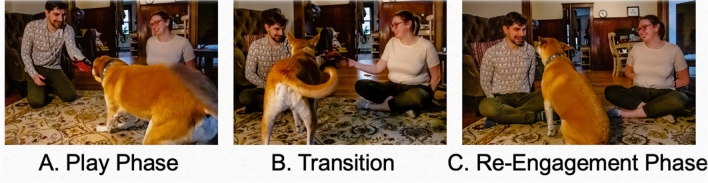
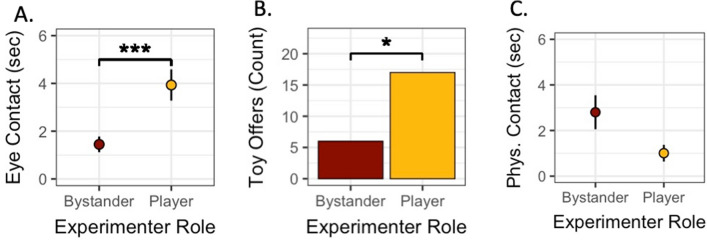
Joint intentionality, the mutual understanding of shared goals or actions to partake in a common task, is considered an essential building block of theory of mind in humans. Domesticated dogs are unusually adept at comprehending human social cues and cooperating with humans, making it possible that they possess behavioral signatures of joint intentionality in interactions with humans. Horschler and colleagues (Anim Behav 183: 159-168, 2022) examined joint intentionality in a service dog population, finding that upon interruption of a joint experience, dogs preferentially re-engaged their former partner over a passive bystander, a behavior argued to be a signature of joint intentionality in human children. In the current study, we aimed to replicate and extend these results in pet dogs. One familiar person played with the dog and then abruptly stopped. We examined if dogs would preferentially re-engage the player instead of a familiar bystander who was also present. Consistent with the findings of Horschler and colleagues (Anim Behav 183: 159-168, 2022), pet dogs preferentially gazed toward and offered the toy to the player significantly more than the familiar bystander. However, no difference was observed in physical contact. These findings provide preliminary evidence for behavioral signatures of joint intentionality in pet dogs, but future work is needed to understand whether this phenomenon extends to other contexts.
Keywords: Canine cognition; Cooperation; Shared intentionality; Social cognition; Theory of mind.
© 2023. The Author(s).
Conflict of interest statement
The authors declare that they have no conflicts of interest as they pertain to their authorship of this article.
Figures
References
-
- Buttelmann D. What is unique in infant thinking about others? Infant social cognition from an evolutionary perspective. In: Hart SL, Bjorklund DF, editors. Evolutionary perspectives on infancy. Cham: Evolutionary Psychology; Springer; 2022. pp. 277–302.
MeSH terms
Grants and funding
LinkOut - more resources
Full Text Sources
