


Mindfulness among lebanese university students and its indirect effect between mental health and wellbeing
- PMID: 37055857
- PMCID: PMC10100626
- DOI: 10.1186/s40359-023-01155-w
Mindfulness among lebanese university students and its indirect effect between mental health and wellbeing
Abstract
Background: University students are a high-risk population for developing mental health issues. Mindfulness, the non-judgmental awareness of the present moment, has an effective role in numerous psychological contexts among students. However, no previous studies have investigated the association between mindfulness, mental health and wellbeing among Lebanese university students. Therefore, this study aimed to assess the mediating effect of mindfulness in the association between mental health and wellbeing in this population.
Methods: This cross-sectional study enrolled 363 Lebanese university students recruited through convenience sampling (July-September 2021). The Wellbeing Index Scale, Lebanese Anxiety Scale, Patient Health Questionnaire and Freiburg Mindfulness Inventory were used to assess subjective well-being, anxiety, depression and mindfulness respectively.
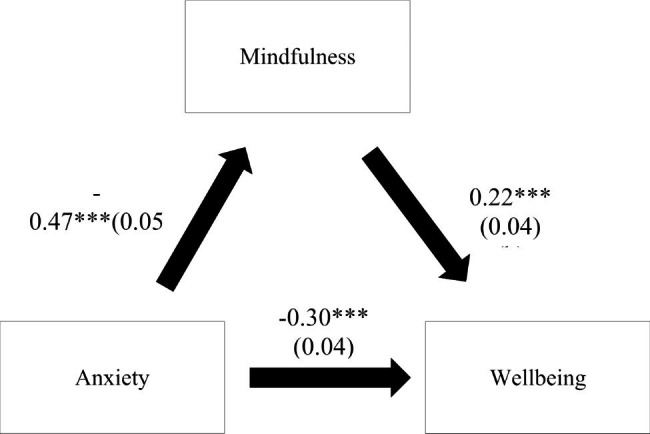
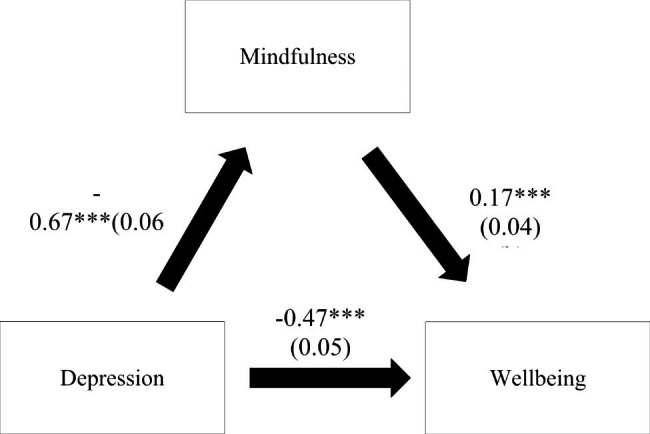
Results: Our findings showed that higher mindfulness (Beta = 0.18; p < 0.001) was significantly correlated with a higher wellbeing, whereas more depression (Beta=-0.36; p < 0.001) was significantly associated with a lower wellbeing. The results of the indirect effect analysis showed that mindfulness mediated the association between anxiety and wellbeing and between depression and wellbeing. Higher anxiety/depression were significantly associated with lower mindfulness and a lower wellbeing (direct effect). Moreover, higher mindfulness was significantly associated with a higher wellbeing.
Conclusion: Mindfulness is associated with improved wellbeing and plays an indirect role between mental health issues and wellbeing. Our results suggest that mindfulness presents an adaptive approach and coping method associated with improved students' wellbeing.
Keywords: Anxiety; Depression; Lebanon; Mental health; Mindfulness; University students; Wellbeing.
© 2023. The Author(s).
Conflict of interest statement
The authors have nothing to disclose.
Figures
References
-
- Briggs ARJ, Clark J, Hall I. Building bridges: understanding student transition to university. Qual High Educ. 2012 Apr;18(1):3–21.
-
- Macaskill A. The mental health of university students in the United Kingdom. Br J Guidance Couns. 2013 Aug;41(4):426–41.
-
- Bernier A, Larose S, Whipple N. Leaving home for college: a potentially stressful event for adolescents with preoccupied attachment patterns. Attach Hum Dev. 2005 Jun;7(2):171–85. - PubMed
-
- Auerbach RP, Mortier P, Bruffaerts R, Alonso J, Benjet C, Cuijpers P, Demyttenaere K, Ebert DD, Green JG, Hasking P, Murray E, Nock MK, Pinder-Amaker S, Sampson NA, Stein DJ, Vilagut G, Zaslavsky AM, Kessler RC, WHO WMH-ICS Collaborators. WHO World Mental Health Surveys International College Student Project. Prevalence and distribution of mental disorders. J Abnorm Psychol. 2018 Oct;127(7):623–38. - PMC - PubMed
-
- World Health Organization. Mental health: strengthening our response [Internet]. 2018 [cited 2021 Nov 30]. Available from: https://www.who.int/news-room/fact-sheets/detail/mental-health-strengthe...
MeSH terms
LinkOut - more resources
Full Text Sources
Medical
