


Editorial
doi: 10.3389/fimmu.2023.1186635.
eCollection 2023.
Editorial: The role of vitamin D as an immunomodulator
Affiliations
- PMID: 37056773
- PMCID: PMC10086413
- DOI: 10.3389/fimmu.2023.1186635
Item in Clipboard
Editorial
Editorial: The role of vitamin D as an immunomodulator
Front Immunol.
.
No abstract available
Keywords: deep vein thrombosis; exercise; gut microbiota; immunomodulation; platelet-mediated inflammation; transcriptome; vitamin D.
Conflict of interest statement
The authors declare that the research was conducted in the absence of any commercial or financial relationships that could be construed as a potential conflict of interest.
Figures
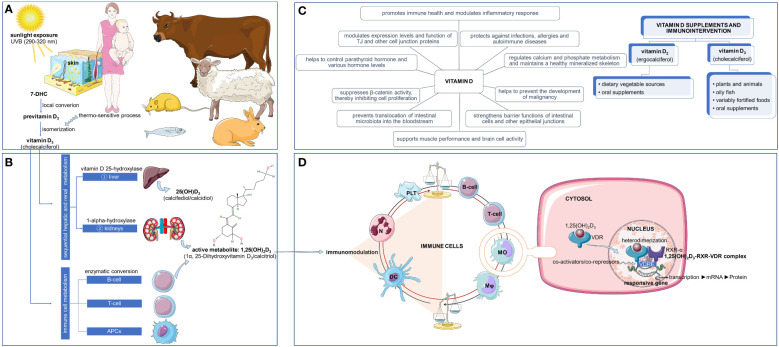
The complexity of vitamin D3: synthesis, metabolism, mechanism of action, and immunointervention. The bioactive form of vitamin D3 plays an important role in the modulation of immune system. The skin of humans and some animals synthesize vitamin D3 when exposed to ultraviolet B (UVB) radiation (290–320 nm) by acting on 7-dehydrocholesterol (7DHC) (A). After undergoing enzymatic processes in the liver and kidneys, vitamin D3 is then metabolized into its active form, 1,25(OH)2D3 (1α, 25-Dihydroxyvitamin D3/calcitriol) by vitamin D 25-hydroxylase and 1-alpha-hydroxylase, respectively. Some immune cells, including B-cells, T-cells and antigen presenting cells (APCs), are also able to transform vitamin D3 into its active metabolite through a process of enzymatic conversion. (B). Not only does vitamin D3 perform many vital roles, it has been shown to possess powerful effects that can control immune function, allowing it to be utilized in immunologic interventions to keep the immune system functioning optimally and to correct any existing vitamin D deficiencies (C). The immune effects of vitamin D3 are ensured by its active metabolite, i.e., 1,25(OH)2D3. Acting upon specific immune cells, 1,25(OH)2D3 binds to the vitamin D receptor (VDR) in the cytoplasm and then heterodimerizes with the retinoid X receptor-a (RXR-a) in the nucleus, forming the 1,25(OH)2D3-RXR-VDR complex which attaches to vitamin D response elements (VDRE) on the DNA (D). DC, dendritic cell; MO, monocyte; Mφ, macrophage; N, neutrophil; PLT, platelet; TJ, tight junction. Some illustrations were sourced from the Servier Medical Art platform.
Comment on
- Editorial on the Research Topic The role of vitamin D as an immunomodulator
References
-
- Ysmail-Dahlouk L, Nouari W, Aribi M. 1,25-dihydroxyvitamin D3 down-modulates the production of proinflammatory cytokines and nitric oxide and enhances the phosphorylation of monocyte-expressed STAT6 at the recent-onset type 1 diabetes. Immunol Lett (2016) 179:122–30. doi: 10.1016/j.imlet.2016.10.002 - DOI - PubMed
Publication types
MeSH terms
Substances
LinkOut - more resources
Full Text Sources
Medical
