Review
. 2023 Jul;19(5):1214-1231.
doi: 10.1007/s12015-023-10539-9. Epub 2023 Apr 14.

Immunomodulatory Mechanisms and Therapeutic Potential of Mesenchymal Stem Cells

Affiliations
Review

Immunomodulatory Mechanisms and Therapeutic Potential of Mesenchymal Stem Cells

Guoqiang Yang et al. Stem Cell Rev Rep. 2023 Jul.

Abstract

Mesenchymal stem cells (MSCs) are regarded as highly promising cells for allogeneic cell therapy, owing to their multipotent nature and ability to display potent and varied functions in different diseases. The functions of MSCs, including native immunomodulation, high self-renewal characteristic, and secretory and trophic properties, can be employed to improve the immune-modulatory functions in diseases. MSCs impact most immune cells by directly contacting and/or secreting positive microenvironmental factors to influence them. Previous studies have reported that the immunomodulatory role of MSCs is basically dependent on their secretion ability from MSCs. This review discusses the immunomodulatory capabilities of MSCs and the promising strategies to successfully improve the potential utilization of MSCs in clinical research.

Keywords: Engineered; Immune cells; Immunomodulation; Mesenchymal stem cells; Therapeutics.


Conflict of interest statement

The authors declare that the research was conducted in the absence of any commercial or financial relationships that could be construed as a potential conflict of interest.

Figures
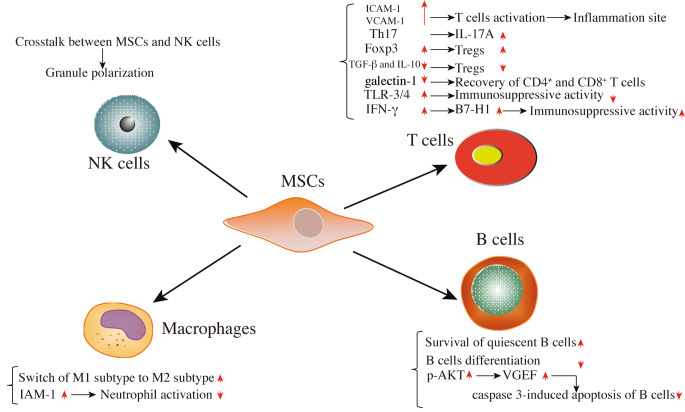
Fig. 1
Fig. 1
Cell-to-cell contact of immunomodulation in adaptive immunity and innate immunity. MSCs display the immunomodulatory effects mainly via mutual effect with immune cells such as T cells, B cells, natural killer (NK) cells, macrophages, etc. and cell-to-cell contact is associated with the modulation of protein expression. Abbreviations: Foxp3, Forkhead box P3; ICAM-1, intercellular adhesion molecule-1; VCAM-1, vascular cell adhesion molecule-1; TLR, Toll-like receptors; IFN, interferon; B7-H1, an inhibitory surface molecule in stem cells; VEGF, vascular endothelial growth factor; IAM-1, intercellular adhesion molecule-1; p-AKT, phosphorylated protein kinase B; TGF-β, transforming growth factor-β; IL, interleukin; B7-H1, an inhibitory surface molecule in stem cells
Fig. 2
Fig. 2
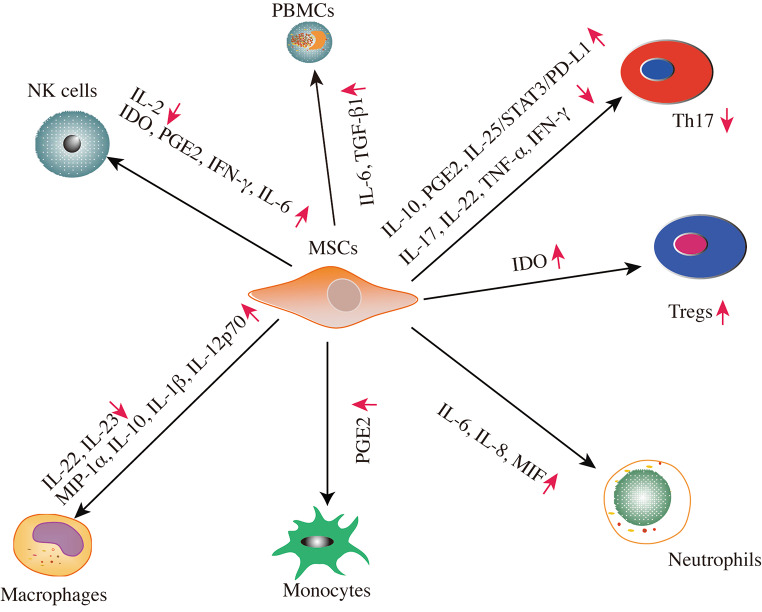
Paracrine activity of immunomodulation in adaptive immunity and innate immunity. MSCs exert immunomodulatory effects through the interactions with immune cells such as T cells, natural killer (NK) cells, macrophages, monocytes, PBMCs and neutrophils, through paracrine activity. MSCs’ secretome secret a battery of cytokines, growth factors, and chemokines for playing their immunomodulatory function. Abbreviations: PBMCs, peripheral blood mononuclear cells; IL, interleukin; TGF-β1, transforming growth factor-β1; PGE2, prostaglandin E2; IFN, interferon; MIF, macrophage migration inhibitory factor; IDO, Indoleamine 2,3-dioxygenase; Th17, T helper 17; Tregs, regulatory T cells; MIP-1α, macrophage inflammatory protein-1 alpha
Fig. 3
Fig. 3
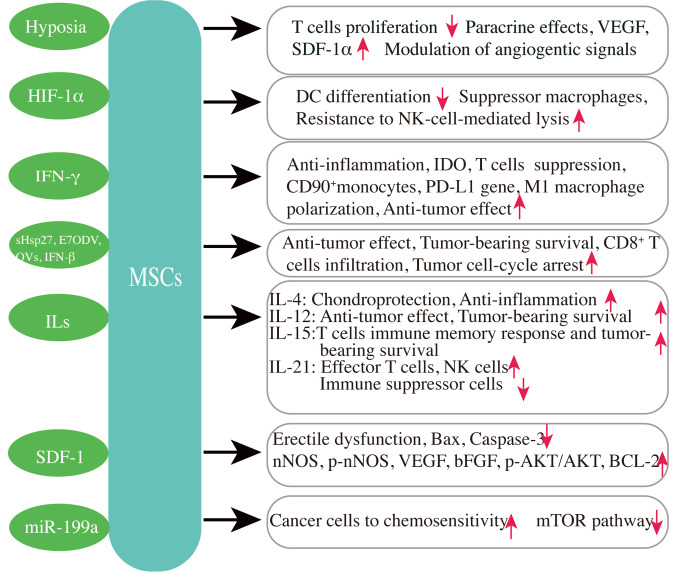
Modified MSCs to increase their immunomodulatory functions and therapeutic efficacy. MSCs exert better immunomodulatory effects through modification compared with signal MSCs admin-istration. MSCs pretreated with hypoxia. heat shock. inflammatory stimulation, and et al. have the poten-tial to increase their therapeutic potency, the expression of cytoprotective genes, and secretion of repara-tive factor. Abbreviations: IL, intcricukin; IFN, interferon; IDO, Indolcaminc 23-dioxygcnasc; Bax, 13cl-2-associated x; nNOS, neuronal nitric oxide synthase; VEGF, vascular endothelial growth factor; bFGF, basic fibroblast growth factor; BCL-2, B-cell lymphoma-2; AKT, protein kinase B; HIF-1α, hypoxia-inducible factor 1α; sHsp27, heat shock proteins 27; E7ODV, E7 oncoprotein DNA vaccinations; OVs, oncolytic viruses; SDF-1, stromal cell-derived factor-1

References

    1. Salem HK, Thiemermann C. Mesenchymal stromal cells: Current understanding and clinical status. Stem Cells. 2010;28(3):585–596. - PMC - PubMed
    1. Wei X, Yang X, Han ZP, Qu FF, Shao L, Shi YF. Mesenchymal stem cells: A new trend for cell therapy. Acta Pharmacologica Sinica. 2013;34(6):747–754. - PMC - PubMed
    1. Friedenstein AJ, Piatetzky S, II, Petrakova KV. Osteogenesis in transplants of bone marrow cells. Journal Of Embryology And Experimental Morphology. 1966;16(3):381–390. - PubMed
    1. Friedenstein AJ, Chailakhjan RK, Lalykina KS. The development of fibroblast colonies in monolayer cultures of guinea-pig bone marrow and spleen cells. Cell Tissue Kinet. 1970;3(4):393–403. - PubMed
    1. Caplan AI. Mesenchymal stem cells. Journal Of Orthopaedic Research. 1991;9(5):641–650. - PubMed

Publication types

MeSH terms

LinkOut - more resources